Method and apparatus for rear-end collision warning and accident mitigation

a technology for rear-end collisions and accident mitigation, applied in signalling/lighting devices, vehicle components, pedestrian/occupant safety arrangements, etc., can solve problems such as complex and expensive solutions such as intersection geometric upgrades, and systems that generally do not address warning a driver of a vehicle, so as to reduce the possibility of occurrence and mitigate the severity of rear-end collisions

US20070152803A1Active Publication Date: 2007-07-05XEROX CORP
17 Cites 98 Cited by

Patent Information

Authority / Receiving Office
US · United States
Current Assignee / Owner
Publication Date
2007-07-05

Smart Images

  • Figure 1
    Figure 1
  • Figure 2
    Figure 2
  • Figure 3
    Figure 3
Patent Text Reader

Abstract

This disclosure introduces a system which generates a visual, audio, and / or tactile warning to a driver of a lead vehicle when a possible rear-end collision is detected, based on the approach of a second vehicle from a rear direction. The system may also generate a warning signal (such as quick blinking red brake light, or an array of multi-color lights) directed to the approaching vehicle when it is determined to be approaching at an unsafe speed. The system may include one or more of: approaching-vehicle-sensors mounted on the back end of the lead vehicle, a computer processing system, a set of warning lights, a set of speakers within the lead vehicle, and an antenna and transmitter / receiver for communicating with systems of other vehicles. This system may include a connection to the existing taillight system and other existing systems in the lead vehicle. Extended systems may include connections to and control of head support system, seat-belt systems and airbags system to provide additional safety to the occupants of the lead vehicle. The system may also record and store a few seconds of sensor data of the pre-crash and crash related scene when an impact occurs, and provide blind spot warnings.
Need to check novelty before this filing date? Find Prior Art

Description

TECHNICAL FIELD

[0001] This disclosure generally relates to electrical communication systems, and in particular it relates to vehicle-mounted indicators or alarms concerning external conditions.BACKGROUND OF THE DISCLOSURE

[0002] Rear-end collision is a significant category of crashes, accounting for nearly one in four of all collisions, or 1.7 million total crashes, in 1998 alone, according to U.S. Department of Transportation (DOT) statistics. Rear-end collisions result in approximately 2,000 deaths, or approximately 4.5% of all traffic related deaths, and approximately 950,000 injuries annually. Rear-end collisions are generally characterized as either “lead vehicle stationary” or “lead vehicle moving.” The incidence of lead vehicle being stationary occurs at least twice as often as a moving lead vehicle.

[0003] The most prevalent existing rear-end collision prevention mechanism is a plurality of red brake lights positioned so as to face the rear direction of a lead vehicle, which acti...

Examples

Embodiment Construction

[0026]Referring now to FIGS. 1-8, wherein similar components of the present disclosure are referenced in like manner, various embodiments of a method and system for rear-end collision warning and accident mitigation will now be described in more detail.

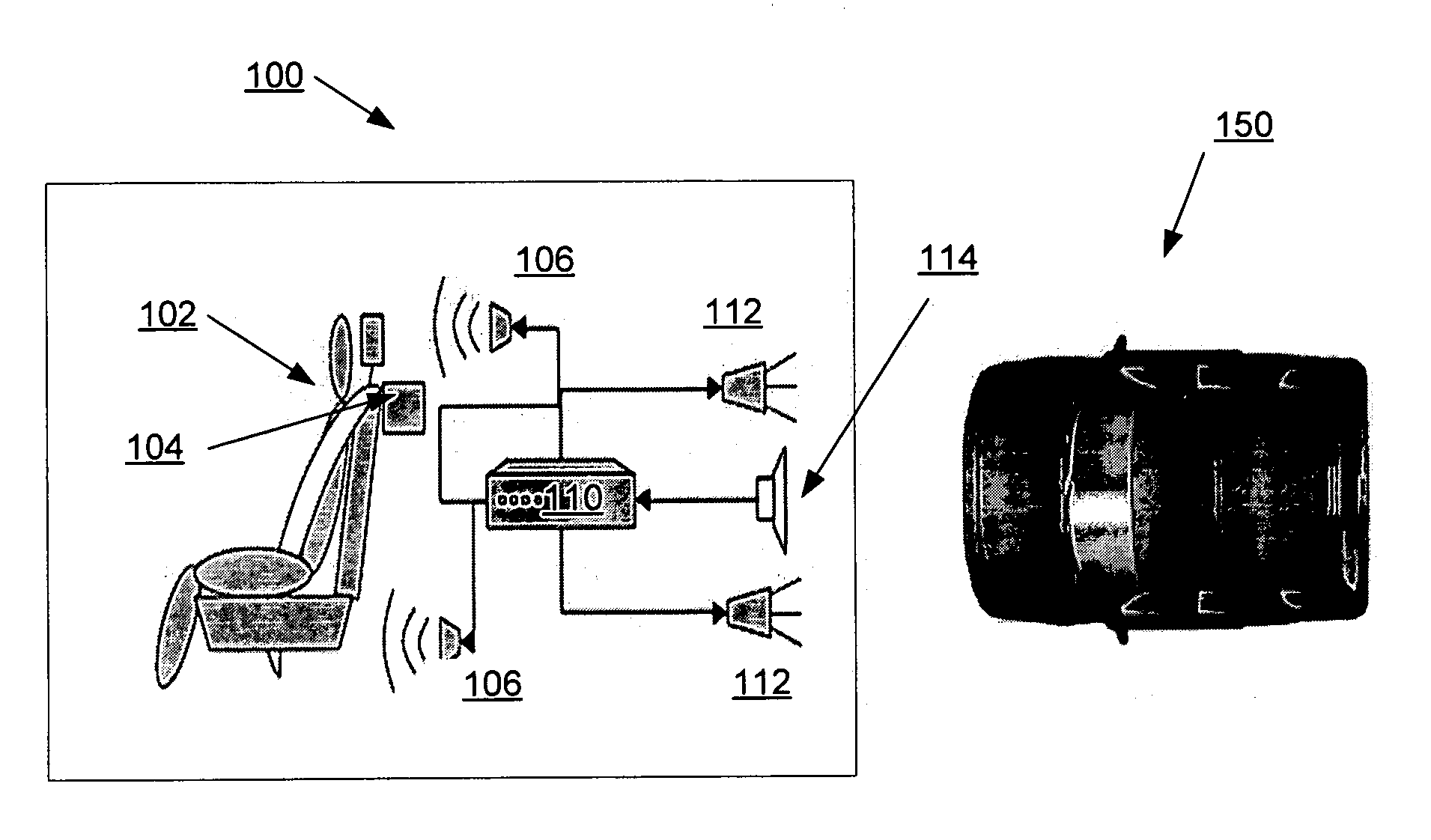
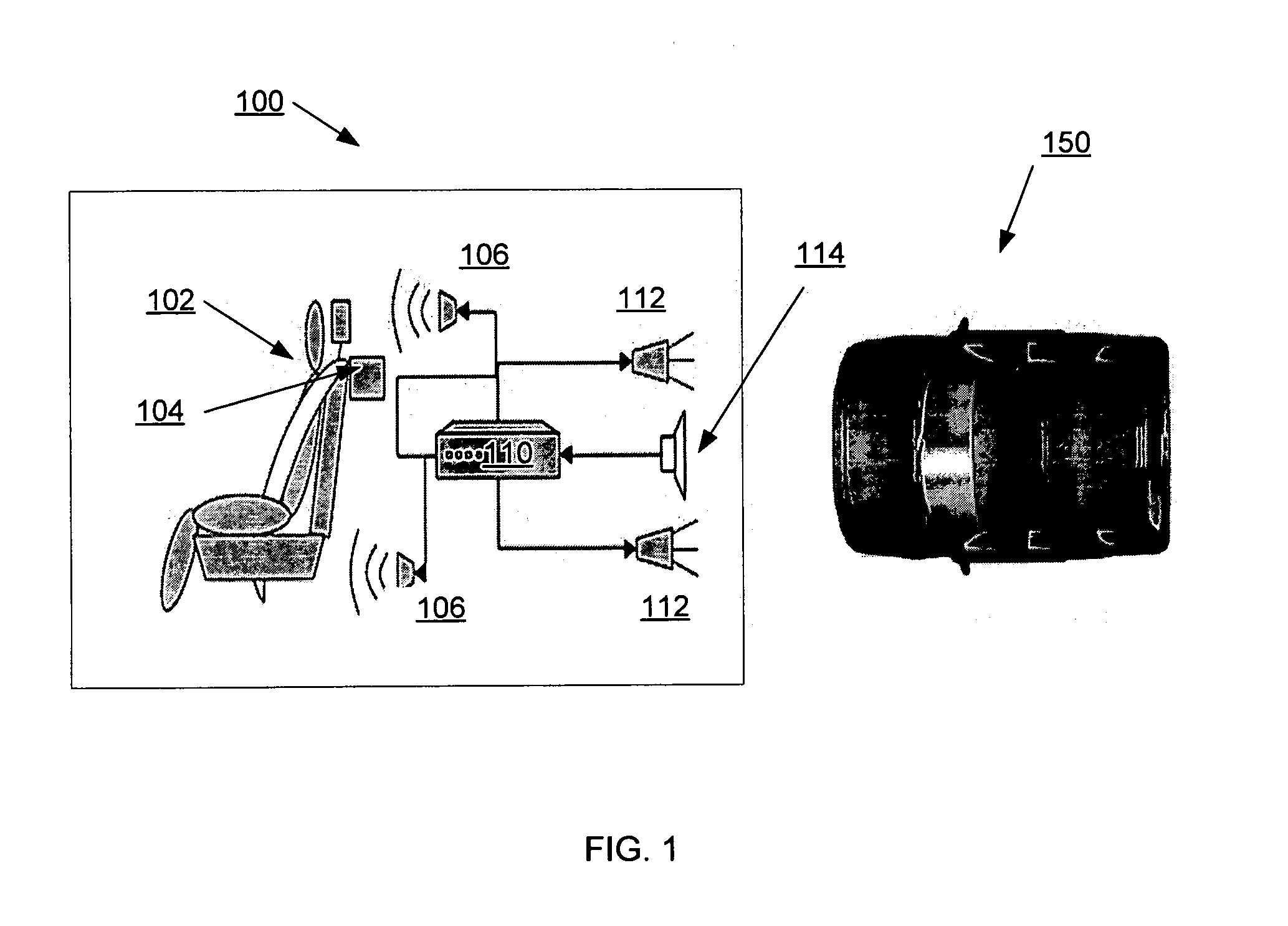
[0027]Turning now to FIG. 1, there is depicted a representation of a lead vehicle 100, which may be any type of motorized vehicle that accommodates a driver 102 or other occupants. The lead vehicle 100 may be equipped with a passenger safety device 104, such as any one or more of a seatbelt restraint system, an airbag system, a head support system or the like, as are commonly found in existing motorized vehicles. The lead vehicle may also include one or more speakers 106, also commonly found in existing motorized vehicles.

[0028]A rear-end collision warning system conforming to the present disclosure may be installed in the lead vehicle 100, either at the time of manufacture or thereafter. In certain embodiments, the rear-end collision...