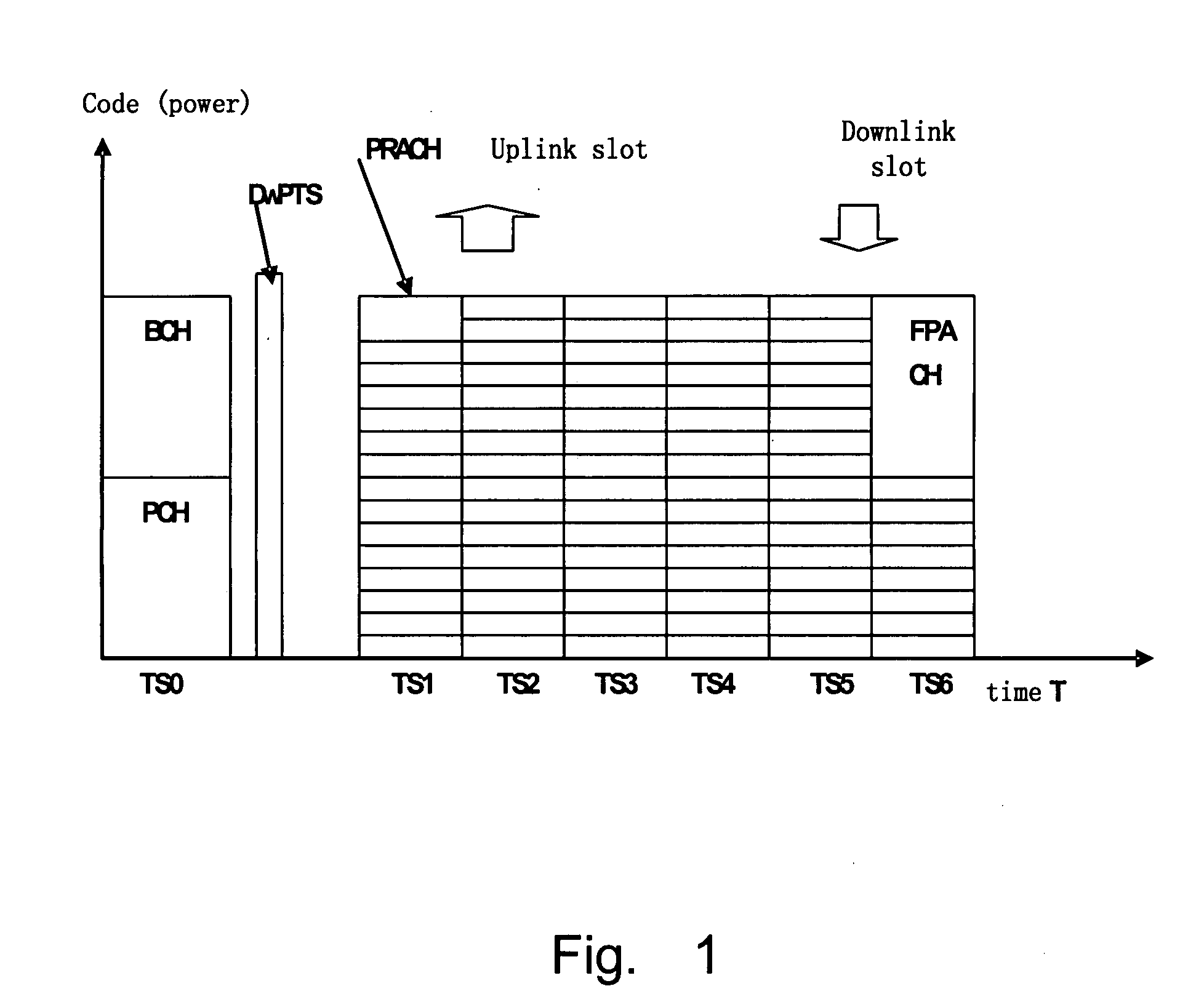
(1) Low system efficiency. Since each carrier must be configured with common channels, each carrier's
channel resource for uplink and downlink traffic is reduced greatly. For example, TS0 of each carrier has been allocated to BCH and PCH; in a downlink timeslot, such as TS6, 8 code channels must be allocated to FPACH; in a uplink timeslot, such as TS1, 2 code channels must be allocated to PRACH. Thus when
spreading factor is 16, only 86 (14+8+4×16) code channels can be allocated to uplink and downlink traffic by each carrier, in another word, only 21 bidirectional voice service or a unidirectional 384 kbps data service can be supported.
(2) Complicated management and control leading to efficiency decrease of some functions. The system considers that the same
base station in the same geographical position covers three cells, which makes the number of cells increases, and increases the management and
control complexity. For an important function of
dynamic channel allocation (DCA) in the mobile communication system, since the execution of this function can only occupy the resources of the local cell while the resources of the local cell is very limited (
spreading factor is 16 and available timeslots and code channels are limited, i.e., available overall resources which can be allocated are limited), the DCA technology can not put to effect because of the
limited resources.
(3) It will be hard for the system to process a
random access or a
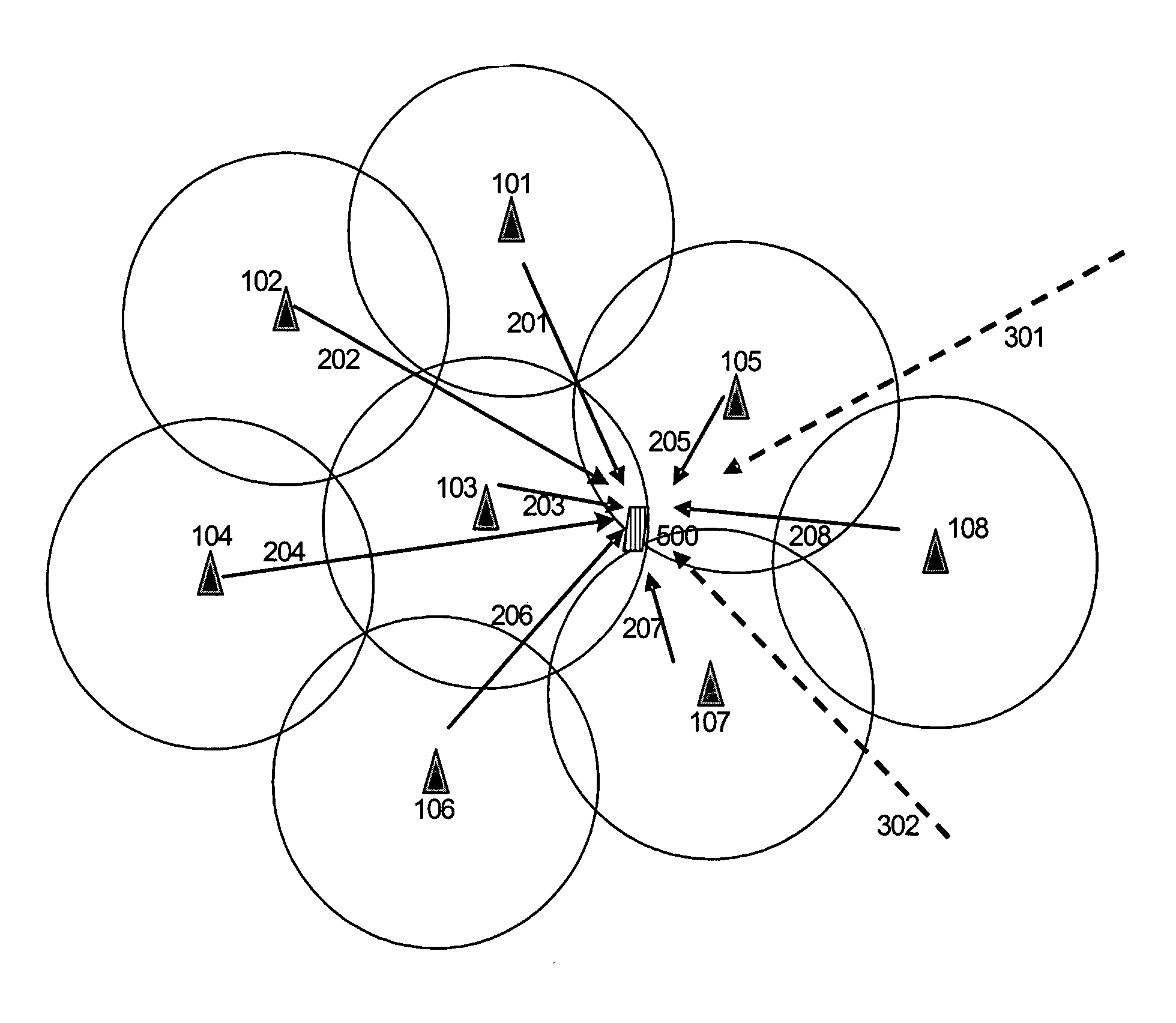
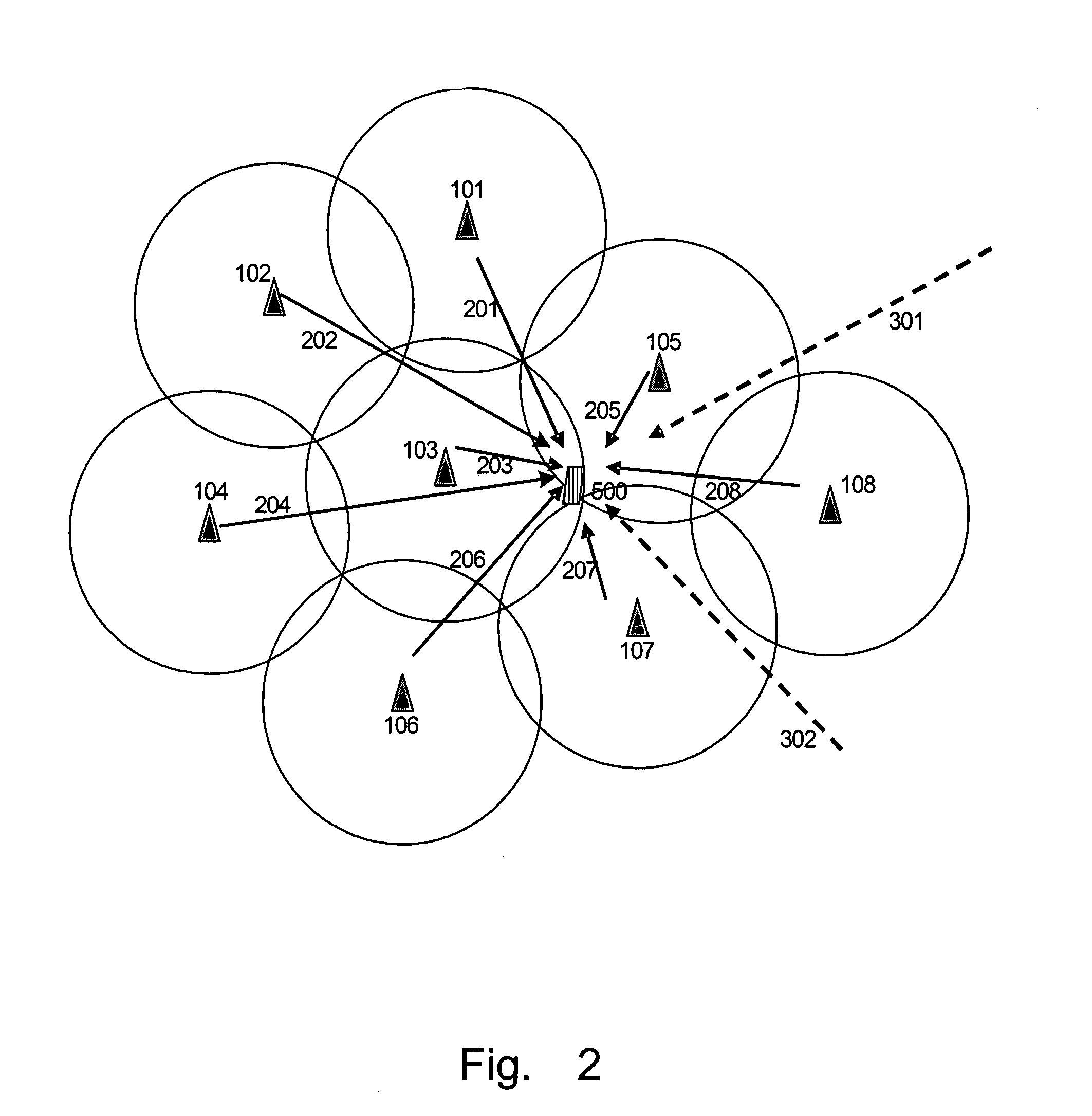
handover of a terminal, which causes detection difficulty. In the cellular mobile communication system, the terminal may move to a position near 3 to 6 base stations. FIG. 2 shows a typical cellular mobile network which illustrates base stations 101, 102 . . . 108 (represented by triangles respectively) and the position of terminal 500 (represented by
a diamond), wherein the nearest base stations are 103, 105 and 107 and the near base stations are 101, 102, 103, 104, 106, 108 and the terminal 500 receives signals 201, 202. . . . 208 from the base stations 101, 102 . . . 108 respectively and interference signals 301 and 302 from distant co-frequency base stations. The terminal 500 may receive different downlink
pilot codes from neighboring cells on a downlink
pilot timeslot (DwPTS) of each carrier, wherein the number of the downlink
pilot codes equals to a product of the number of the base stations and the number of carriers of each
base station. For example, if an occupied bandwidth is 10 MHz and each
base station may use 6 carriers, the terminal 500 may receive signals from around or more than 20 cells. At this time, since it is impossible for the downlink pilot signals from different cells to be synchronous, SNR can reach −5 to −8 dB on each carrier frequency, which makes it more difficult for the terminal to search for and to access the cell; while in a connected mode (communication mode), if each base
station uses multi-carriers, the terminal may detect signals from around 10 different cells and levels of these signals are close, which causes detection difficulty. The above cases thus lead to many wrong handovers and
handover difficulty, which causes the system unstable.
(4) In the
cellular network, after being transmitted for a
far distance, the downlink pilot signals (transmitted in DwPTS), such as 301 and 302 shown in FIG. 2, of distant co-carrier frequency base stations may interfere uplink pilot signals transmitted by the terminal 500, which increases the difficulty of accessing the system.



 Login to View More
  Login to View More