
Melatonin agonist treatment
a technology of melatonin and agonists, applied in the field of melatonin agonists, can solve the problems of difficult interpretation of the effect of ma-1 on the sleep-wake cycl
- Summary
- Abstract
- Description
- Claims
- Application Information
AI Technical Summary
Benefits of technology
Problems solved by technology
Method used
Image

Examples
example 1
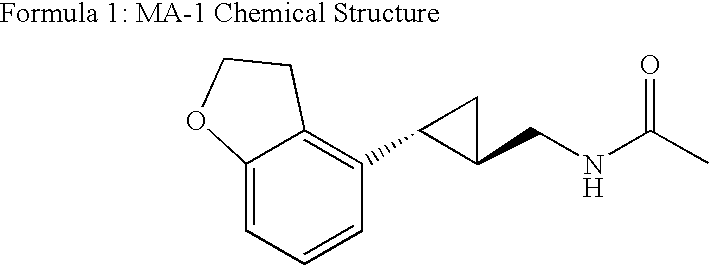
[0029]A clinical trial was conducted to assess the safety of MA-1 as well as to determine the ability of MA-1 to shift the sleep / wake cycle following a 5 hour advance in bedtime. The study was a randomized, double-blind, parallel group, placebo-controlled study. It consisted of a 2-4 week outpatient screening period followed by an 8-day inpatient stay. After acclimating to the sleep lab, bedtime was advanced by 5 hours. The primary objectives of this study were to investigate the exposure-response to MA-1 on advancement of circadian release of endogenous melatonin rhythm as measured by dim light melatonin onset (DLMO, a biomarker of the sleep-wake cycle), to investigate the exposure-response to MA-1 on mean sleep efficiency parameters as measured by PSG, to investigate the exposure-response to MA-1 on objective neurobehavioral performance lapses during scheduled work-time as measured by computerized continuous performance testing, and to assess the safety and tolerability of MA-1. F...
example 2
[0061]A multi-center, randomized, double-blind, placebo-controlled, parallel-group study was conducted to investigate the efficacy and safety of single oral doses of VEC-162 (20, 50, and 100 mg) and matching placebo in healthy male and female subjects with induced transient insomnia. Approximately four hundred subjects were randomized in approximately a 1:1:1:1 ratio to the treatment groups.
[0062]In general, a screening period began 14 to 35 days prior to the start of the evaluation period, which was Day 1. Prior to Day 1, subjects were asked to increase their sleep time to 9 hours per night. Drug, or placebo, was administered on Night 1, approximately 0.5 hour prior to lights off.
[0063]The primary efficacy variable was LPS. LPS is defined as the length of time elapsed between lights off and onset of persistent sleep. In this trial, persistent sleep is defined as the point at which 10 minutes of uninterrupted sleep has begun. Sleep was determined on the basis of polysomnography (PSG...
PUM
| Property | Measurement | Unit |
|---|---|---|
| Mass | aaaaa | aaaaa |
| Mass | aaaaa | aaaaa |
| Mass | aaaaa | aaaaa |
Abstract
Description
Claims
Application Information
 Login to View More