
Gene vector
a gene therapy and vector technology, applied in the field can solve the problems of poor availability of matched donors, low efficacy of hct in some disorders, limited transplantation, etc., and achieve the effects of facilitating the development of gene therapy strategies, preventing transgene toxicity, and being easily quantifiabl
- Summary
- Abstract
- Description
- Claims
- Application Information
AI Technical Summary
Benefits of technology
Problems solved by technology
Method used
Image

Examples
example 1
Construction and Validation of Lentiviral MicroRNA Reporter Vectors
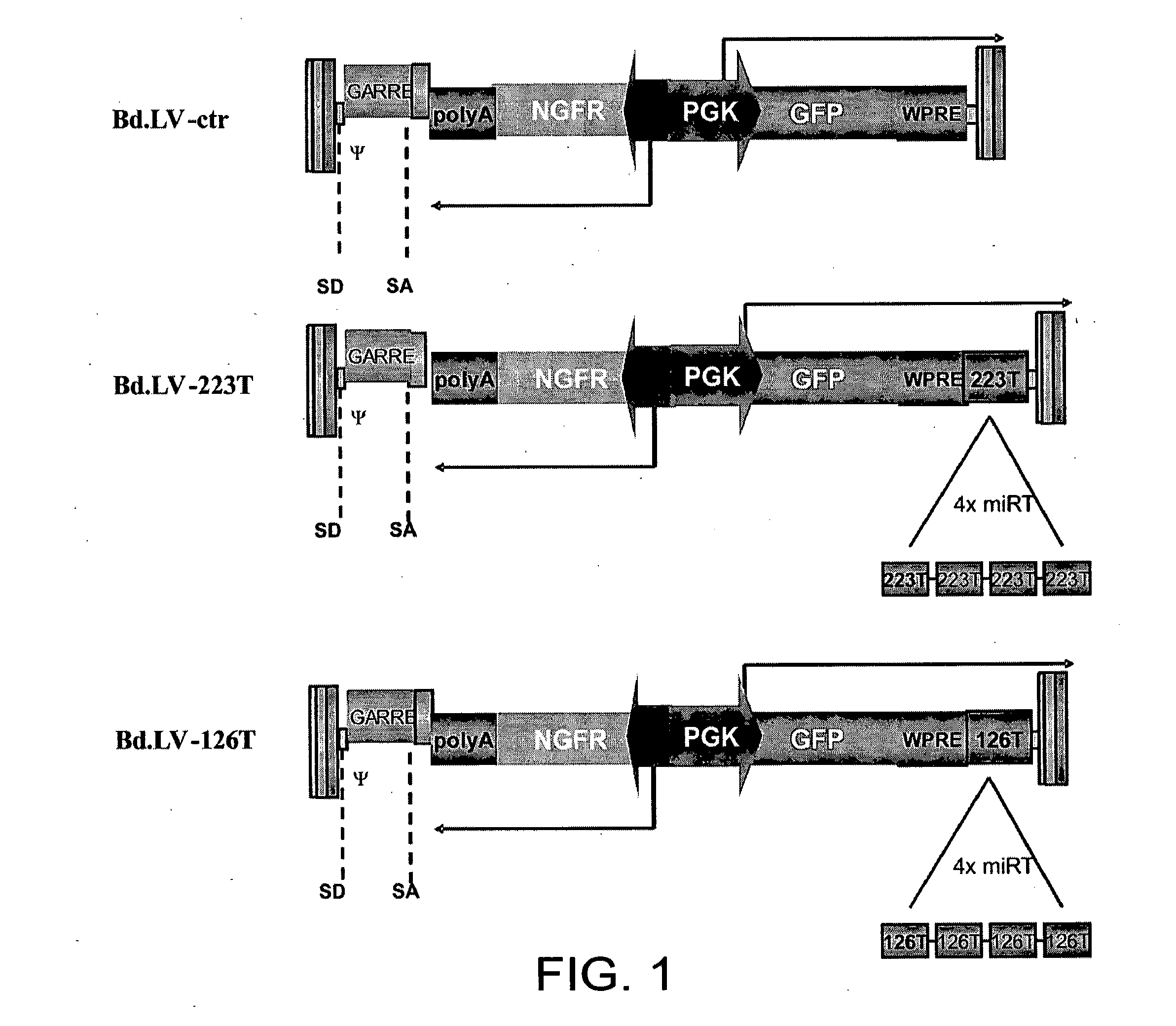
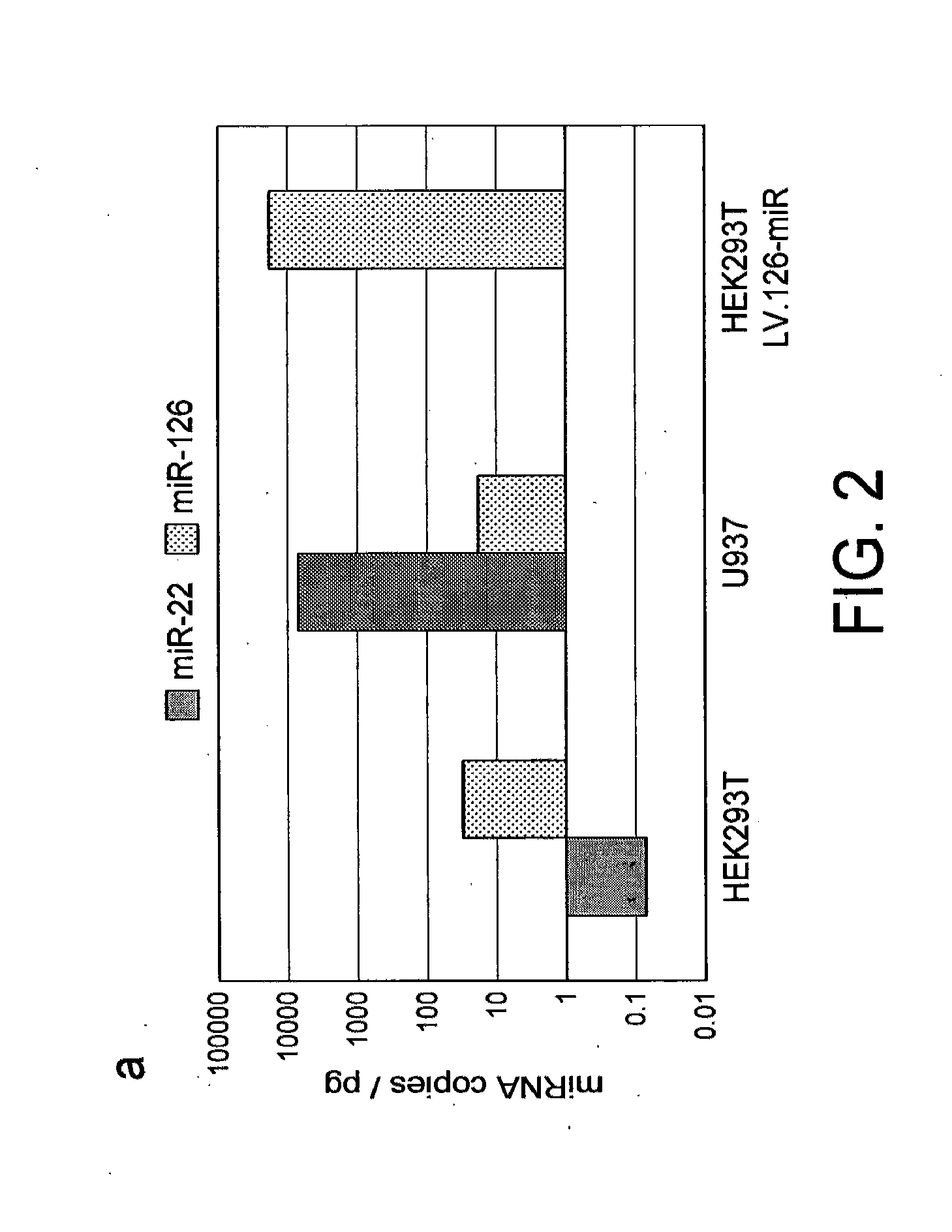
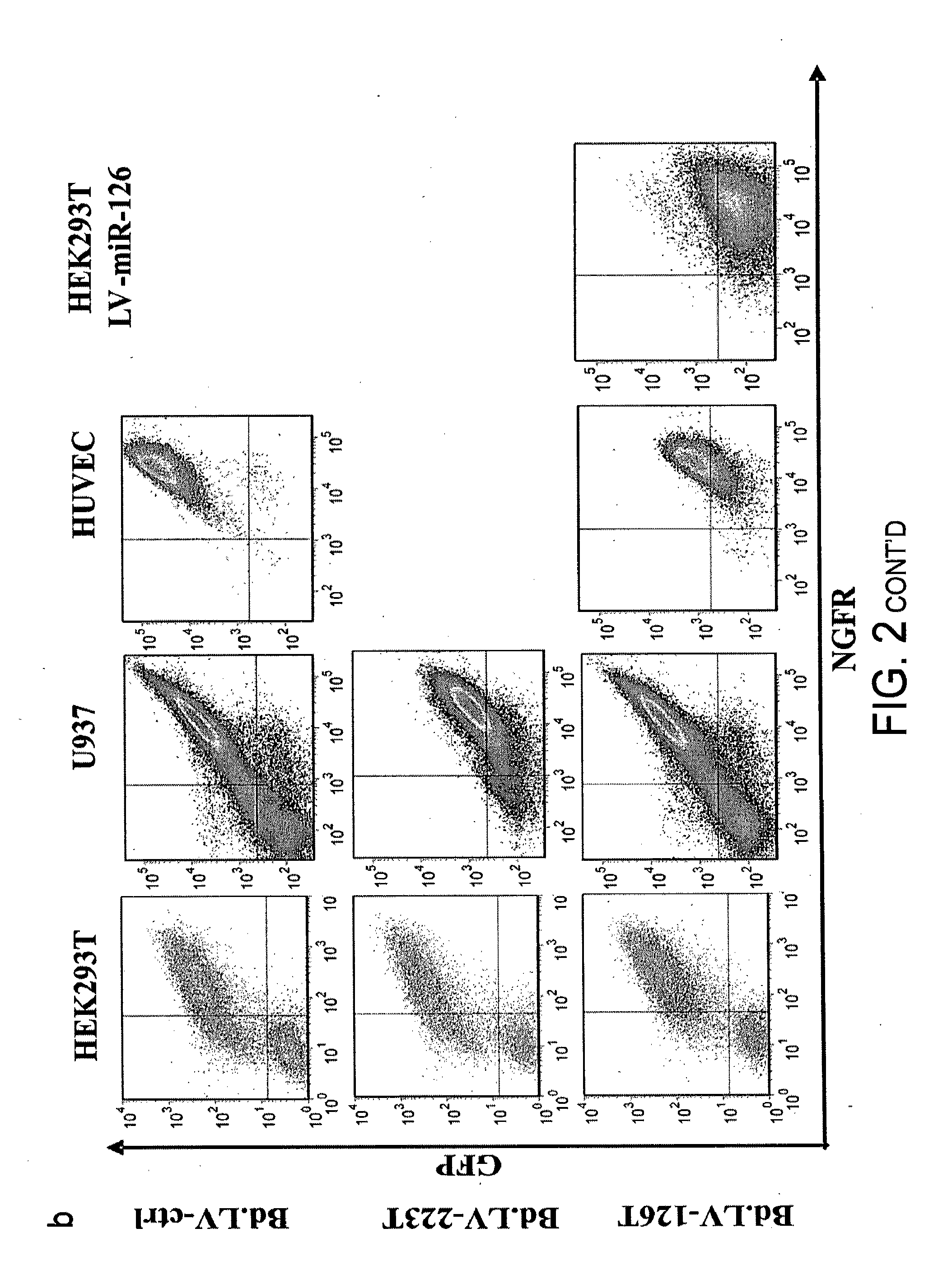
[0120]In order to determine the activity of miRNAs in hematopoietic cells including rare and poorly characterized populations like HSC, we took advantage of our prior observation that transgenes expressed from lentiviral vectors can be down-regulated by endogenous miRNA for which artificial binding sites (miRT, miRNA target sites) are added to the transgene cassette (Brown B D., 2006). We thus aimed at constructing lentiviral miRNA reporter vectors reading out miRNA activity in real time and at single cell resolution. Bidirectional lentiviral vectors (Bd.LV) allow the coordinate expression of two reporter genes driven by a constitutive promoter with bidirectional activity, composed of the human phosphoglycerate kinase (PGK) promoter fused to a TATA-box in the form of a minimal cytomegalovirus (CMV) promoter in opposite orientation (Amendola M., 2005) Since this design allows both reporters to be expressed as two inde...
example 2
Forced GALC Expression in HSPC
[0133]In order to assess the feasibility of GALC over-expression in murine HSPC (mHSPC), we isolated Lin− cells from FVB / twi (GALC − / −) mice. mHSPC were transduced at MOI 100 with GALC.LV in the presence of an optimized cytokine combination (Biffi et al., 2004). After transduction, cells were cultured 10-14 days in vitro to assess enzymatic activity and the vector copy number (VCN) by Q-PCR. We compared the expression level of GALC with the over-expression of other lysosomal enzymes, Arylsulfatase A (ARSA) and -Iduronidase (IDUA), obtained by transducing mHSPC with the control vectors ARSA.LV and IDUA.LV. All vectors expressed the transgene from the same expression cassette containing the human PGK promoter. Since our aim was to compare the enzyme over-expression in transduced − / −HSPC with respect to physiological enzyme levels in wild type HSPC, mHSPC obtained from ARSA KO mice and from IDUA KO mice were used for ARSA.LV and IDUA.LV transduction, respe...
PUM
| Property | Measurement | Unit |
|---|---|---|
| Angle | aaaaa | aaaaa |
| Composition | aaaaa | aaaaa |
| Safety-related properties | aaaaa | aaaaa |
Abstract
Description
Claims
Application Information
 Login to View More