
Retention feature for soft interface connection
a soft interface and retention feature technology, applied in the field of retention feature for soft interface connection, can solve the problems of increasing the frictional force between the retention device and the threads, increasing the frictional force between the set of interconnected threads, etc., to improve the threaded connection, increase the frictional force, and increase the connection security
- Summary
- Abstract
- Description
- Claims
- Application Information
AI Technical Summary
Benefits of technology
Problems solved by technology
Method used
Image

Examples
Embodiment Construction
[0026]It will be readily understood that the components of the present disclosure, as generally described and illustrated in the figures herein, could be arranged and designed in a wide variety of different configurations. Thus, the following more detailed description, as represented in the figures, is not intended to limit the scope of the disclosure, but is merely a representative of exemplary combinations of the components.
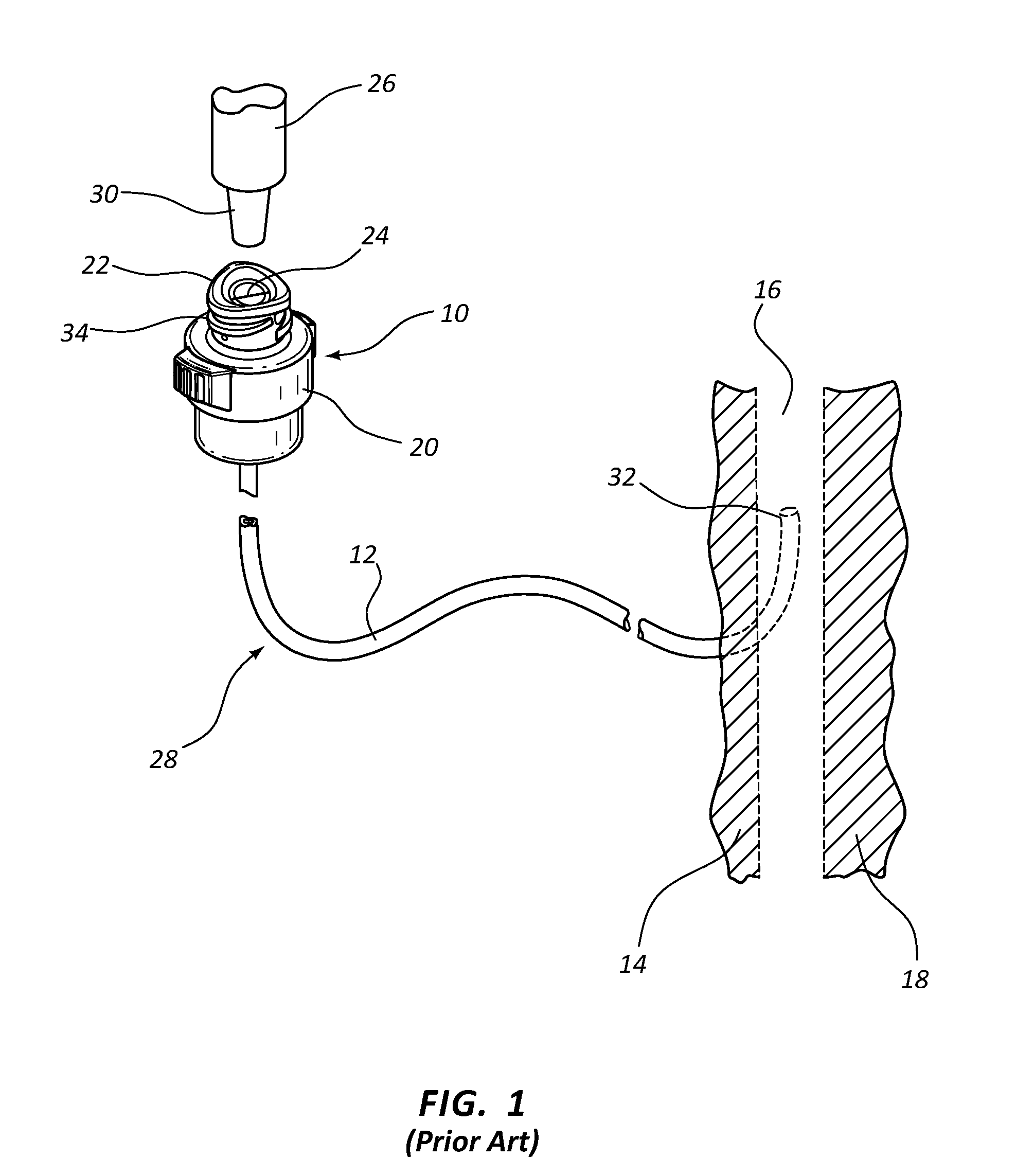
[0027]As used herein, the term “needleless connector” is used to denote a medical coupler which is used as part of an intravenous assembly. In some instances, a needleless connector comprises a Luer adapter. In other instances, a needleless connector comprises a PRN connector. An example of a needleless connector is the Q-Syte™ luer access port from Becton, Dickinson. Further, in some instances a needleless connector comprises a port or valve of a section of intravenous tubing or a connector thereof. One having skill in the art will appreciate that the systems ...
PUM
| Property | Measurement | Unit |
|---|---|---|
| resistance | aaaaa | aaaaa |
| height | aaaaa | aaaaa |
| width | aaaaa | aaaaa |
Abstract
Description
Claims
Application Information
 Login to View More