
Detecting Critical Links in Bluetooth Mesh Networks
a critical link and mesh network technology, applied in the field of wireless communication networks, can solve the problems of limiting the availability of redundancy mechanisms, increasing interference and energy consumption, and reducing the overall reliability of wireless communication
- Summary
- Abstract
- Description
- Claims
- Application Information
AI Technical Summary
Benefits of technology
Problems solved by technology
Method used
Image

Examples
Embodiment Construction
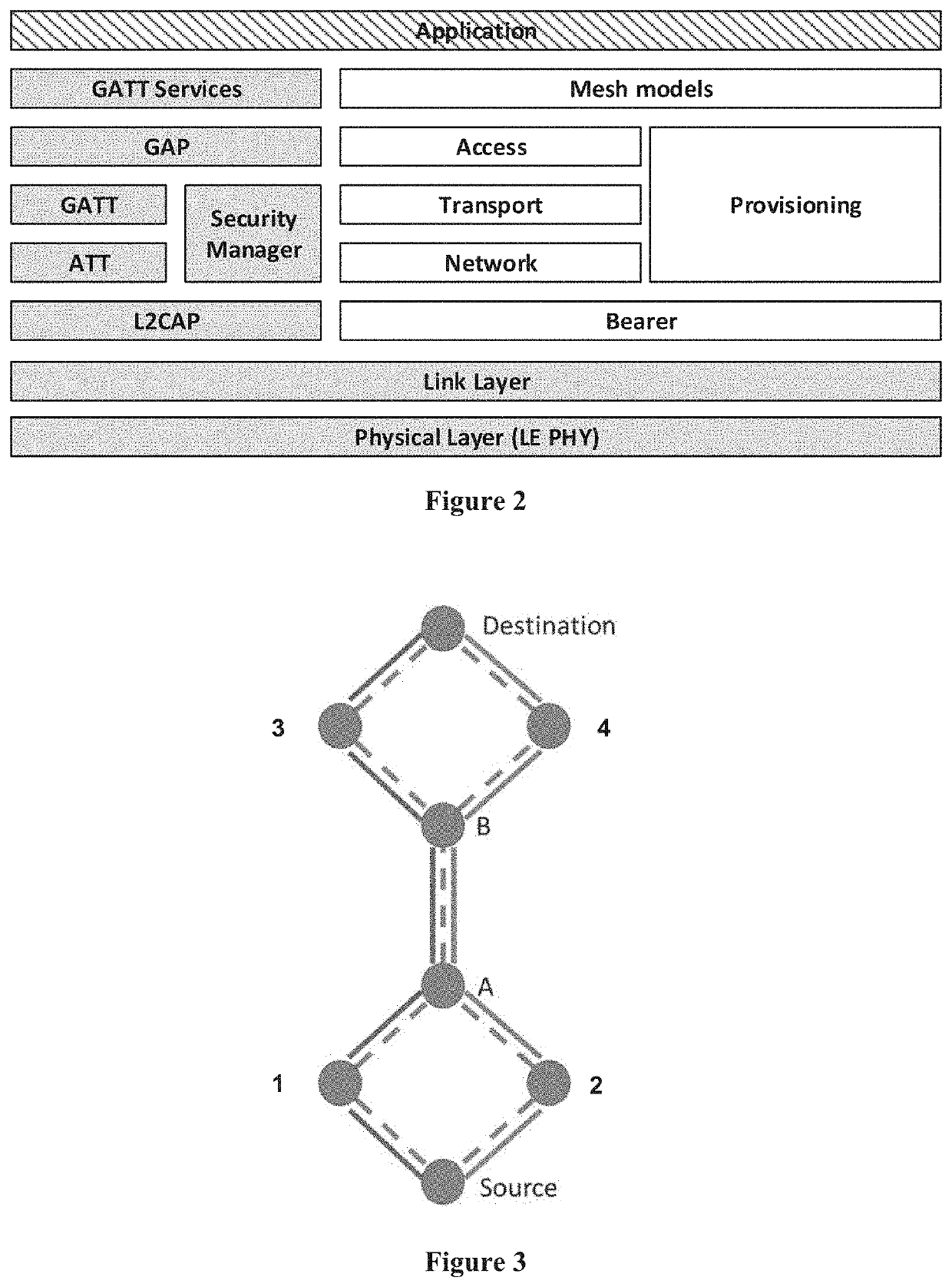
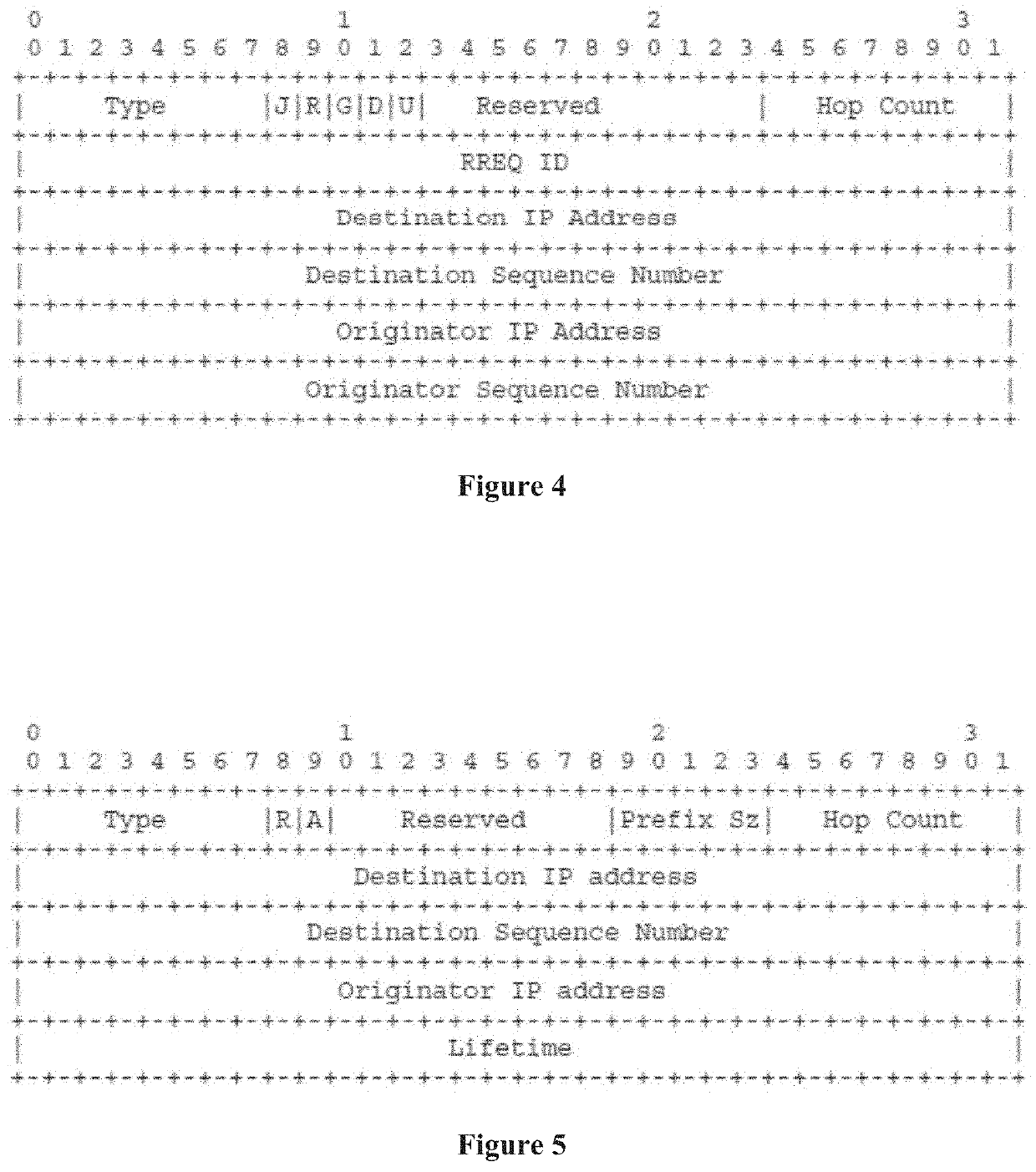
[0041]As briefly mentioned above, the existence of critical links between source and destination nodes limit the capability of available redundancy mechanisms in Bluetooth mesh networking. FIG. 3 shows an exemplary mesh network comprising a source node, a destination node, and six intermediate (or relay) nodes. As illustrated in FIG. 3, the relay nodes are labelled 1-4 and A-B. As further illustrated by the solid lines in FIG. 3, there are two paths between the source and destinations nodes, one traversing relay nodes {1, A, B, 3} and the other traversing relay nodes {2, A, B, 4}. The dashed lines illustrated the propagation of path request messages throughout the mesh network. Since link A-B is part of both paths, it is a critical link, such that the two paths are not independent. FIG. 3 is representative of a scenario where source and destination nodes are located in different areas of a building, interconnected by corridors.
[0042]In the event that critical link A-B was no longer ...
PUM
 Login to View More
 Abstract
Description
Claims
Application Information
 Login to View More