
Self-cooled oxygen-fuel burner for use in high-temperature and high-particulate furnaces
a technology of oxygen fuel burner and which is applied in the field of combustion, can solve the problems of increasing the frequency of maintenance, affecting the design of tight burner blocks, and unable to meet the requirements of high-temperature and high-particulate furnaces
- Summary
- Abstract
- Description
- Claims
- Application Information
AI Technical Summary
Benefits of technology
Problems solved by technology
Method used
Image

Examples
embodiment 2
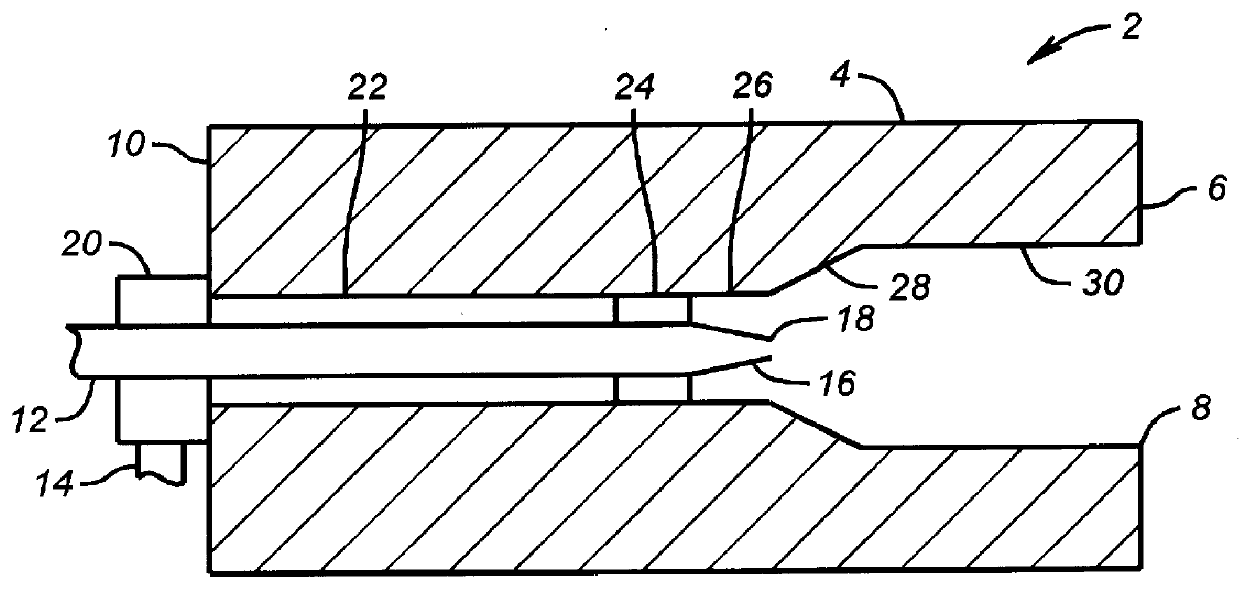
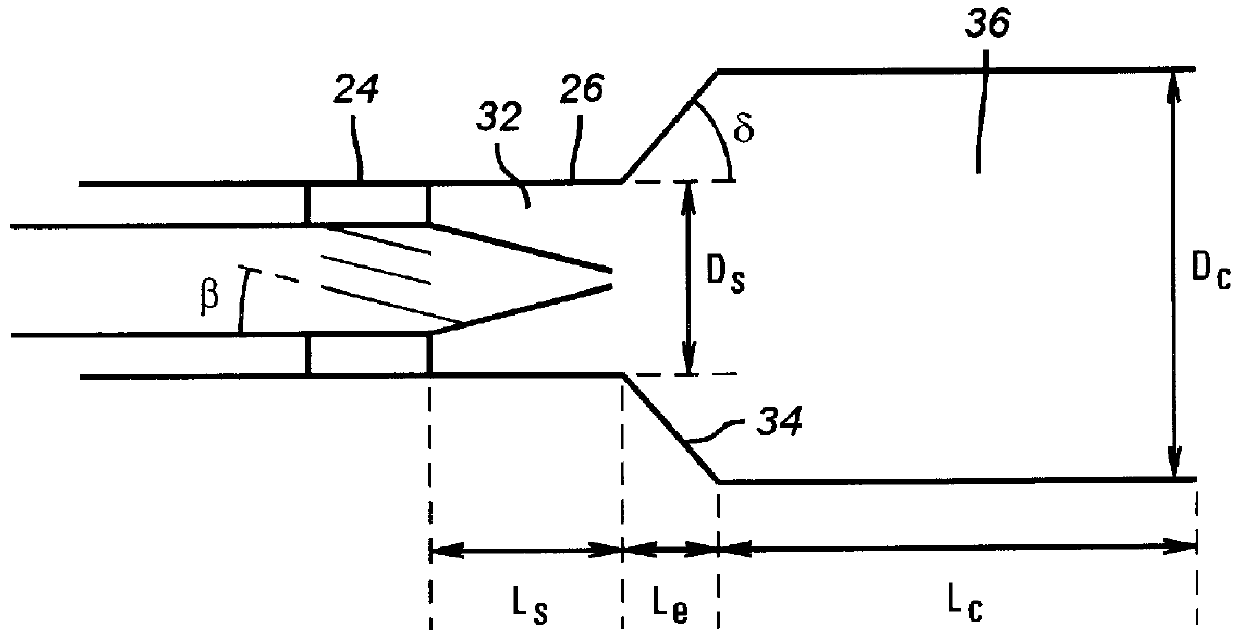
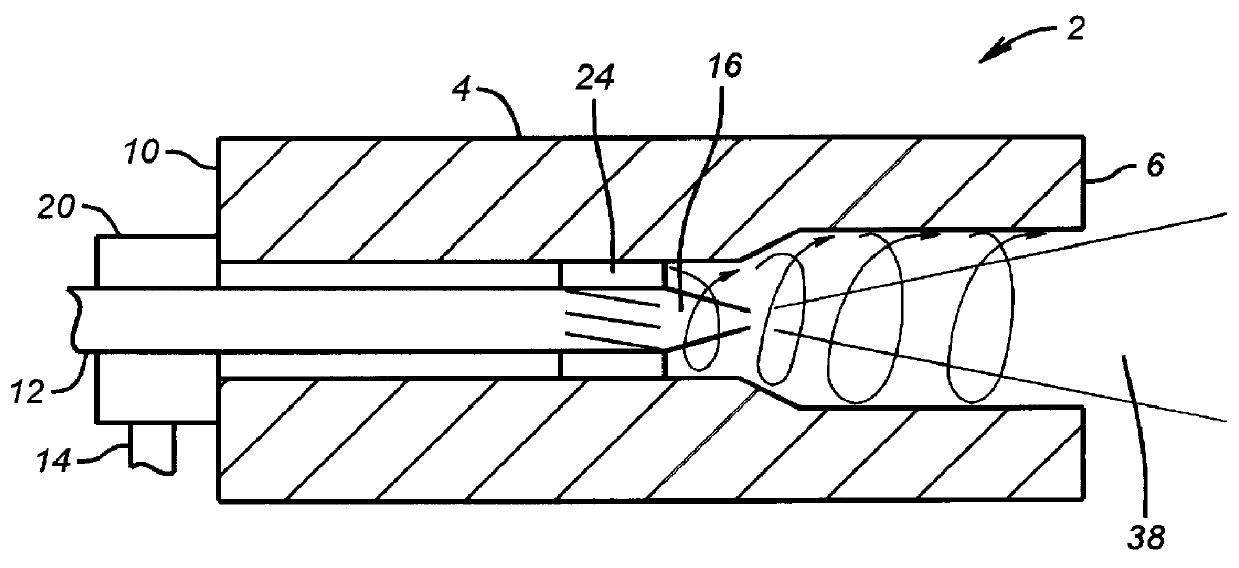
Referring to the figures, FIG. 1 illustrates in cross-section, side elevation view the first burner embodiment 2 in accordance with the invention. In this embodiment, the burner apparatus comprises a burner block 4, preferably refractory in nature, having an end or hot face 6, an exit 8 for flame and hot combustion gases, and a cold end 10. A fuel conduit 12 and an oxidant conduit 14 are fluidly connected to cold end 10 of burner block 4. Fuel conduit 12, preferably a metallic pipe, has a nozzle 16 attached thereto terminating in a nozzle tip 18. Oxidant conduit 14 feeds an oxidant plenum 20, which is fluidly connected to cold end 10, thus allowing oxidant to enter a substantially annular oxidant passage 22. The oxidant travels through oxidant conduit 14, plenum 20, and through substantially annular oxidant passage 22, which surrounds the fuel conduit 12, on its way toward one or more oxidant swirlers 24. Oxidant is thus given an radial-tangential flow component as it passes axially...
first embodiment
A numerical simulation of the burner described in the first embodiment has been performed, using the FLUENT / UNS computational fluid dynamics computer program. The domain used was a 2D axisymmetric field with swirl. The physical models employed include the PDF model for combustion, the RNG k-epsilon model for turbulence and the P1 model to account for the effects of radiative heat transfer. The natural gas flowrate considered was 2,300 scfh, and the oxygen flow rate was 4,900 scfh. The virtual walls of the combustion space were considered to be adiabatic, and conductive heat transfer through the block wall was taken into account. For comparison, two different cases have been investigated: the base case without swirl, and the second case including a swirl angle .beta. of 20.degree. for the oxygen flow only.
FIGS. 7a and 7b illustrate the oxygen profile in the two cases, FIG. 7a for the non-swirled flow, and FIG. 7b for the flow with swirl, for a burner constructed in accordance with FI...
PUM
| Property | Measurement | Unit |
|---|---|---|
| expansion angle | aaaaa | aaaaa |
| expansion angle | aaaaa | aaaaa |
| expansion angle | aaaaa | aaaaa |
Abstract
Description
Claims
Application Information
 Login to View More