
Ruthenium compounds, their production and use
a technology of ruthenium compounds and ruthenium osmium, which is applied in the direction of ruthenium organic compounds, physical/chemical process catalysts, osmonium organic compounds, etc., can solve the problems of steric and electronic consequences that are often dramatic, and the fine tuning of activity and selectivity remains elusive, and achieves a high rate of catalytic turnover
- Summary
- Abstract
- Description
- Claims
- Application Information
AI Technical Summary
Benefits of technology
Problems solved by technology
Method used
Image

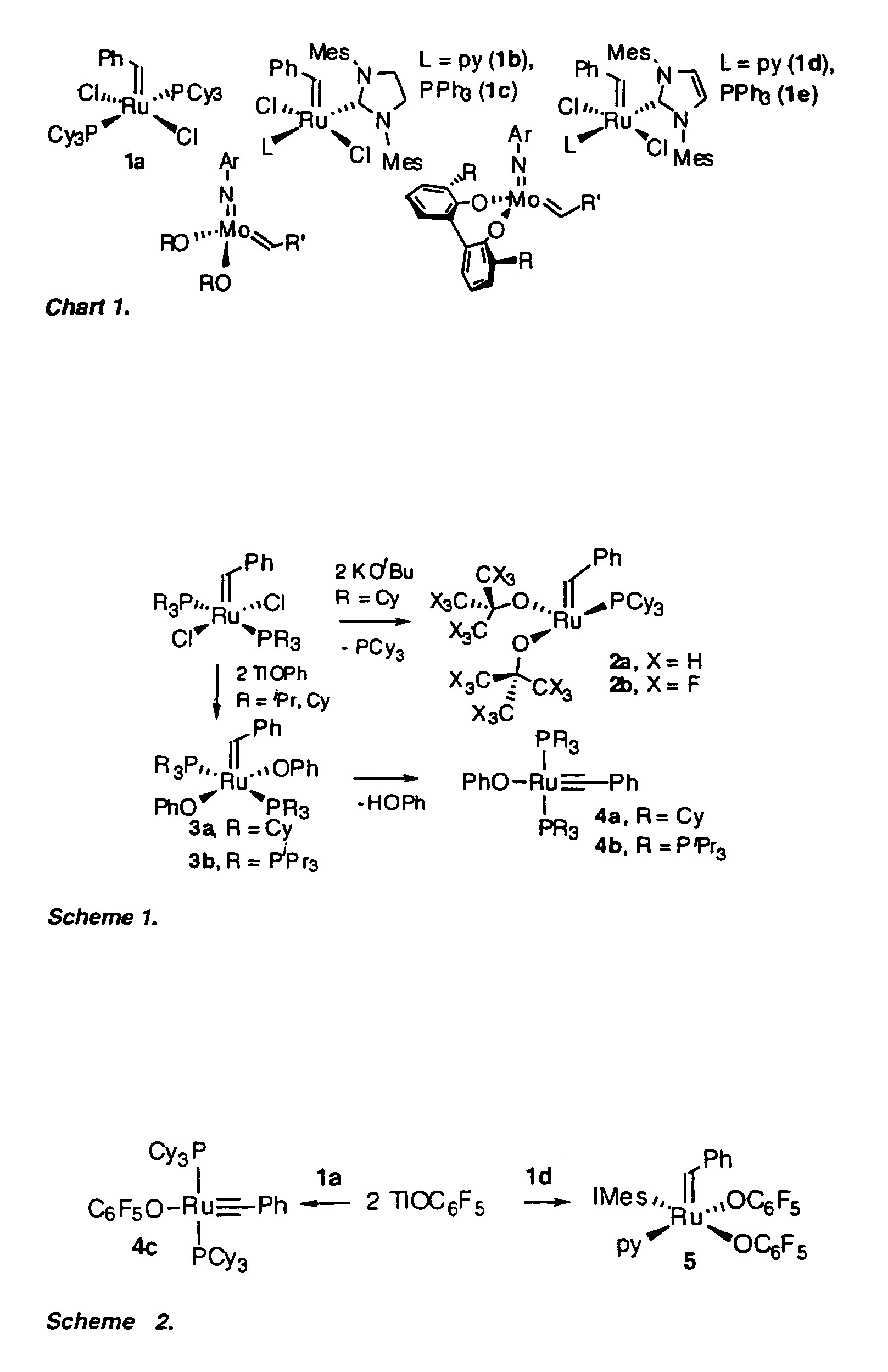
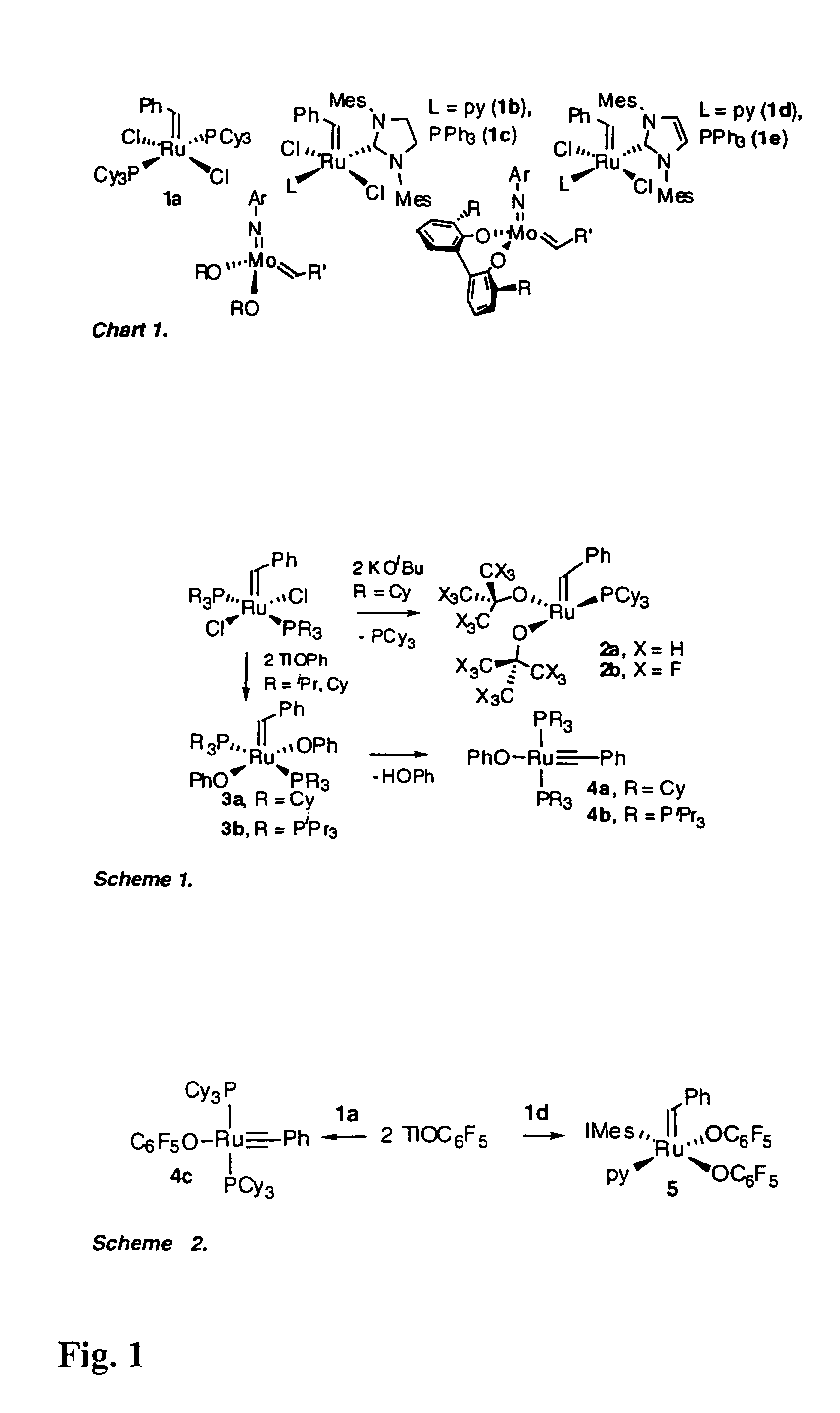
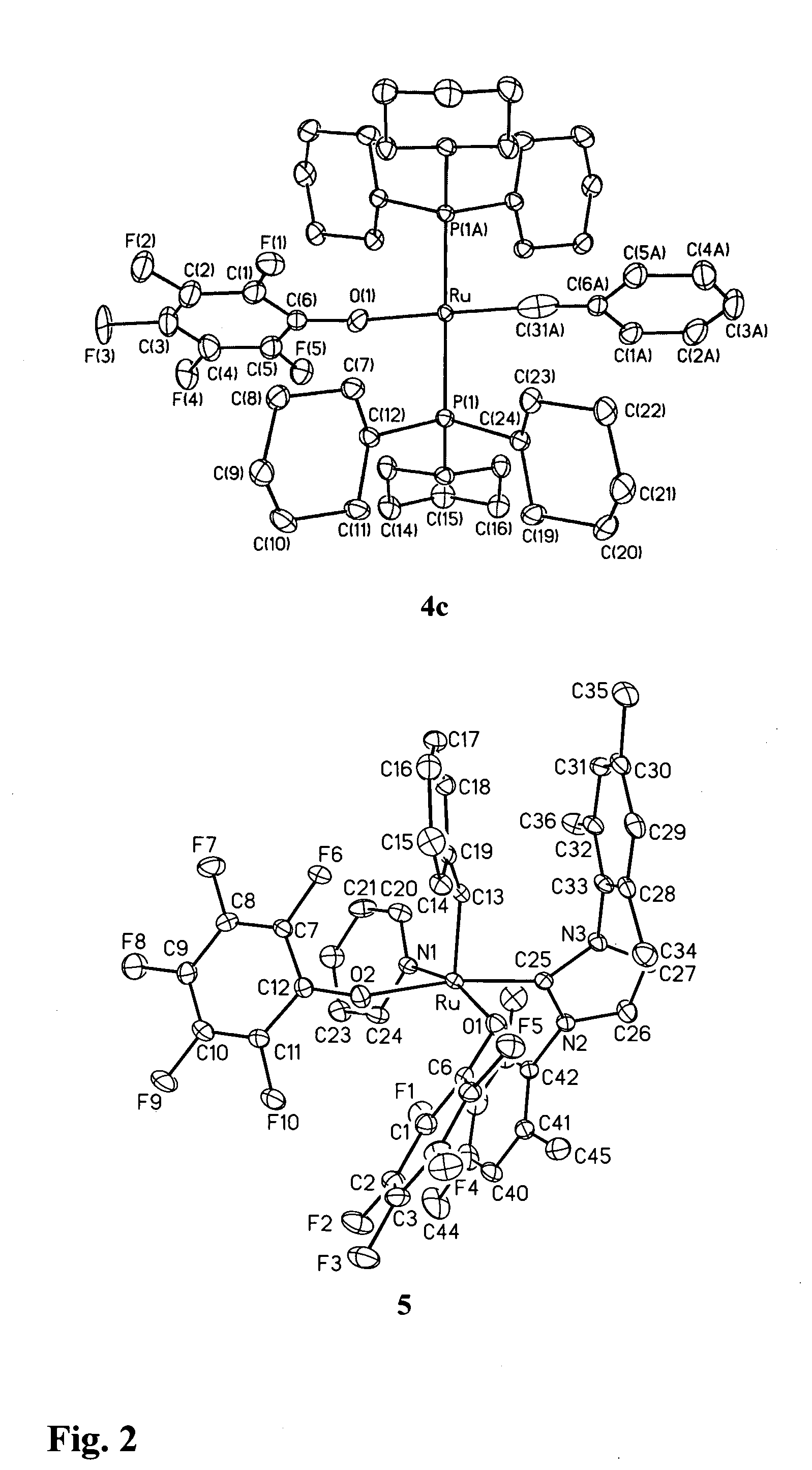
Examples
example 1
Production of Compound 4c (see FIGS. 1 and 2)
[0093]Treatment of compound 1a (FIG. 1) with TlOC6F5 effected quantitative conversion to four-coordinate alkylidyne compound 4c (FIG. 1, Scheme 2) within 3 hours at room temperature. The reaction is carried out under N2 at room temperature using standard Schlenk or drybox techniques and dry, oxygen-free solvents. Addition of TlOC6F5 (566 mg, 1.46 mmol) in 7 mL toluene to a purple solution of RuCl2(CHPh)(PCy3)2 (600 mg, 0.73 mmol) in 7 mL benzene resulted in quantitative reaction (as judged by NMR analysis) within 3 h, accompanied by a colour change to dark green. The suspension was filtered through Celite™ and the filtrate concentrated to dryness. On redissolving the residue in cold (−35° C.) ether, a green powder of 4c slowly deposited. This was filtered off and washed with cold ether. Yield 395 mg (56%); isolated yields are limited by high solubility in ether. Characterization data: 1H NMR (C6D6, 298K) δ 7.68 (d, 2H, JHH=7.6 Hz, Ph o-CH...
example 2
Production of Compound 5 (see FIGS. 1 and 2)
[0095]Ru(OC6F5)2(CHPh)(py)(IMes)
[0096]The analysis disclosed in Example 1 led the inventors to consider that alkylidene complexes of simple aryloxide ligands could potentially be accessed by attenuating the bulk of the neutral ligands as well as the pseudohalide. For this reason, the inventors turned their attention to NHC complexes of the type shown as compound 1d (FIG. 1), containing an approximately two-dimensional IMes ligand (IMes=N,N′-bis(mesityl)imidazol-2-ylidene) (Ref. 13). Reaction of TlOC6F5 with compound 1d was selective for transmetallation, yielding solely alkylidene 5. Addition of TlOC6F5 (470 mg, 1.21 mmol) with RuCl2(CHPh)(IMes)(py)2 (440 mg, 0.607 mmol) in 20 mL benzene gave complete reaction (as judged by NMR analysis) within 8 h. The green suspension was filtered through Celite™ to remove TlCl. The Celite was washed with CH2Cl2, and the combined filtrate was reduced to dryness. Precipitation from CH2Cl2-hexane afforded ...
example 3
Comparison of Ru Compounds for the Catalysis of a Test RCM Reaction
[0097]Retention of the potentially labile pyridine ligand within compound 5 (FIG. 1) attests to the absence of steric constraints in this five-coordinate complex. Importantly, it also signifies the presence of a potential coordination site for incoming substrate in compound 5, in contrast with the sterically encumbered alkoxide complexes of compound 2 (Ref. 12). Indeed, compound 5 exhibits dramatically increased activity for ring closing metathesis (Table 1). Thus, the alkoxide derivatives show very poor catalytic activity for RCM of diethyldiallylmalonate even at high catalyst loadings (20 mol %; i.e. a ratio of 5 mol substrate per mol of catalyst). Catalyst 2a achieves less than one turnover; catalyst 2b achieves two turnovers. In contrast, catalyst 5 effects >99% ring-closing of this substrate at lower catalyst loadings (ranging from 5 mol % to 0.05 mol %) over periods ranging from 20 minutes to 3 hours. Catalytic...
PUM
| Property | Measurement | Unit |
|---|---|---|
| reaction time | aaaaa | aaaaa |
| reaction time | aaaaa | aaaaa |
| stability | aaaaa | aaaaa |
Abstract
Description
Claims
Application Information
 Login to View More