
Mapping apparatus for backup and restoration of multi-generation recovered snapshots
a snapshot and mapping apparatus technology, applied in the field of storage systems for storing and backing up data, can solve the problems of inconsistent data state, and achieve the effect of convenient access
- Summary
- Abstract
- Description
- Claims
- Application Information
AI Technical Summary
Benefits of technology
Problems solved by technology
Method used
Image

Examples
Embodiment Construction
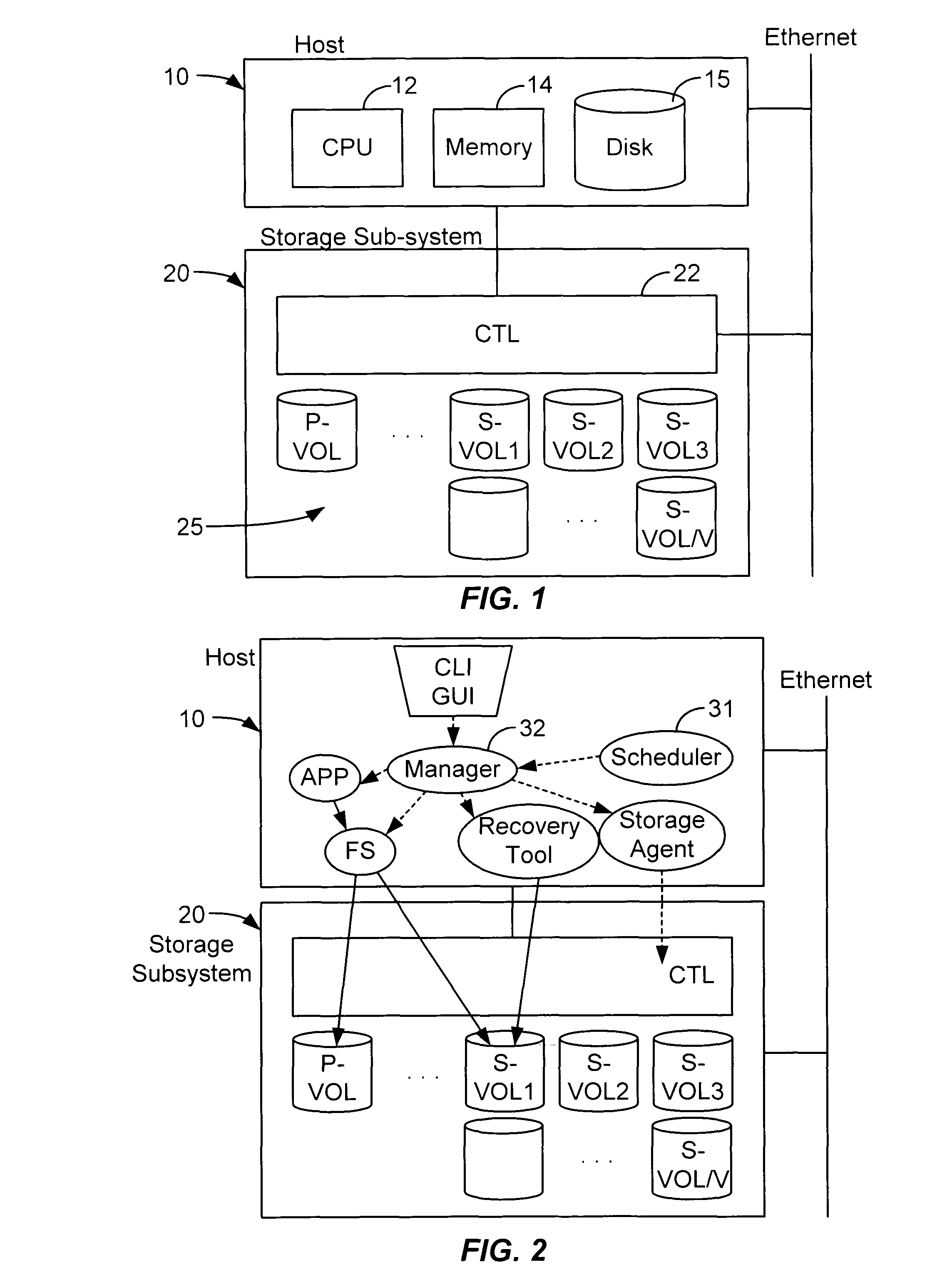
[0025]FIG. 1 is a diagram illustrating the hardware components and interconnections among components according to one embodiment of the invention. As shown by the diagram, the system is generally divided into two parts, a host 10 and a storage subsystem 20. Host 10 typically is a commercially available conventional computer system, for example, a server. In the depicted embodiment, host 10 includes a central processing unit (CPU) 12, memory 14, and storage 15. Storage 15 typically will provide storage for an operating system, application software, and storage subsystem management software.
[0026]The storage subsystem 20 includes a control processor 22 and a series of storage volumes 25 for storing data. Storage volumes 25 typically are provided by hard disk drives or arrays of hard disk drives, for example, configured as a RAID system. Like the host 10, the control processor 22 typically will include a central processing unit, and preferably includes non-volatile random access memory...
PUM
 Login to View More
 Abstract
Description
Claims
Application Information
 Login to View More