LDPC decoding apparatus and method with low computational complexity algorithm

a decoding apparatus and computational complexity technology, applied in the field of ldpc decoding apparatus and methods, can solve the problems of high complexity of turbo code, difficulty in high-speed processing, and difficulty in actual implementation, and achieve the effect of increasing the amount of computation, reducing the repetition number of turbo code, and not degrading the performan

US7539920B2Inactive Publication Date: 2009-05-26ELECTRONICS & TELECOMM RES INST
15 Cites 7 Cited by

Patent Information

Authority / Receiving Office
US · United States
Patent Type
Patents(United States)
Current Assignee / Owner
Publication Date
2009-05-26
Estimated Expiration
Not applicable · inactive patent

Smart Images

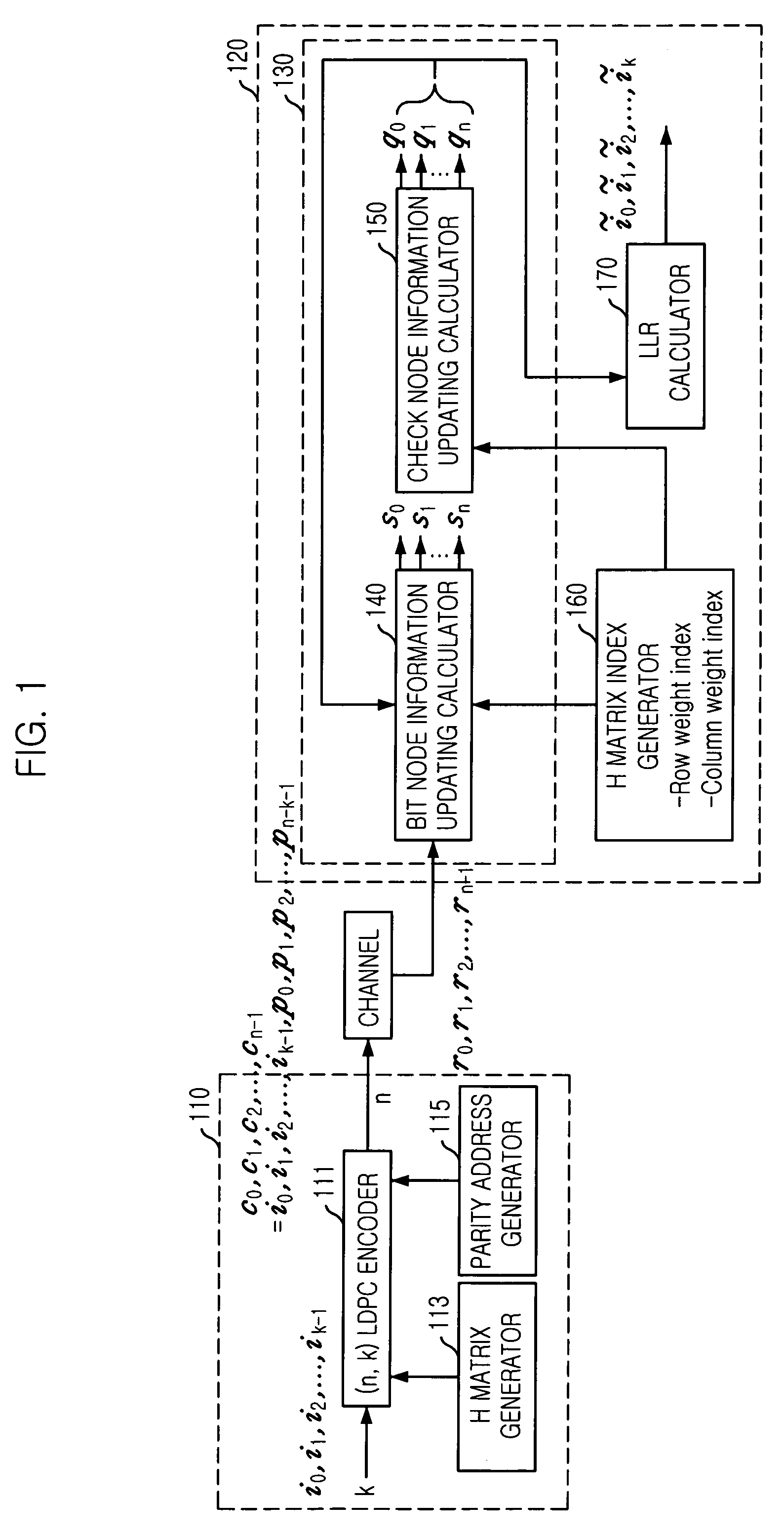
  • Figure 1
    Figure 1
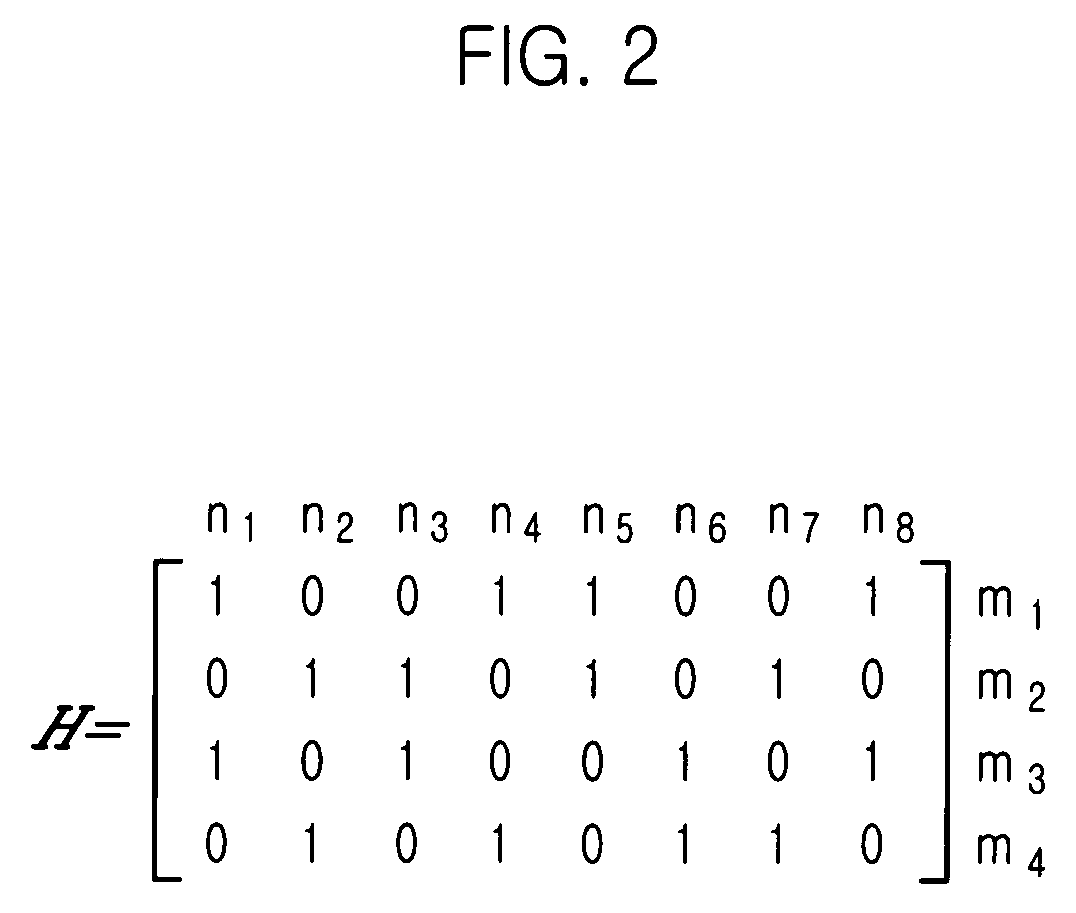
  • Figure 2
    Figure 2
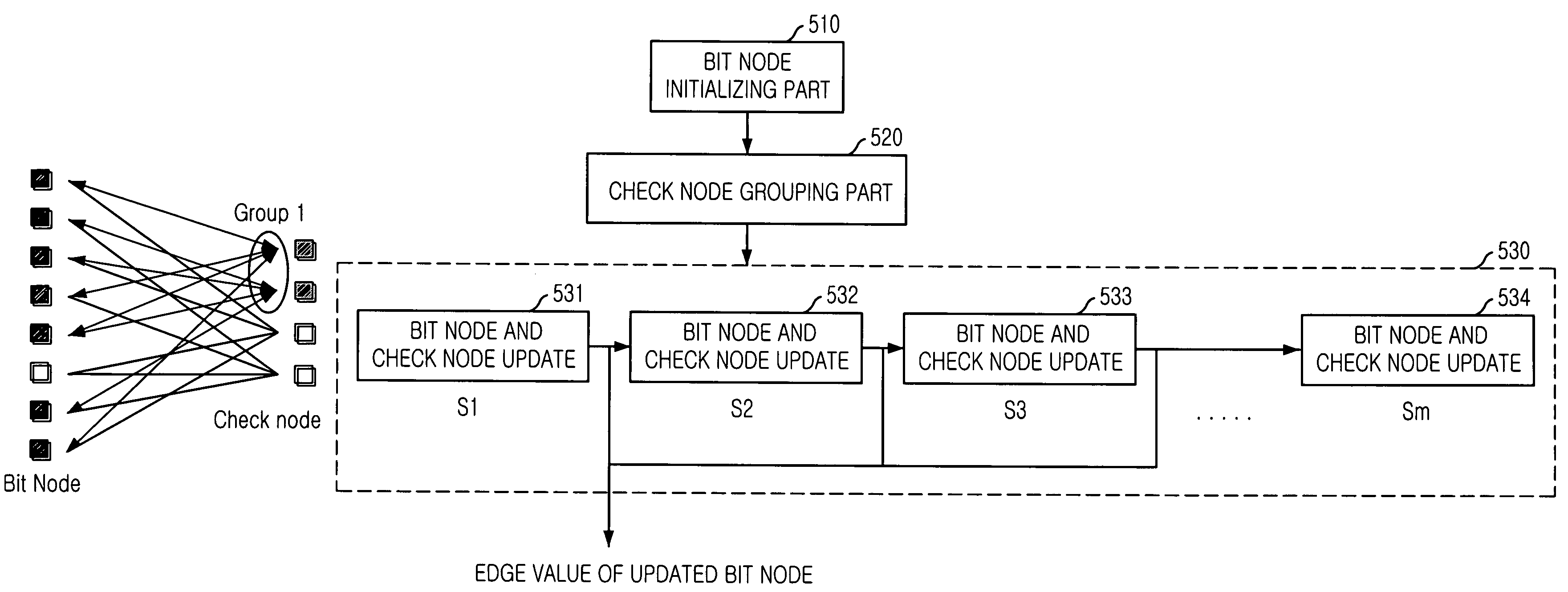
  • Figure 3
    Figure 3
Patent Text Reader

Abstract

Provided are an LDPC decoding apparatus and method using a sequential decoding algorithm having a partial group, capable of reducing the number of an iterative decoding by more than half without degrading the performance and increasing an amount of computation. The LDPC decoding method includes the steps of: receiving a prior probability information (channel values) based on information on channel values associated with distance between symbol signals in constellation related to the received noise and LDPC encoded data, and initializing bit nodes; dividing check nodes into partial groups before updating check node information based on the prior probability information, and performing a decoding by applying a sequential decoding algorithm; determining whether a parity check equations are satisfied; and outputting decoded messages obtained when satisfying the parity check equation or after terminating an iterative processor by a termination algorithm.
Need to check novelty before this filing date? Find Prior Art

Description

CROSS-REFERENCE TO RELATED APPLICATIONS

[0001] The present application claims priority to Korean patent application number 10-2004-0106779 filed on Dec. 16, 2004, which is incorporated herein by reference in its entirety.FIELD OF THE INVENTION

[0002] The present invention relates to an LDPC decoding apparatus and method using a sequential decoding algorithm having a partial group of a low computational complexity; and, more particularly, to an LDPC decoding apparatus and method using a sequential decoding algorithm having a partial group, capable of reducing the repetition number of a decoding by more than half without degrading the performance and increasing an amount of computation.DESCRIPTION OF RELATED ART

[0003] A low density parity check (hereinafter, referred to as an LDPC) decoding widely uses a sequential decoding method.

[0004] An LDPC code has the best performance among the known channel codes and is recently used for an actual implementation. A turbo code has been widely used be...

Examples

Embodiment Construction

[0016]Other objects and aspects of the invention will become apparent from the following description of the embodiments with reference to the accompanying drawings, which is set forth hereinafter.

[0017]FIG. 1 is a conceptual diagram of an LDPC encoding / decoding apparatus. In FIG. 1, the LDPC encoding / decoding apparatus includes an LDPC encoding part 110 and an LDPC decoding part 120.

[0018]The LDPC encoding part 110 includes an H matrix generator 113, a parity address generator 115, and a (n, K) LDPC encoder 111.

[0019]The LDPC decoding part 120 includes a bit node information updating calculator 140 for updating bit node information, a check node information updating calculator 150 for updating check node information, an iterative loop executor 130 for iteratively updating the bit node information and the check node information and repeating the calculation until satisfying a parity check equation, and a log-likelihood ratio (LLR) calculator 170 for deciding whether to decode origina...