
Non-relay initialization for modems
- Summary
- Abstract
- Description
- Claims
- Application Information
AI Technical Summary
Benefits of technology
Problems solved by technology
Method used
Image

Examples
Embodiment Construction
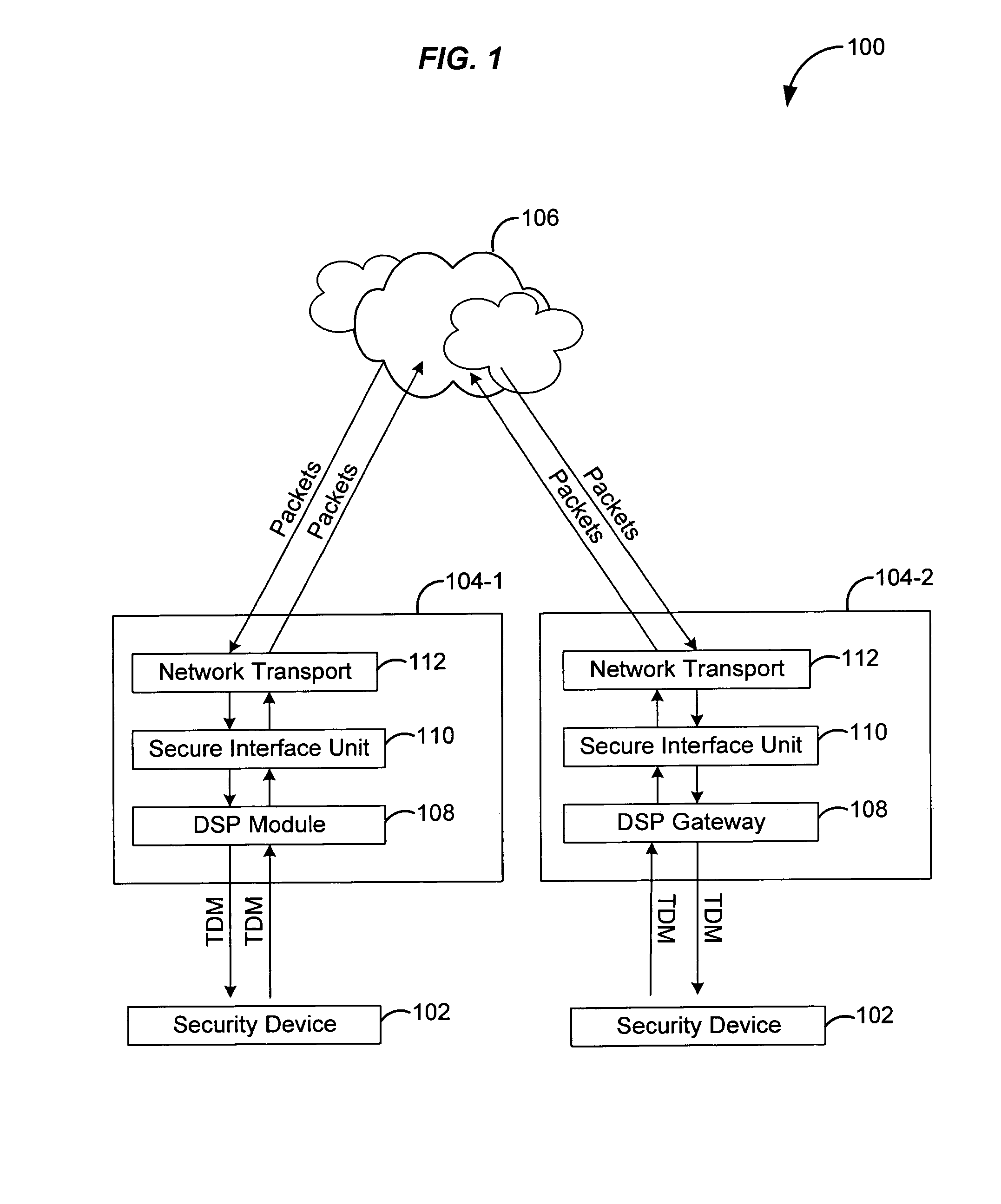
[0028]FIG. 1 depicts a system 100 for transmitting secure information over a packet-based network according to one embodiment of the present invention. As shown, system 100 includes one or more secure devices 102, a first gateway 104-1, and a second gateway 104-2, and a network 106.
[0029]Network 106 may be any packet-based network. Network 106 transports data asynchronously. For example, network 106 is configured to transfer packets received from gateways 104. In one embodiment, packet-based network 106 may be a frame relay or asynchronous transfer mode (ATM) network.
[0030]Secure device 102 may be any device configured to transmit information according to a secure protocol. For example, secure device 102 may be a future narrow band digital terminal (FNBDT), a secure terminal unit-III (STU-III), a STU-IIb, etc. Also, although secure devices are described, it will be understood that other non-secure modems may be used, such as generic modems (any V.90 and below modems, i.e. v.90, v.34...
PUM
 Login to View More
 Abstract
Description
Claims
Application Information
 Login to View More