Check patentability & draft patents in minutes with Patsnap Eureka AI!

Nanonylon composites prepared by chain extension reactive extrusion

a technology of reactive extrusion and polyamide, which is applied in the field of polyamide and organoclay composites, can solve the problems of unable to achieve the dispersion extent of organoclay with pre-polymerized nylon, and the difficulty of both preparation methods of nanonylons, and achieve the optimal barrier properties of nanonylon films, containers and other articles

Inactive Publication Date: 2010-01-05
POLYONE CORP
View PDF9 Cites 6 Cited by
  • Summary
  • Abstract
  • Description
  • Claims
  • Application Information

AI Technical Summary

Benefits of technology

This approach allows for the production of nanonylons with organoclay concentrations up to 35 weight percent, enabling enhanced barrier properties and improved processing characteristics, suitable for various article forms like films, fibers, and containers.

Problems solved by technology

Unfortunately, there are difficulties with both preparation methods for nanonylons.
Melt mixing of organoclay with pre-polymerized nylon fails to achieve the extent of dispersion required for establishing the full benefits of the organoclay throughout the bulk of the nylon, which fails to approach optimized barrier properties for nanonylon films, containers and other articles in which limitation of transport through the nanonylon is highly desired.
Moreover, melt mixing with too high a concentration of organoclay can create viscosity problems in the mixing device.
In-situ polymerization of nylon from monomer in the presence of organoclay (“polymerized nanonylon”) currently has a practical limit of about 8% concentration by weight of the organoclay in the nanonylon, above that concentration the polymerized nylon containing the organoclay is often too viscous for convenient removal from the reaction chamber.
Therefore, while an 8% nanonylon may be suitable for a nanonylon compound, it is not suitable for a nanonylon concentrate, an intermediate product which is sold to customers to extrude or mold with a “let-down” dilution of the concentrate in the presence of additional nylon, other polymers, other compounding ingredients, and the like.
Thus, the problem in the art is that nanonylon presently has a practical concentration limit of about 8%, while there are many who desire a concentration of organoclay in a concentrate that exceeds well beyond 8%.

Method used

the structure of the environmentally friendly knitted fabric provided by the present invention; figure 2 Flow chart of the yarn wrapping machine for environmentally friendly knitted fabrics and storage devices; image 3 Is the parameter map of the yarn covering machine
View more

Image

Smart Image Click on the blue labels to locate them in the text.
Viewing Examples
Smart Image
  • Nanonylon composites prepared by chain extension reactive extrusion
  • Nanonylon composites prepared by chain extension reactive extrusion

Examples

Experimental program
Comparison scheme
Effect test

examples

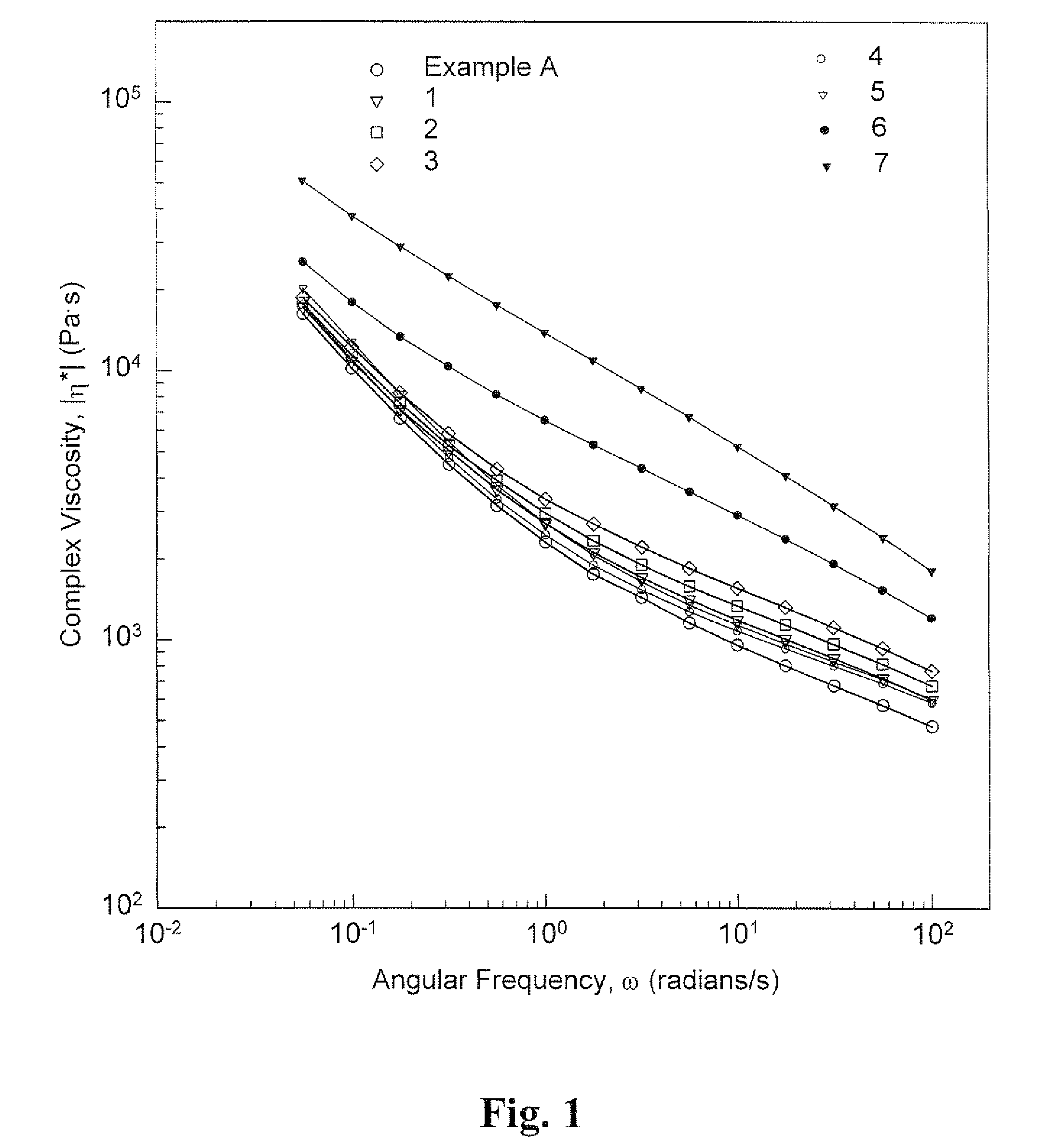
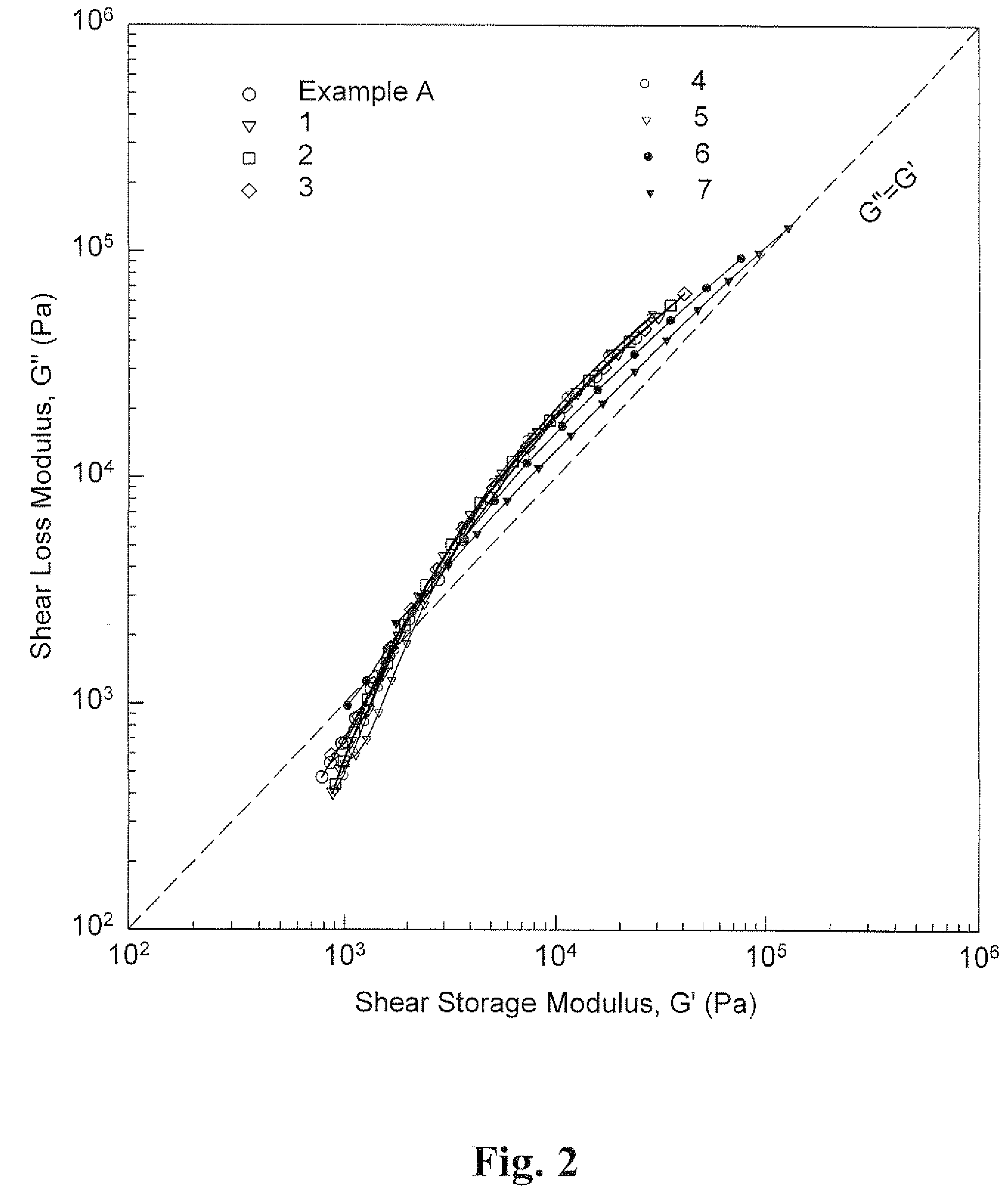
[0071]Rheological tests on sixteen samples of 8% Nanoblend™ nanonylon (PolyOne Corporation, Avon Lake, Ohio, USA), modified with Bruggolen M1251 from Bruggemann Chemical U.S., Inc. of Newtown Square, Pa., USA, Raschig 7000, and Raschig 9000 (both from Raschig GmbH of Ludwigshafen, Germany) were performed to investigate the effect the chain-extending agents have on molecular weight of the in-situ polymerized 8% nanonylon via chain extension.

[0072]For purposes of this invention, experimentations with 8% nanonylon are asserted to be establishment of efficacy of the inventive process to chain-extend a nanonylon. This efficacy experiment predicted the results for nanonylon of greater concentrations of organoclay (e.g., about 20%) because of the same chemistry shared by polymerized nanonylon of 8% organoclay concentration and oligomeric nanonylon of 20% organoclay concentration in respect of the reactivity of the nylon ends to the chain extending agents. Table 4 shows the formulations of ...

the structure of the environmentally friendly knitted fabric provided by the present invention; figure 2 Flow chart of the yarn wrapping machine for environmentally friendly knitted fabrics and storage devices; image 3 Is the parameter map of the yarn covering machine
Login to View More

PUM

PropertyMeasurementUnit
weight percentaaaaaaaaaa
melt flow indexaaaaaaaaaa
Login to View More

Abstract

Chain-extended nanonylon is made from the reaction of oligomeric nanonylon and chain-extending agents. Such chain-extended nanonylon contains concentrations of organoclay exceeding 10 weight percent. High concentrations of organoclay permit the chain-extended nanonylon to be used as either a concentrate or a compound that provides good barrier properties for thermoplastic articles made from the chain-extended nanonylon.

Description

CLAIM OF PRIORITY[0001]This application claims priority from U.S. Provisional Patent Application Ser. No. 60 / 749,255 bearing and filed on Dec. 9, 2005, which is incorporated by reference.FIELD OF THE INVENTION[0002]This invention concerns composites of polyamide and organoclay which contain concentrations of organoclay in excess of ten weight percent.BACKGROUND OF THE INVENTION[0003]The mixture of organoclays and polyamides, commonly called nanonylons, is highly desired because the organoclays can contribute barrier properties to polyamides for food packaging and other situations where the contained product within packaging must not leach, escape, or decay. Polyamides have been useful since the mid-20th Century. Organoclays, nanoclays intercalated with organic ions, such as quaternary ammonium, have become useful in the last decade.[0004]Presently, nanonylons can be made using two conventional processes: (1) melt mixing of the organoclay into the previously polymerized nylon, in whi...

Claims

the structure of the environmentally friendly knitted fabric provided by the present invention; figure 2 Flow chart of the yarn wrapping machine for environmentally friendly knitted fabrics and storage devices; image 3 Is the parameter map of the yarn covering machine
Login to View More

Application Information

Patent Timeline
no application Login to View More
Patent Type & Authority Patents(United States)
IPC IPC(8): C08K3/22C08G69/14C08G69/46C08K3/34C08L77/02
CPCB82Y30/00C08G69/48C08J5/005C08J2377/00
Inventor GOLBA, JOSEPH C.AVAKIAN, ROGER W.BOYE, WILLIAM F.
Owner POLYONE CORP
Features
  • R&D
  • Intellectual Property
  • Life Sciences
  • Materials
  • Tech Scout
Why Patsnap Eureka
  • Unparalleled Data Quality
  • Higher Quality Content
  • 60% Fewer Hallucinations
Social media
Patsnap Eureka Blog
Learn More