Check patentability & draft patents in minutes with Patsnap Eureka AI!

Method for adaptively screening a continuous tone original and device for carrying out said method

a continuous tone and original technology, applied in the field of graphic arts, facsimile and publishing techniques, can solve the problems of loss of fine details and distortion of contour geometry, unsatisfactory quality of contour reproduction in said method and device, and the contour is not free from stepwise distortion, etc., to achieve the effect of increasing the definition and sharpness of a prin

Inactive Publication Date: 2011-10-04
KUZNETABOV JURY VENIAMINOVICH +1
View PDF6 Cites 0 Cited by
  • Summary
  • Abstract
  • Description
  • Claims
  • Application Information

AI Technical Summary

Benefits of technology

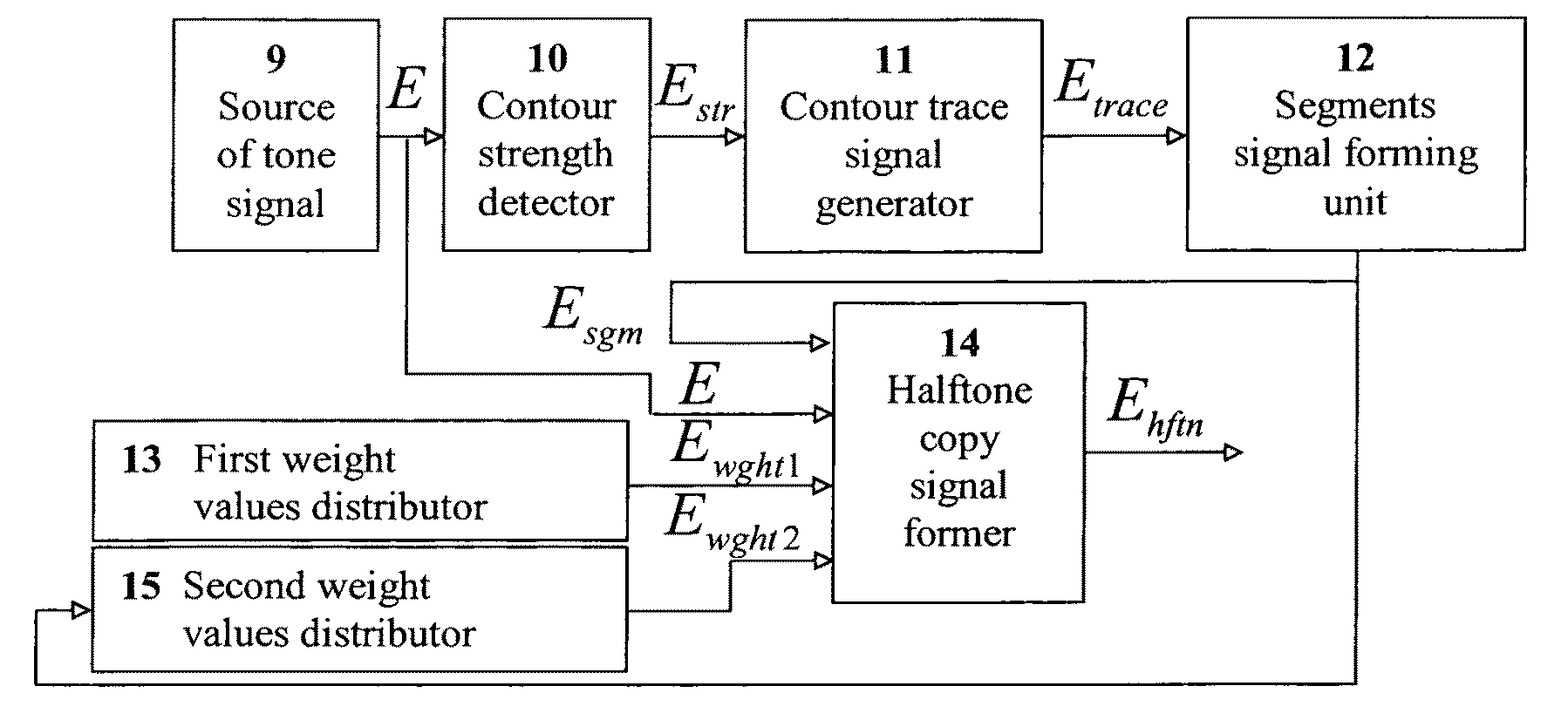
"The invention is about a method and device for adaptive screening of a CT original to improve the definition and sharpness of a print. The method involves creating a two-level halftone copy by adaptively screening the original using a matrix of weight values. These weight values are distributed among the elements of the original based on their tone values. The two-level signal is formed by combining the original with the weight values. The device includes a source of the original tone signal, a detector, a distributor of the weight values, and a contour trace generator. The method and device can be used to improve the accuracy and detail of printing, especially for complex contour patterns."

Problems solved by technology

At the same time, insufficient screen ruling will limit image definition and sharpness resulting in the loss of fine details and distortion of contours geometry.
Nevertheless, these contours are not free from the stepwise distortion as far as they are formed by the halftone dots of relatively low spatial periodicity.
The unsatisfactory quality of contour reproduction in said method and device is associated with the halftone dot size being dependent on the averaged value of the tone signal of an area, for example, of the reflection coefficient thereof.
However, these methods and devices do not completely use the printing process facilities to render fine details and contours even when the image is captured at the level of this process resolution, i.e. when the number and placement of printing elements coincides with the number and placement of areas of an original.
The presence of the substrate areas regular pattern of relatively low spatial frequency does not permit the complete adaptation of weight values to arbitrary contour which results in partial loss of definition and sharpness at transition from the original to its halftone copy.

Method used

the structure of the environmentally friendly knitted fabric provided by the present invention; figure 2 Flow chart of the yarn wrapping machine for environmentally friendly knitted fabrics and storage devices; image 3 Is the parameter map of the yarn covering machine
View more

Image

Smart Image Click on the blue labels to locate them in the text.
Viewing Examples
Smart Image
  • Method for adaptively screening a continuous tone original and device for carrying out said method
  • Method for adaptively screening a continuous tone original and device for carrying out said method
  • Method for adaptively screening a continuous tone original and device for carrying out said method

Examples

Experimental program
Comparison scheme
Effect test

Embodiment Construction

Method Description

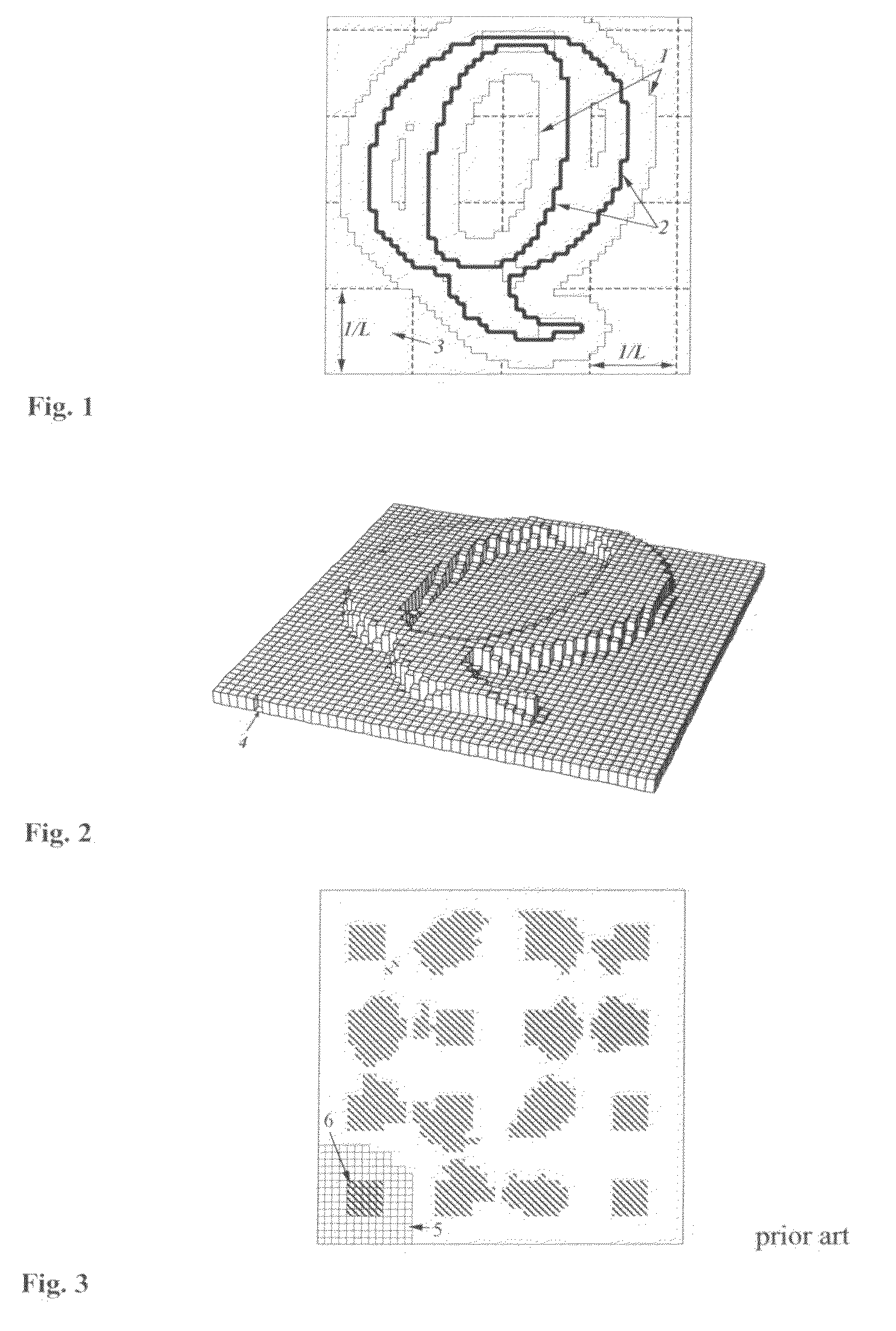
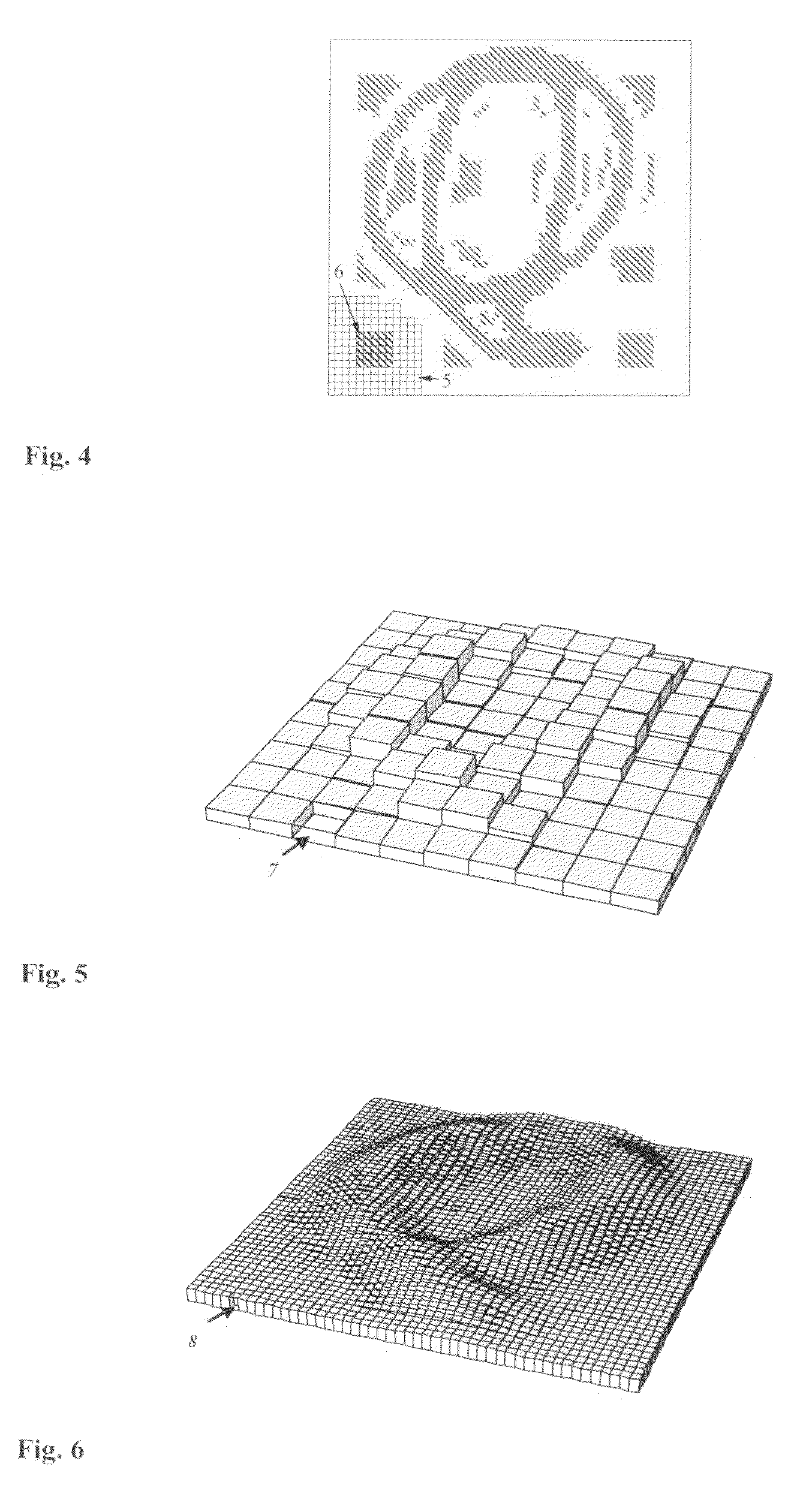
[0068]According to this invention the method for adaptive screening a continuous tone original is comprised in that the latter is divided on areas (4) and each of them is assigned by one of the tone signal values of an original. The number and location of these areas correspond to that of the weight values matrix and of the matrix of the two-dimensional bi-level signal of the halftone copy of an original. In other words, the resolution of media, which comprises the original as the two-dimensional signal of its tone, is made equal to that of the media which reproduces the halftone copy. Such two-dimensional signal is three-dimensionally (3D) shown on FIG. 2. It can be analytically presented by the discrete function E=f(k×Δx,i×Δy) of two spatial variables, where k and i are integers indicating the location of the given original area and Δx, Δy are correspondingly the spatial sampling intervals for x and y coordinates, or by the complete matrix [Ei,k]m,n of this funct...

the structure of the environmentally friendly knitted fabric provided by the present invention; figure 2 Flow chart of the yarn wrapping machine for environmentally friendly knitted fabrics and storage devices; image 3 Is the parameter map of the yarn covering machine
Login to View More

PUM

No PUM Login to View More

Abstract

A method of converting two-dimension signal including multilevel tone values of areas of the original into two-dimension halftone print copy signal including two-level tone values of printed and blank elements thereof includes, forming two types of two-dimension weight values. In the first, these values are distributed among print copy elements in an order independent of the tone variation along areas of the original. In the second, the geometry of contours and fine details thereof are taken into account. The two-level halftone copy signal is formed by comparing signal values of areas of the original and weight values of the first and second types. The second type values are placed inside the space intervals-segments, whose position is determined by forming the counter trace signal, and the boundaries of segments are set according to the number of neighboring elements for reproducing the counter or fine detail on the halftone copy.

Description

FIELD OF THE INVENTION[0001]The invention relates to graphic arts, facsimile and publishing techniques and, more specifically, to the systems reproducing an image by two tone levels for an each of the process (triad) colors. The invention can be used in graphic outputs and digital presses, in computer systems for graphic data processing, in facsimile and copier equipment.DESCRIPTION OF THE RELATED ART[0002]The so called screening is used in graphic arts printing, electrophotography and thermography, in matrix and ink jet printing to imitate the grey levels of a continuous tone (CT) original image. It comprises the variation of relative area occupied on a copy by the printing elements creating the halftone dots, providing the first tone level, and by the non-printing elements, creating the blanks to provide the second tone level. The minimum sizes of steadily reproducible halftone dots and blanks have a finite value dependent on a noise level in a system, which level is, in turn, dep...

Claims

the structure of the environmentally friendly knitted fabric provided by the present invention; figure 2 Flow chart of the yarn wrapping machine for environmentally friendly knitted fabrics and storage devices; image 3 Is the parameter map of the yarn covering machine
Login to View More

Application Information

Patent Timeline
no application Login to View More
Patent Type & Authority Patents(United States)
IPC IPC(8): H04N1/405
CPCH04N1/405
Inventor KUZNETSOV, JURY VENIAMINOVICHSHADENKO, ANDREI ALEKSANDROVICH
Owner KUZNETABOV JURY VENIAMINOVICH
Features
  • R&D
  • Intellectual Property
  • Life Sciences
  • Materials
  • Tech Scout
Why Patsnap Eureka
  • Unparalleled Data Quality
  • Higher Quality Content
  • 60% Fewer Hallucinations
Social media
Patsnap Eureka Blog
Learn More