
Opiate reduction utilizing catalytic hydrogen transfer reaction
a hydrogen transfer reaction and catalytic technology, applied in the field of catalytic hydrogen transfer reaction for opiate reduction, can solve the problems of reducing reaction yield, difficult use of oripavine, and high cost of oxycodon
- Summary
- Abstract
- Description
- Claims
- Application Information
AI Technical Summary
Problems solved by technology
Method used
Image

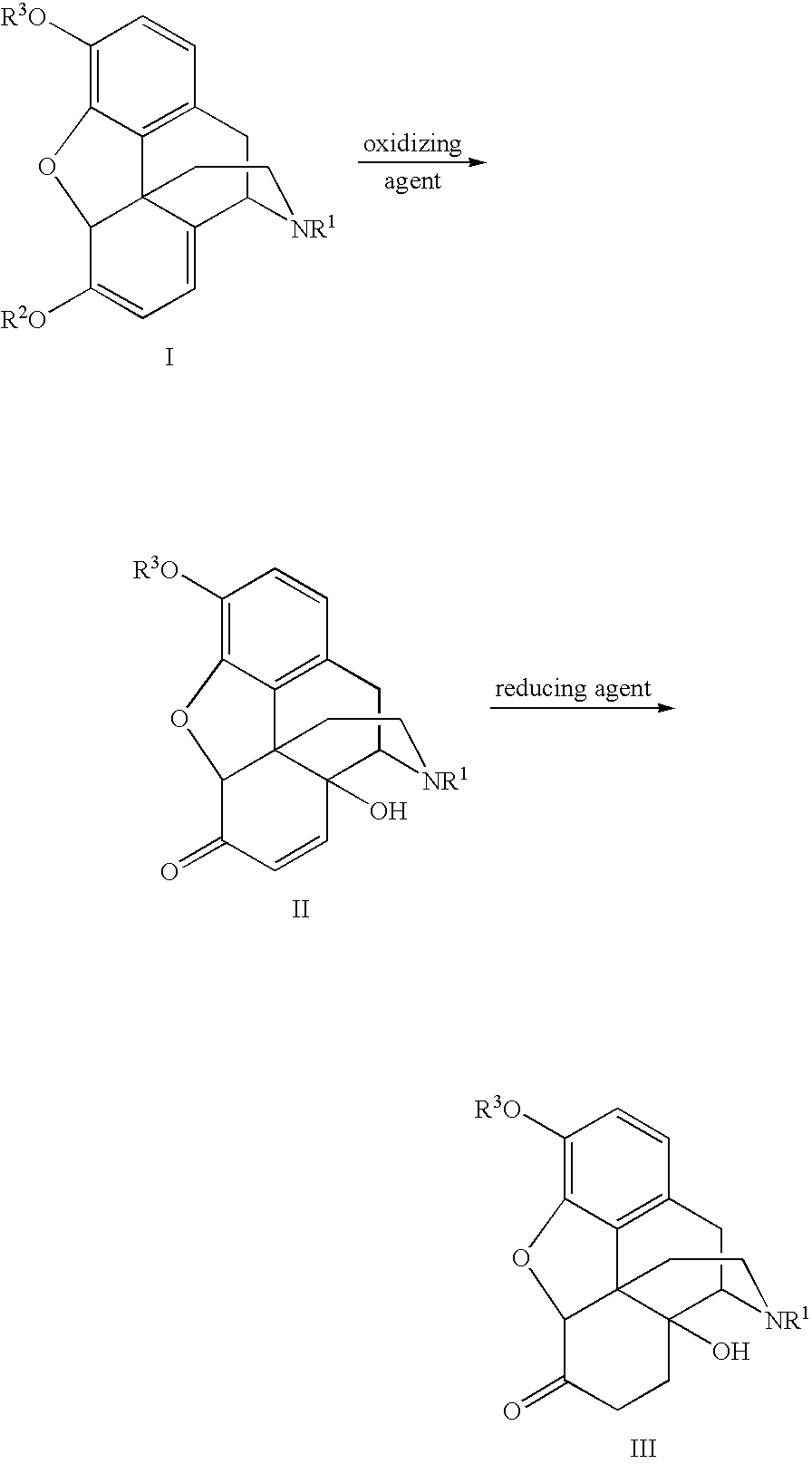
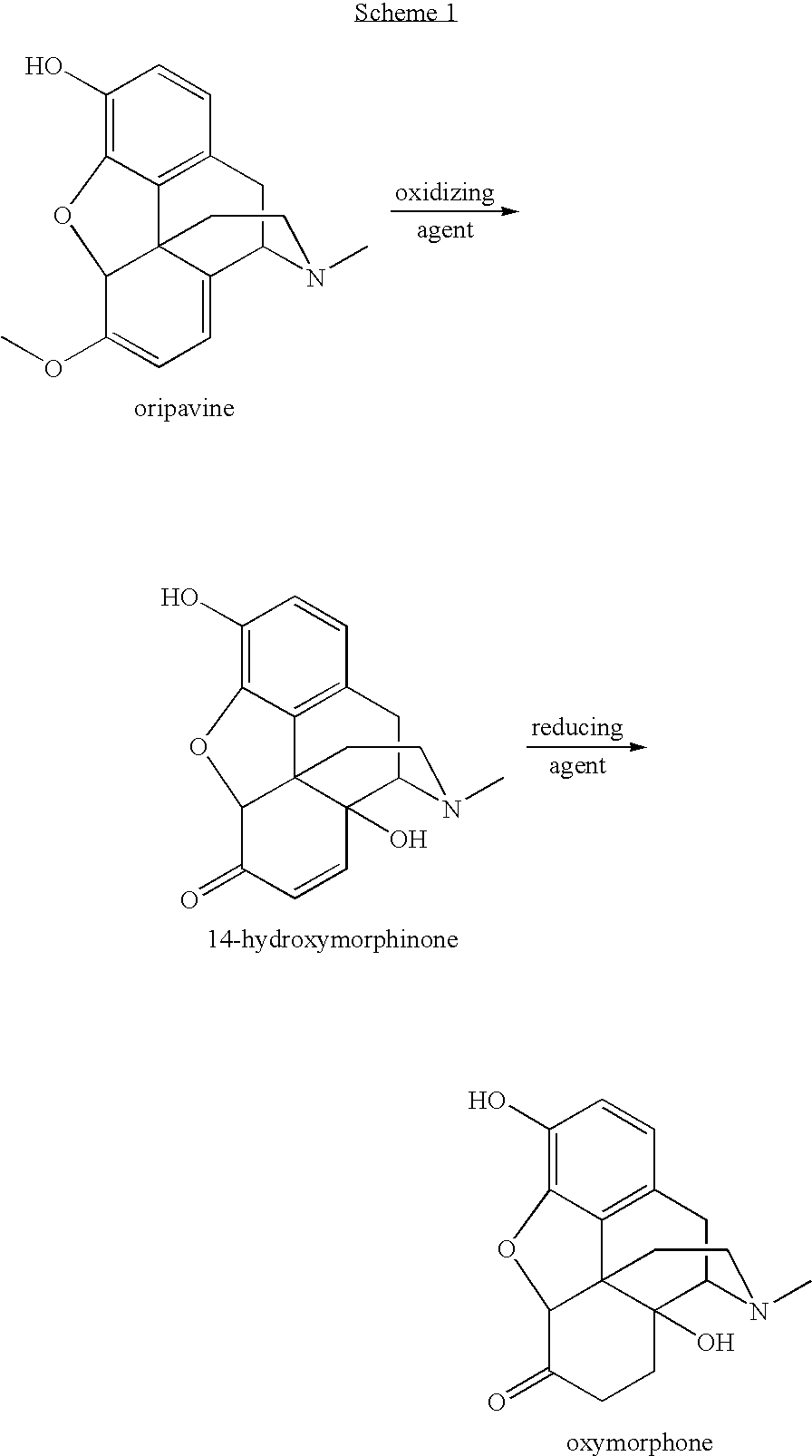
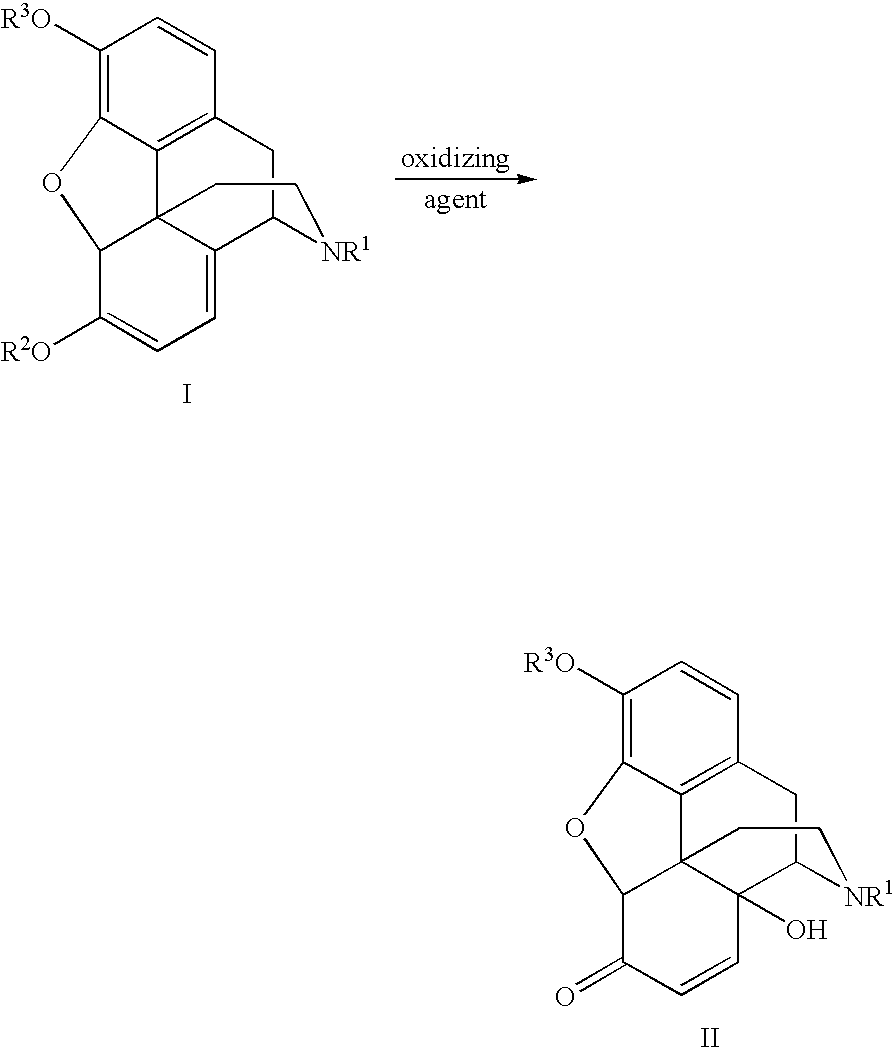
Examples
example 1
[0036]
[0037]Dried thebaine (3.2 g, 95% wt / wt %) was dissolved in HCO2H / H2O (6 mL / 9 mL) to form a reaction solution. H2O2 (50% wt / wt, 0.9 mL) and H2SO4 (0.30 g) were added to the reaction solution, which was stirred at 20° C. until HPLC data showed that the thebaine was completely converted to 14-hydroxycodeinone, about 3 to 6 hours. 0.3 g of 5% Pd / C was then added and the resulting mixture was heated at 45° C. for 2 hours, and then at 60° C. for an additional 2 hours, after which HPLC showed greater than 95% conversion from 14-hydroxycodeinone. The reaction mixture was filtered at 60° C. and the resulting filtrate was cooled to room temperature. c-NH4OH was added slowly until the pH of the mixture was raised sufficiently to yield a precipitate. The resulting mixture was stirred at room temperature for 1 hour and filtered. The recovered solid was washed with water (3×15 mL), and dried under house vacuum at 75° C. for 18 hour to give 1.8 g of product.
example 2
[0038]
[0039]Dried oripavine (3.0 g, 95% wt / wt %) was dissolved in HCO2H / H2O (6.0 mL / 9.0 mLg) to form a reaction solution. H2O2 (50% wt / wt, 0.70 mL) and H2SO4 (0.45 mL) were added to the reaction solution, which was stirred at 20° C. until HPLC data showed that the oripavine was completely converted to 14-hydroxycodeinone, about 20-30 hours. 0.3 g of 5% Pd / C was then added and the resulting mixture was stirred for 30 minutes at room temperature. HCO2Na (0.6 g) and NEt3 (7.5 mL) were added. The mixture was heated at 45° C. for 2 hours, and then at 80° C. for an additional 4-8 hours, after which HPLC showed complete disappearance of 14-hydroxymorphinone. The reaction mixture was cooled to 60° C. and filtered. The resulting filtrate was cooled to room temperature. c-NH4OH was added slowly until the pH of the mixture was adjusted to 9.2-10.0 to yield a precipitate. The resulting mixture was stirred at room temperature for 1 hour and filtered. The recovered solid was washed with water (3×...
example 3
[0040]Dried oripavine (3.0 g, 95% wt / wt %) was dissolved in HCO2HIH2O (6.0 mL / 9.0 mLg) to form a reaction solution. H2O2 (50% wt / wt, 0.70 mL) and H2SO4 (0.45 mL) were added to the reaction solution, which was stirred at 20° C. until HPLC data showed that the oripavine was completely converted to 14-hydroxycodeinone, about 20-30 hours. 0.3 g of 5% Pd / C was then added and the resulting mixture was stirred for 30 minutes at room temperature. NEt3 (8.8 mL) was added. The mixture was heated at 45° C. for 2 hours, and then at 80° C. for an additional 4-8 hours, after which HPLC showed that complete disappearance of 14-hydroxymorphinone. The reaction mixture was cooled to 60° C. and filtered. The resulting filtrate was cooled to room temperature. c-NH4OH was added slowly until the pH of the mixture was adjusted to 9.2-10.0 to yield a precipitate. The resulting mixture was stirred at room temperature for 1 hour and filtered. The recovered solid was washed with water (3×15 mL), and dried und...
PUM
| Property | Measurement | Unit |
|---|---|---|
| temperature | aaaaa | aaaaa |
| temperature | aaaaa | aaaaa |
| temperature | aaaaa | aaaaa |
Abstract
Description
Claims
Application Information
 Login to View More