Physical downlink shared channel transmission method

a shared channel and transmission method technology, applied in the field of wireless communication systems, can solve the problems of inability to schedule in cross-carrier, grave adjacent channel interference, downlink subframes, etc., and achieve the effect of enhancing cross-carrier scheduling flexibility, increasing terminal user peak rate, and increasing terminal user throughpu

US9332529B2Active Publication Date: 2016-05-03SAMSUNG ELECTRONICS CO LTD
11 Cites 0 Cited by

Patent Information

Authority / Receiving Office
US · United States
Patent Type
Patents(United States)
Current Assignee / Owner
Publication Date
2016-05-03

Smart Images

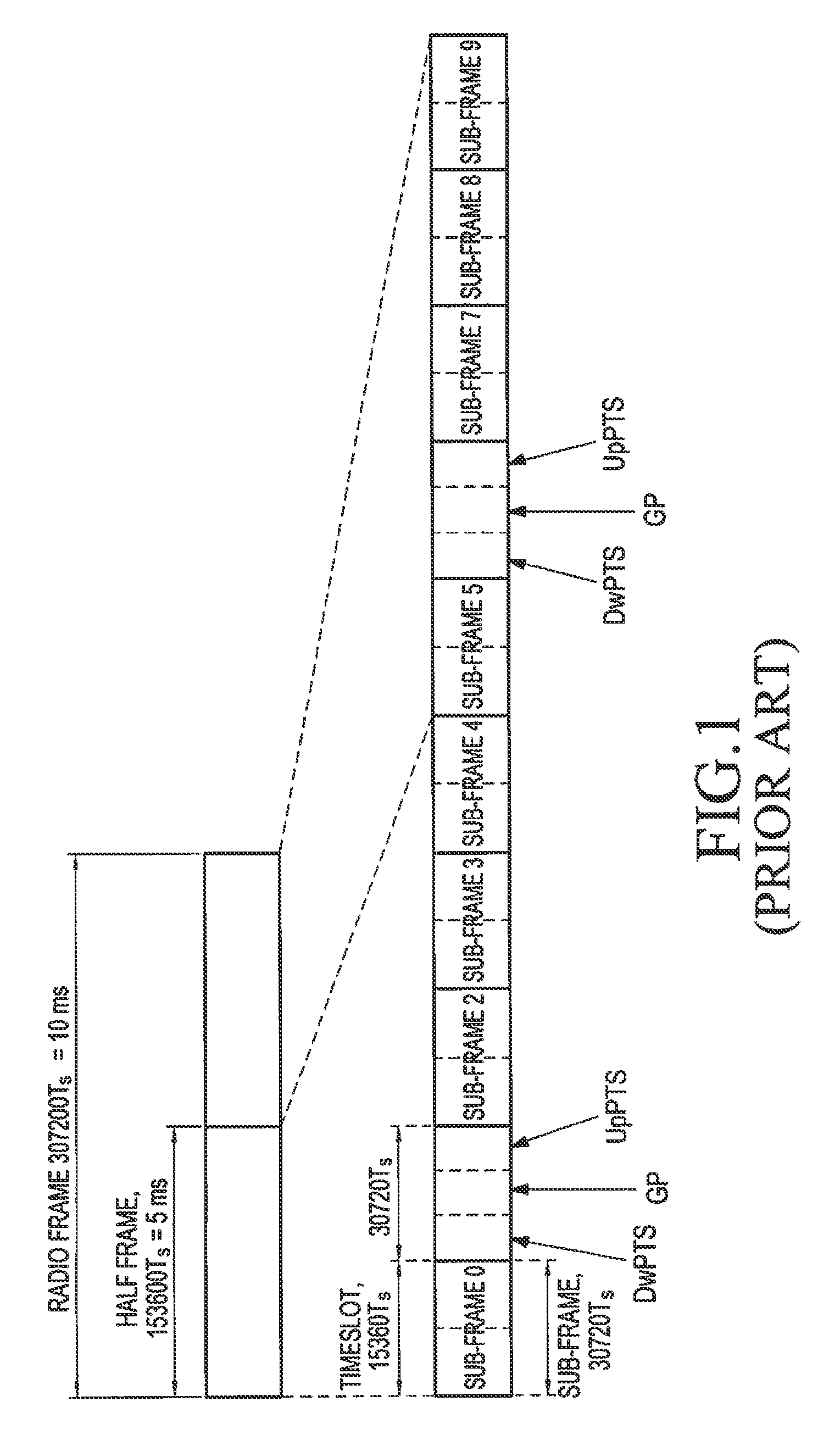
  • Figure 1
    Figure 1
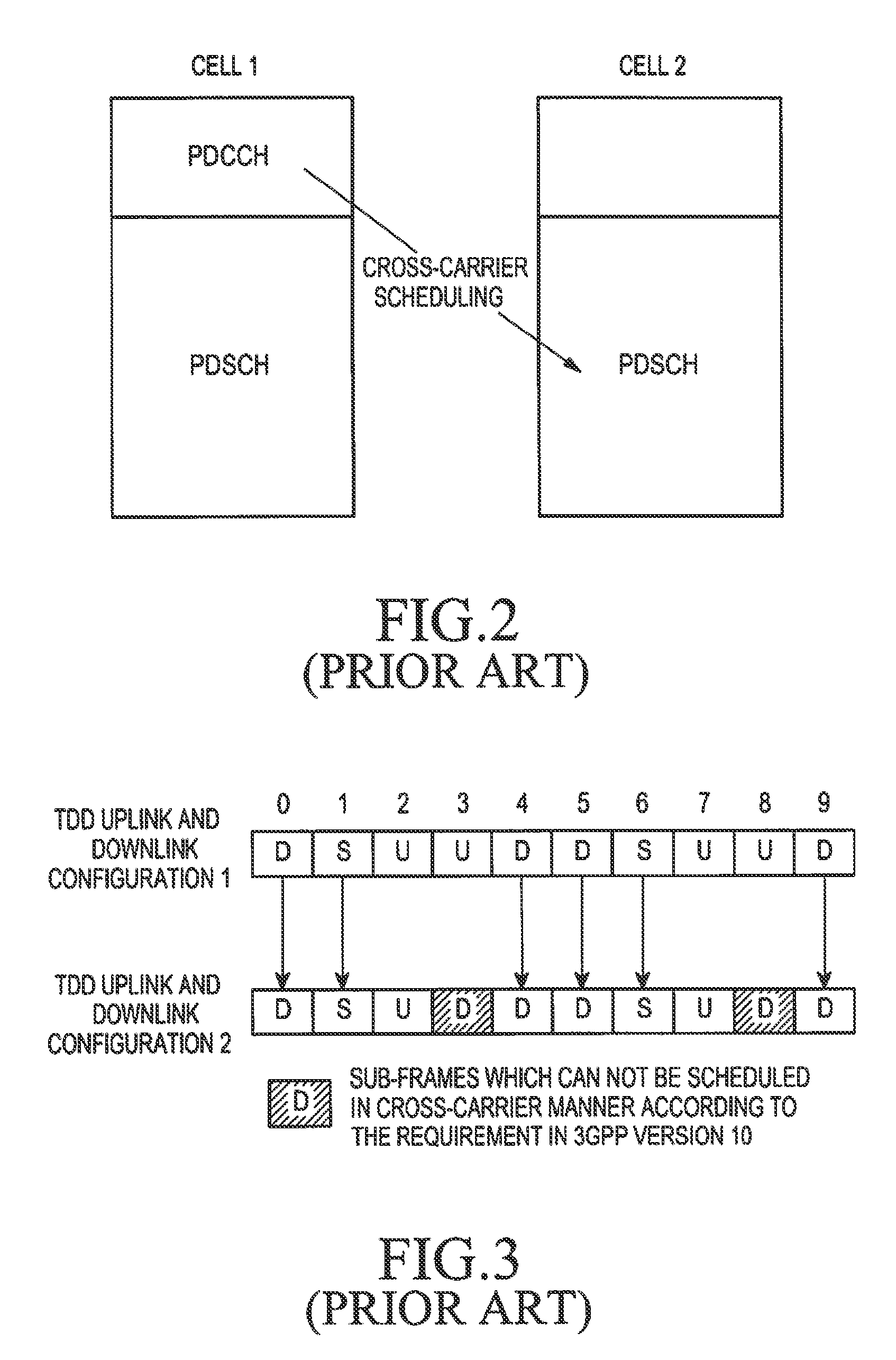
  • Figure 2
    Figure 2
  • Figure 3
    Figure 3
Patent Text Reader

Abstract

A Physical Downlink Shared CHannel (PDSCH) transmission data method is provided. A User Equipment (UE) receives cross-carrier scheduling information in a PDCCH of a cell for scheduling. The cross-carrier scheduling information carries scheduling information indicating at least one PDSCH in at least one sub-frame of a cell being scheduled in cross-carrier scheduling. The UE processes data of PDSCH corresponding to the instruction according to received cross-carrier scheduling information. The UE sends a HARQ-ACK message to a base station according to the processed result. The peak rate of the UE is increased, and the requirement for higher throughput of the UE is satisfied.
Need to check novelty before this filing date? Find Prior Art

Description

PRIORITY

[0001] This application claims priority under 35 U.S.C. §119(a) to Chinese Application Serial No. 201210071047.8, which was filed in the Chinese Intellectual Property Office on Mar. 16, 2012, the entire content of which is incorporated herein by reference.BACKGROUND OF THE INVENTION

[0002] 1. Field of the Invention

[0003] The present invention generally relates to wireless communication systems, and more particularly, to a Physical Downlink Shared CHannel (PDSCH) data transmission method.

[0004] 2. Description of the Related Art

[0005] A Long Term Evolution (LTE) system supports a Frequency Division Duplexing (FDD) mode and a Time Division Duplexing (TDD) mode. FIG. 1 is a schematic diagram illustrating the structure of a frame in a TDD system. The length of each radio frame is 10 ms, with each radio frame divided into two half-frames of a length of 5 ms. Each half-frame consists of eight data time slots, each of which having a length of 0.5 ms, and three special time slots, i.e., Do...

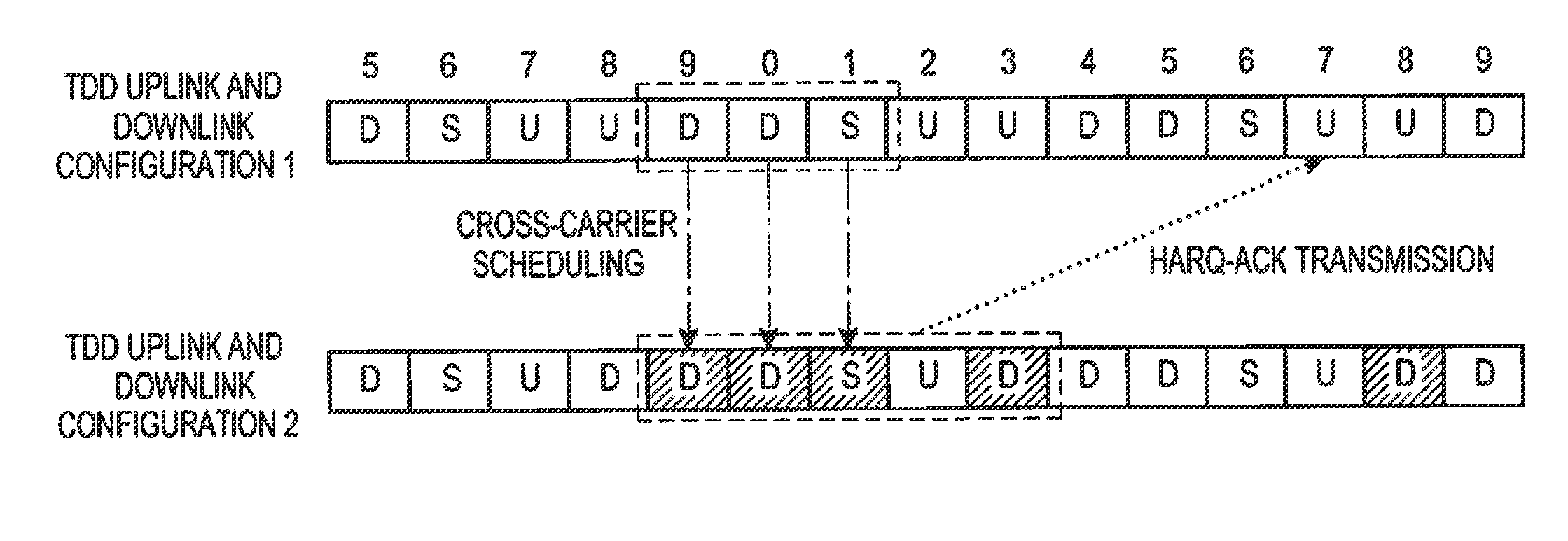
Examples

Embodiment Construction

[0028]Hereinafter, various embodiments of the present invention will be described with reference to the accompanying drawings. In the following description of the present invention, a detailed description of known functions and configurations incorporated herein will be omitted when it may obscure the subject matter of the present invention.

[0029]For a TDD system configured with carrier aggregation, in the present invention, TDD uplink and downlink configurations of multiple cells of a base station may be different. Similar to LTE-A, it is possible to configure a UE accessing the base station to work in at least one cell.

[0030]When sending cross-carrier scheduling information to a UE utilizing a PDCCH of a cell for scheduling, a base station also indicates a PDSCH of a cell being scheduled using the cross-carrier scheduling information, and the UE may determine PDSCH data in which sub-frames should be processed according to the indication. Thus, when cross-carrier scheduling is impl...