
Video-based system and method for parking occupancy detection
a video-based system and parking technology, applied in closed circuit television systems, instruments, image enhancement, etc., can solve the problems of slow and efficient video-based parking solutions for large-scale deployment, data transmission, data storage and processing steps, etc., to improve scalability and memory efficiency, the effect of improving the scalability of parking types
- Summary
- Abstract
- Description
- Claims
- Application Information
AI Technical Summary
Benefits of technology
Problems solved by technology
Method used
Image

Examples
example 1
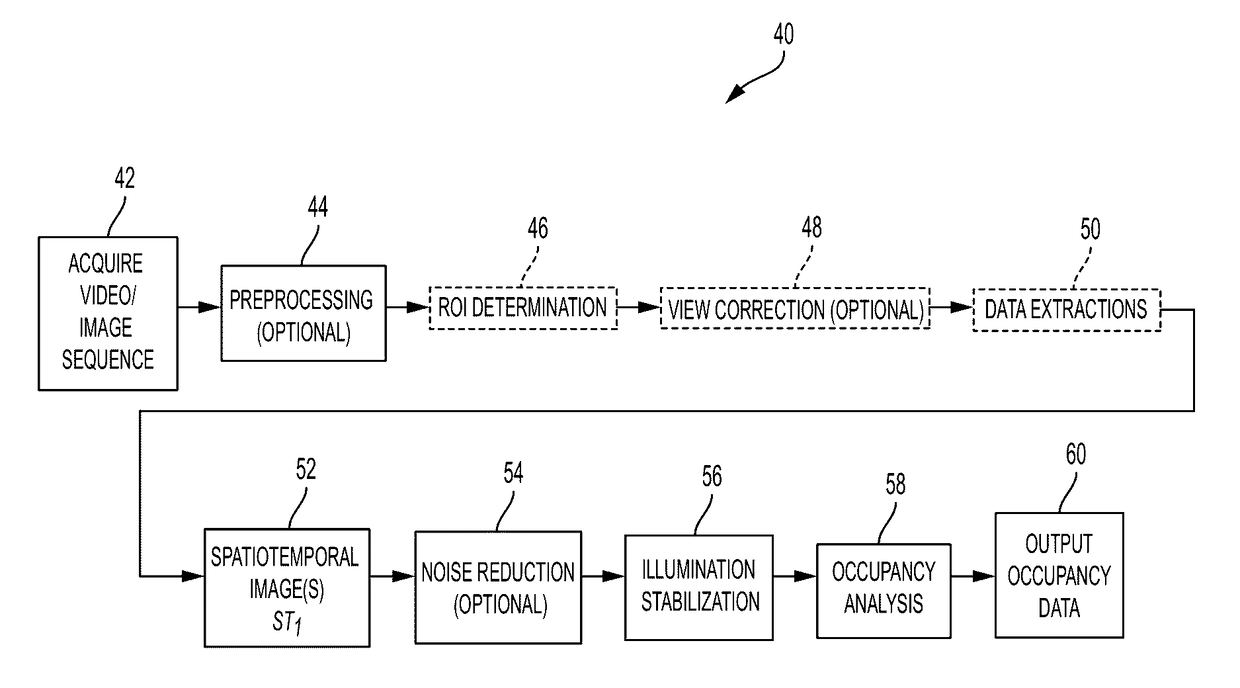
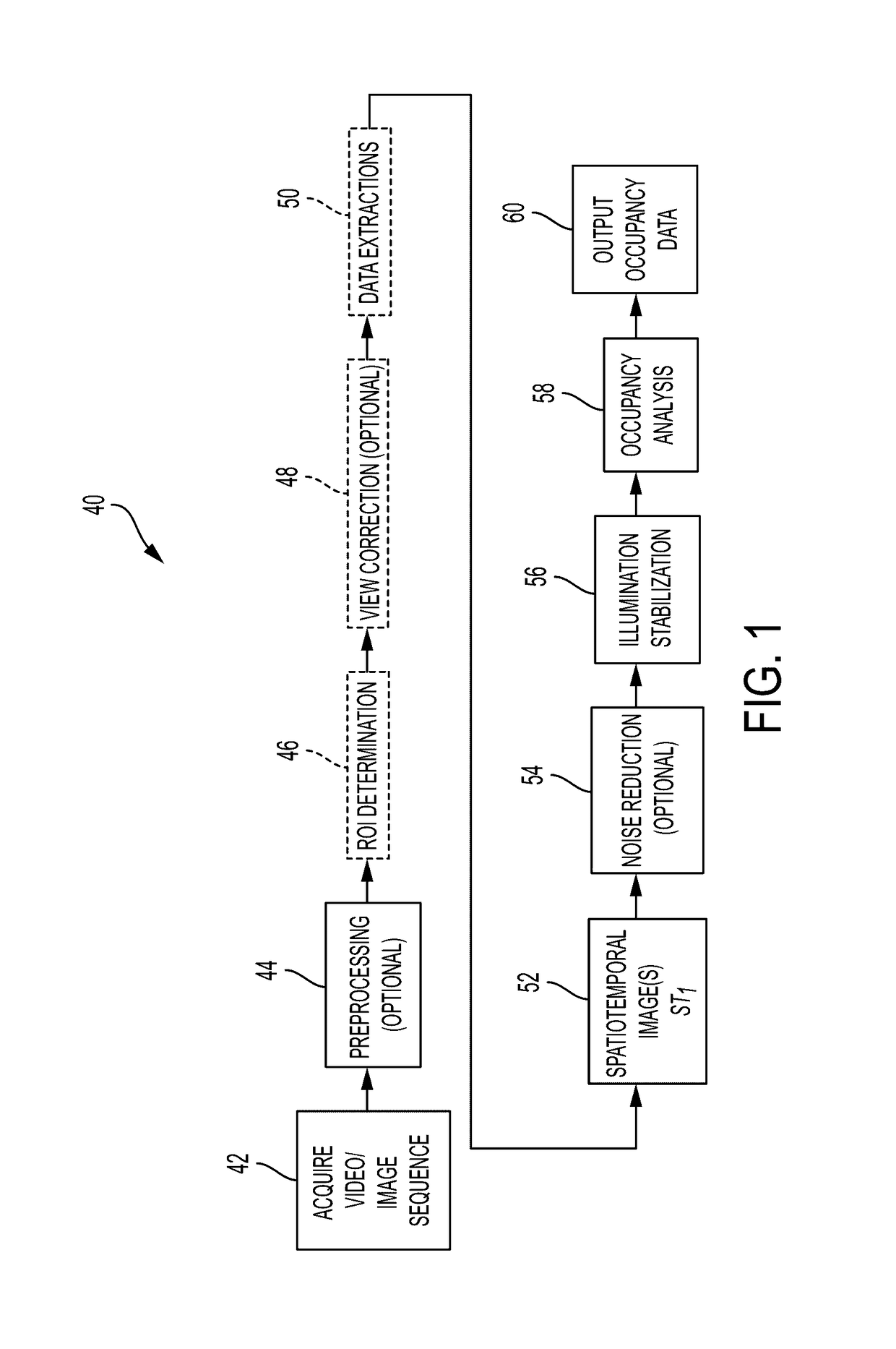
[0096]In a first approach, the S value for each pixel or group of pixels can be compared to a threshold. If S is below the threshold, then that pixel in the ST image is interpreted to be relatively neutral in color, which means that the original spatial differences were slight, further implying non-occupancy. The converse is true for S above the threshold.
example 2
[0097]In a second approach, a computer color difference or strength comparison is performed by calculating difference across channels.
[0098]With reference to FIG. 3, an exemplary embodiment 70 is illustrated wherein HSV, or generally the transformed space, with normalized lightness (e.g., {tilde over (V)}) is transformed to a space where channel differences can be used to determine color strength (occupancy). For example,
[0099]C=V~×SX=C×(1-|(H / 60°)mod2-1|)m=V~-C(R′,G′,B′)={(C,X,0),0°≤H60°(X,C,0),60°≤H120°(0,C,X),120°≤H180°(0,X,C),180°≤H240°(X,0,C),240°≤H300°(C,0,X),300°≤H360°(R.,G_,B.)=(R′+m,G′+m,B′+m)
[0100]Pixel-wise or area-wise differences across {dot over (R)}(STR(s,t)), G(STG(s,t)), {dot over (S)}(STB(s,t)) indicate color strength (saturation), which can be determined by calculations such as the maximum or summed magnitude of all pairwise differences. These example spaces are not intended to be limiting.
[0101]Another example of a suitable transformed space ...
example 3
[0104]In a third approach, when multiple ST images are obtained, the differences between two or more ST images can be used for occupancy determination. An exemplary way to perform this approach includes determining the maximum absolute difference (per pixel wise) between all ST images. The value of the absolute difference between all ST images will reflect the occupancy state in the parking space. A simple threshold can be used to find the occupied spaces.
PUM
 Login to View More
 Abstract
Description
Claims
Application Information
 Login to View More