
Method for removing sulfur-containing compound from carbon fuel by catalytic oxidation
A technology for catalytic oxidation and hydrocarbon fuel, applied in the petrochemical field, can solve the problems of high price of oxidant, difficult extraction and separation, high cost, and achieve the effect of continuous operation, obvious desulfurization effect and overcoming high cost.
Patent Information
- Authority / Receiving Office
- CN · China
- Patent Type
- Applications(China)
- Current Assignee / Owner
- Publication Date
- 2007-08-01
- Estimated Expiration
- Not applicable · inactive patent
Smart Images
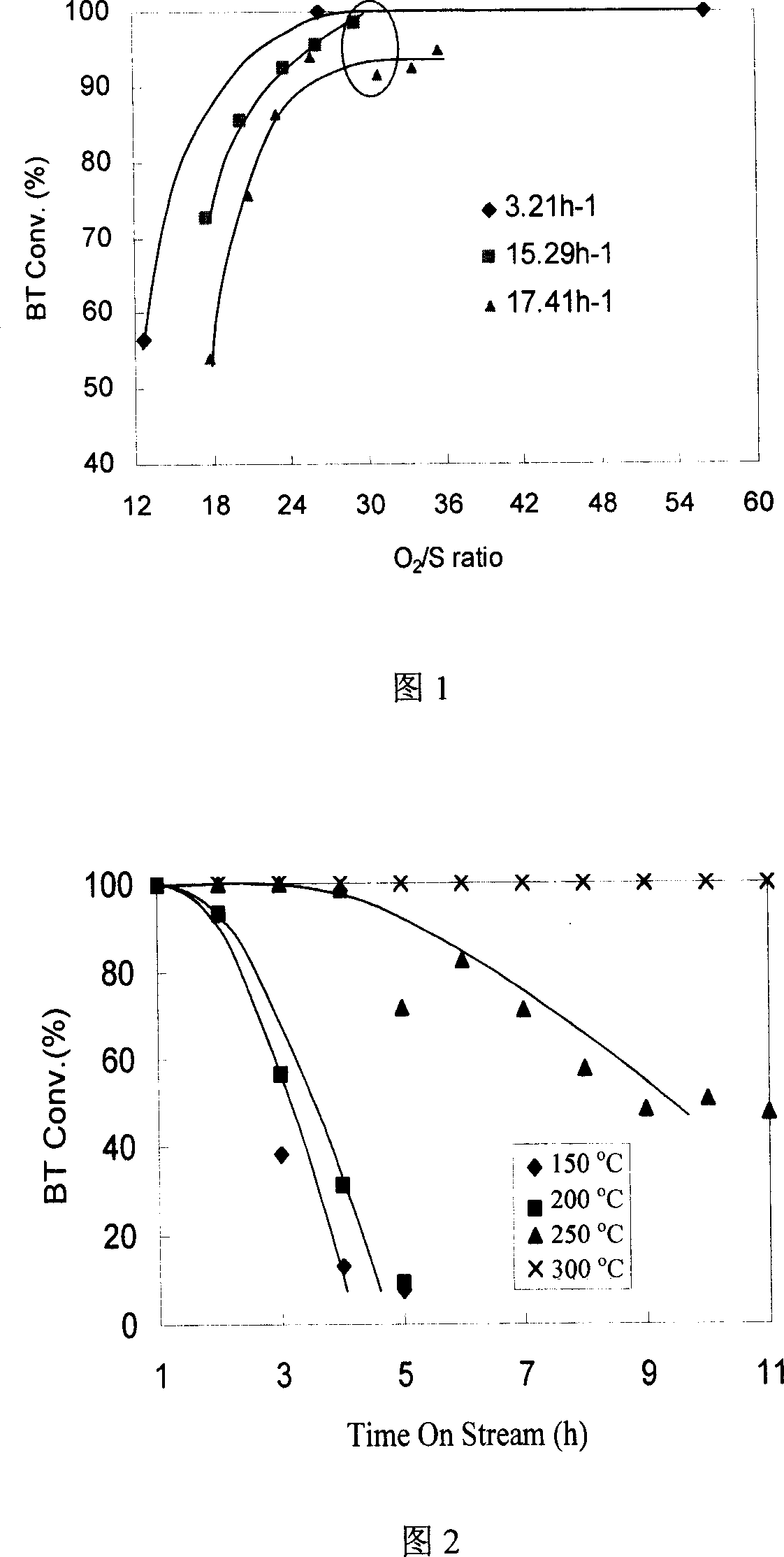
Figure 1
Abstract
Description
technical field
[0001] The invention relates to a method for catalytically oxidizing and removing sulfur-containing compounds in hydrocarbon fuels, belonging to the field of petrochemical industry. technical background
[0002] The increasingly stringent environmental protection requirements have made the world's oil refining industry face the severe challenge of producing clean hydrocarbon fuels with low sulfur content. According to the plan of the US Environmental Protection Agency, the sulfur content of gasoline is required to be less than 30 μg / g in 2006, and the sulfur content of diesel is less than 15 μg / g; the European Union and Japan plan to impose stricter restrictions on sulfur content. In response to new environmental protection requirements, the world's major oil companies and scientific researchers are devoting themselves to the research and development of new technologies for the removal of sulfides in economical and efficient hydrocarbon fuels. Among them, ne...
Examples
Embodiment 1-3
[0021] With 1.5wt%Pd / CeO 2 As a catalyst [synthesis details: Applied Catalysis B, 53 (2004) 77-85], isooctane containing 1000 μg / g sulfur (benzothiophene is the sulfur source) The hourly space velocity is 3.21, 15.29 and 17.41h respectively -1 Under the condition, the O 2 / S ratio, the results are shown in Figure 1. From the results in Figure 1, it can be seen that the best O on the catalyst to achieve the maximum desulfurization rate 2 / S ratio is about 30; at 3.21, 15.29 and 17.41h -1 Under the heavy hourly space velocity, the desulfurization rates are >99%, 98% and 95%, respectively. After identification by PFPD chromatography and mass spectrometer, the sulfur-containing gas in the reaction tail gas is SO 2 . o 2 The selectivity is above 30%.
[0022] 1.5wt%Pt / CeO 2 The same results as in Examples 1-3 were also obtained on the catalyst.
Embodiment 4-6
[0024] 1.5wt%Pt / CeO 2 As a catalyst [synthesis see: Journal of Catalysis, 229 (2005) 499-512], isooctane containing 1000 μg / g sulfur (benzothiophene as sulfur source) is used as raw material, under normal pressure, O 2 / S ratio 30, raw material oil heavy hourly space velocity 15.29h -1 Under the same conditions, the change of benzothiophene removal rate with time at 150, 200, 250, and 300°C was investigated, and the results are shown in Figure 2. It can be seen from the results in Figure 2 that the optimum reaction temperature on this catalyst is ~300 °C; at lower reaction temperatures, the catalyst will be deactivated rapidly.
Embodiment 7-8
[0026] 5wt%Cu / CeO 2 As a catalyst [synthesis details see: Applied Catalysis B, 28 (2000) 113-125], isooctane containing 1000 μg / g sulfur (benzothiophene as sulfur source) is used as raw material, under normal pressure, O 2 / S ratio 17, raw material oil heavy hourly space velocity 40h -1 Under the conditions, the removal rate of sulfur reaches >99% at 300°C, O 2 The selectivity of sulfur is 61.7%; the removal rate of sulfur reaches 97% at 280 ° C, O 2 The selectivity was 59.9%. At normal pressure, O 2 / S ratio 17, raw material oil weight hourly space velocity 80h -1 Under these conditions, the removal rate of sulfur reaches ~70% at 300°C.