
Reduction-resistant nickel electrode ceramic dielectric material
A ceramic dielectric and nickel electrode technology, applied in the field of ceramic dielectric materials, can solve the problem of high production cost, and achieve the effects of improving compressive strength, high reliability and uniform grain growth
Patent Information
- Authority / Receiving Office
- CN · China
- Patent Type
- Patents(China)
- Current Assignee / Owner
- Publication Date
- 2013-07-03
Smart Images
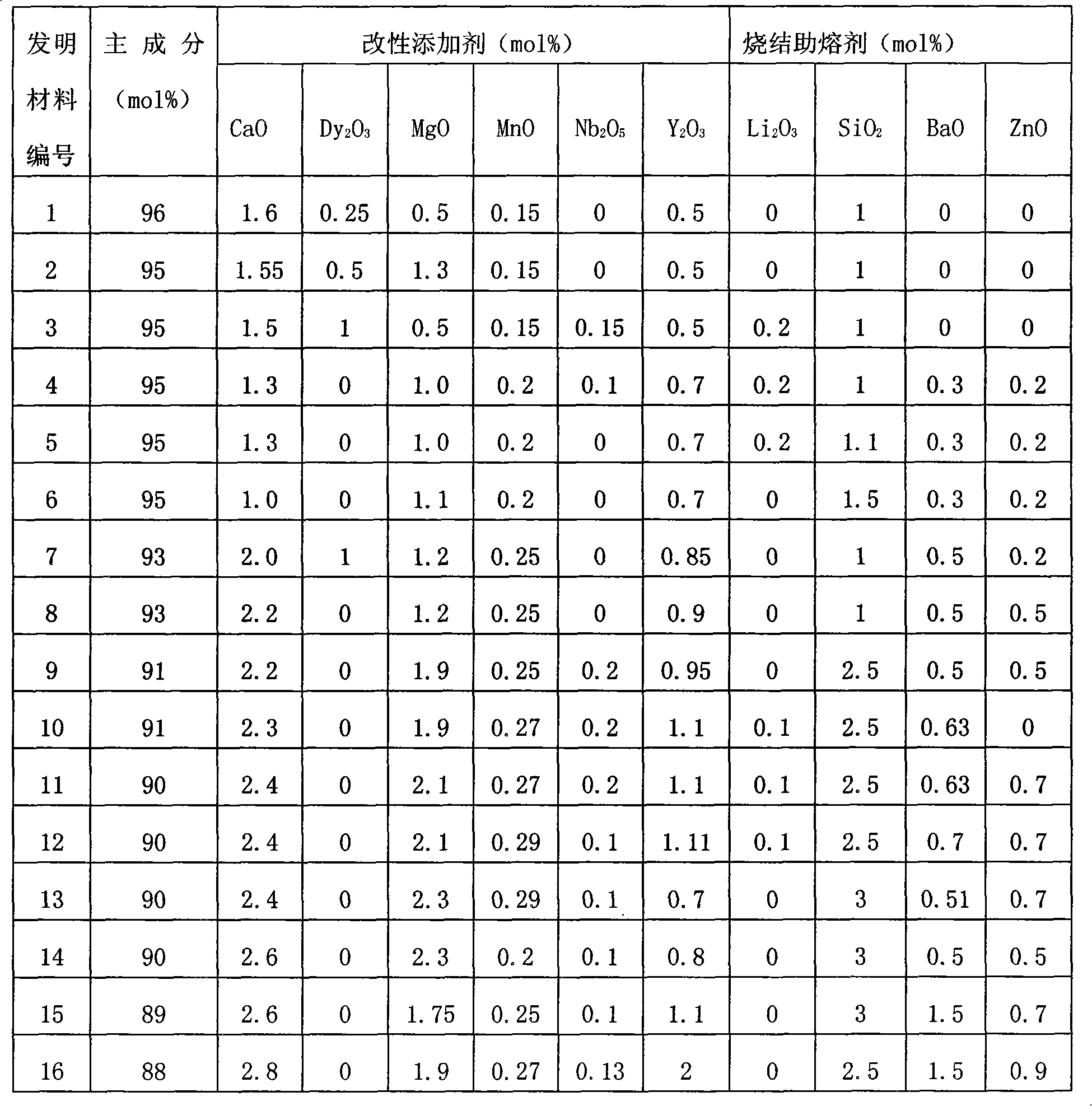
Figure 1
Abstract
Description
technical field
[0001] The invention relates to a ceramic dielectric material for a multilayer chip ceramic capacitor MLCC, in particular to an anti-reduction nickel electrode ceramic dielectric material. Background technique
[0002] The traditional MLCC production method is generally completed in two steps. The first step is to purchase BT and small materials from downstream manufacturers, mix BT and small materials in a certain proportion, and go through fine-tuning of components→ball milling→drying treatment→powdering treatment→sieving treatment , after packaging, the required X7R porcelain powder is obtained. The production process of X7R porcelain powder takes one month; the second step is to purchase X7R porcelain powder from upstream manufacturers, add adhesives, solvents, and plasticizers to the porcelain powder, and make pulp →Casting→Silk printing→Lamination→Cutting→Sintering→Encapping→Electroplating process to make MLCC. Such production costs are high. Content...
Examples
Embodiment
[0017] An anti-reduction nickel electrode ceramic dielectric material and a new MLCC manufacturing method thereof, in Table 1 No. 1 to No. 16 material formulations, BT can pass through BaO and TiO 2 Obtained by sintering synthesis, various small materials, namely glass components and modified additives) can be purchased directly, using the new technology of BT+ small materials, that is, MLCC direct batching method (mixing BT, glass components and modified additives to make casting slurry The material is cast, and the MLCC is cast to 20um. When these anti-reduction nickel electrode ceramic dielectric materials are used to make MLCC products by conventional methods, the sintering temperature is 1270 ° C ~ 1290 ° C, and the 0603B103K specification products are made. After making MLCCs, At room temperature of 25°C, use HP4278 to test capacitor capacity and loss at 1MHz, 1.0V (AC); use SF2512 fast insulation machine, apply 100V DC rated voltage for 10 seconds, and test insulation re...