
Preparation method of 1-(2-chloro-4-pyridyl)-3-phenylurea
A pyridyl phenyl urea and pyridyl technology, applied in the field of preparation of crop growth regulators, can solve the problems of difficult industrialized production, difficult to obtain raw materials, difficult product purity and the like, and achieve easy removal, short preparation period and high product purity. Effect
Patent Information
- Authority / Receiving Office
- CN · China
- Current Assignee / Owner
- Publication Date
- 2014-06-25
- Estimated Expiration
- Not applicable · inactive patent
Smart Images
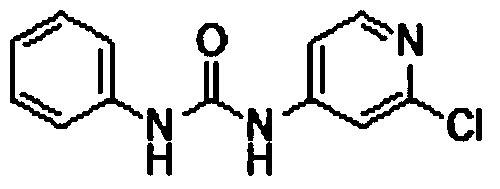
Figure 1 
Figure 2 
Figure 3
Abstract
Description
technical field
[0001] The invention relates to a preparation method of a crop growth regulator, in particular to a phenylurea-type cytokinin high-efficiency plant production regulator pyridinephenylurea, whose chemical name is 1-(2-chloro-4-pyridyl )-3-phenylurea preparation method. Background technique
[0002] A kind of 1-(2-chloro-4-pyridyl)-3-phenylurea (also known as forchlorfenuron, steryou, pyroxuron, CPPU, KT-30 or 4PU-30) of the present invention, its The molecular structure is:
[0003]
[0004] It is a new type of high-activity plant growth regulator, with high-activity phenylurea cytokinin substances, which can promote plant growth, early maturity, delay the aging of leaves in the later stage of crops, and increase production. Since 1981, the Faculty of Pharmacy, University of Tokyo, Japan Since Okamoto, Shouto and others discovered its high cell division activity, chemists from various countries have carried out in-depth synthesis research and application ...
Examples
preparation example Construction
[0034] Its specific preparation method steps are as follows:
[0035] (1) Using aniline and phenyl chloroformate as raw materials, potassium carbonate, sodium carbonate, triethylamine, pyridine, N,N-dimethylaniline, 4-dimethylaminopyridine (DMAP), N,N-di Isopropylethylamine, 1,4-diazabicyclo[2.2.2]octane (DABCO), substituted pyridine and other inorganic bases or organic bases are used as an acid agent, with toluene, xylene, chlorine Benzene, tetrahydrofuran (THF), N,N-dimethylformamide (DMF), dimethyl sulfoxide (DMSO), dioxane, acetonitrile, ethylene glycol dimethyl ether, ethylene glycol diethyl ether, acetic acid One of ethyl ester, acetone, methyl ethyl ketone, dichloromethane, and chloroform is used as solvent A; dissolve aniline and acid agent in solvent A, and then add phenyl chloroformate, at -5-80 ° C, preferably Stir the reaction at a temperature of 0-60°C, monitor the completion of the reaction by liquid phase tracking, distill a part of the solvent under reduced pr...
Synthetic example 1
[0039] (1) Dissolve 28.1g of aniline and 33.5g of triethylamine in 400mL of butanone, then add 51.5g of phenyl chloroformate, stir the reaction at 40°C, monitor the completion of the reaction by liquid phase tracking, and distill under reduced pressure Part of the solvent was removed, and a white solid was precipitated, which was filtered to obtain 62.7 g of phenyl aniline carbamate, with a content of 99%.
[0040] (2) Add 25.6g of 2-chloro-4-aminopyridine, 43g of phenyl anilate, and 2.1g of N,N-diisopropylethylamine into 300mL of THF solution, and after the reflux reaction is complete , After THF was distilled under reduced pressure, an appropriate amount of water was added and stirred for 0.5 hours, and filtered under reduced pressure to obtain 47.9 g of white solid CPPU with a content of 98.8%.
Synthetic example 2
[0042] (1) Dissolve 28.1g of aniline and 26.3g of pyridine in 400mL of toluene, then add 51.5g of phenyl chloroformate, stir the reaction at 30°C, monitor the completion of the reaction by liquid phase tracking, and distill a part of the solvent under reduced pressure. A white solid was precipitated and filtered to obtain 62.8 g of phenyl 2-chloro-pyridine-4-carbamate, with a content of 99.1%.
[0043](2) Add 25.6g of 2-chloro-4-amino-pyridine, 43g of phenyl anilate, and 2.4g of DMAP into 300Ml of DMF solution, stir the reaction at 80°C, and add after the reaction is complete Appropriate amount of water precipitated solid, and filtered under reduced pressure to obtain 48 g of white solid CPPU, with a content of 99.0%.