

A kind of anti-ultraviolet treatment agent based on disperse dye modification and preparation method thereof
A technology of disperse dyes and treatment agents, applied in the direction of nitro/nitroso dyes, amino-hydroxyanthraquinone dyes, anthracene dyes, etc., can solve the problems of fiber initial strength decline, spinneret hole clogging, and failure to meet the use requirements, etc. , to achieve a high affinity effect
Patent Information
- Authority / Receiving Office
- CN · China
- Patent Type
- Patents(China)
- Current Assignee / Owner
- Publication Date
- 2019-06-28
Smart Images
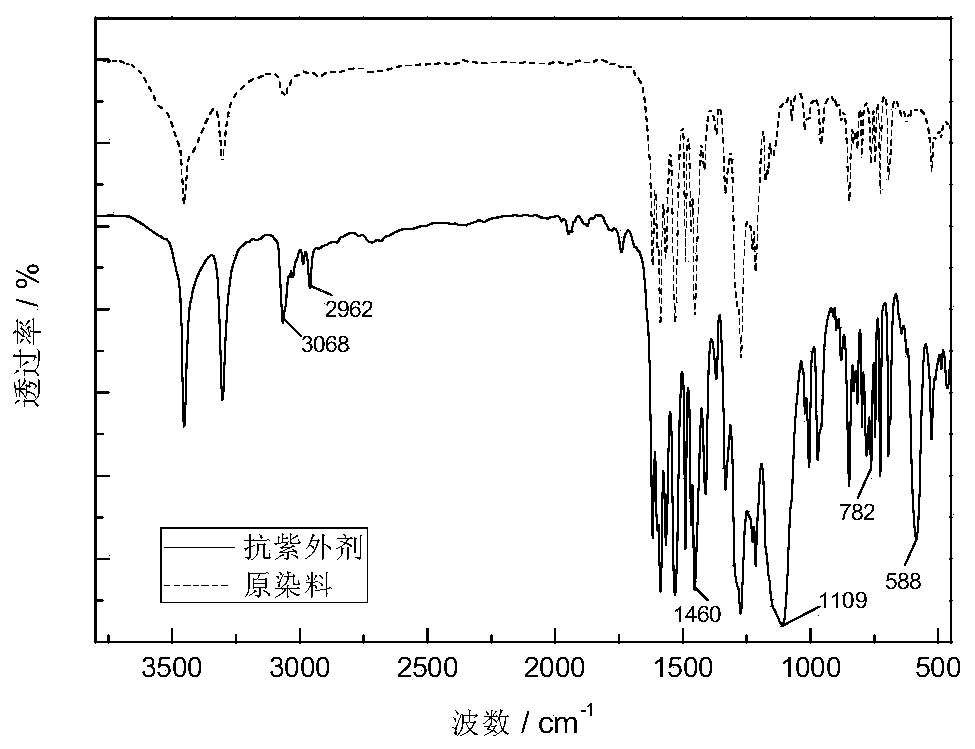
Figure 1 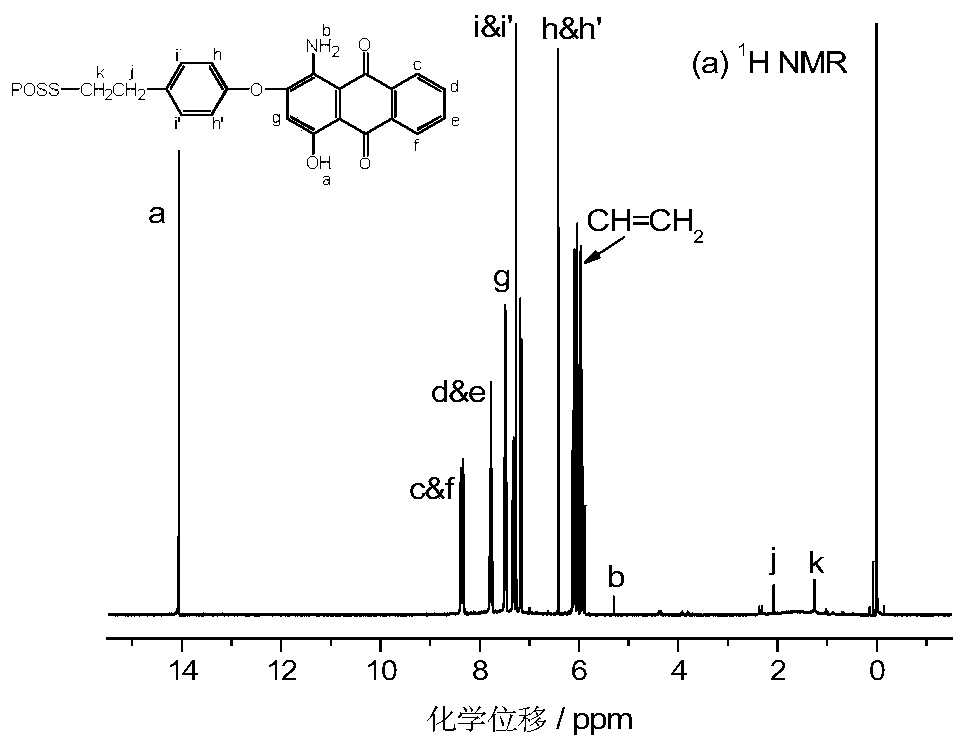
Figure 2 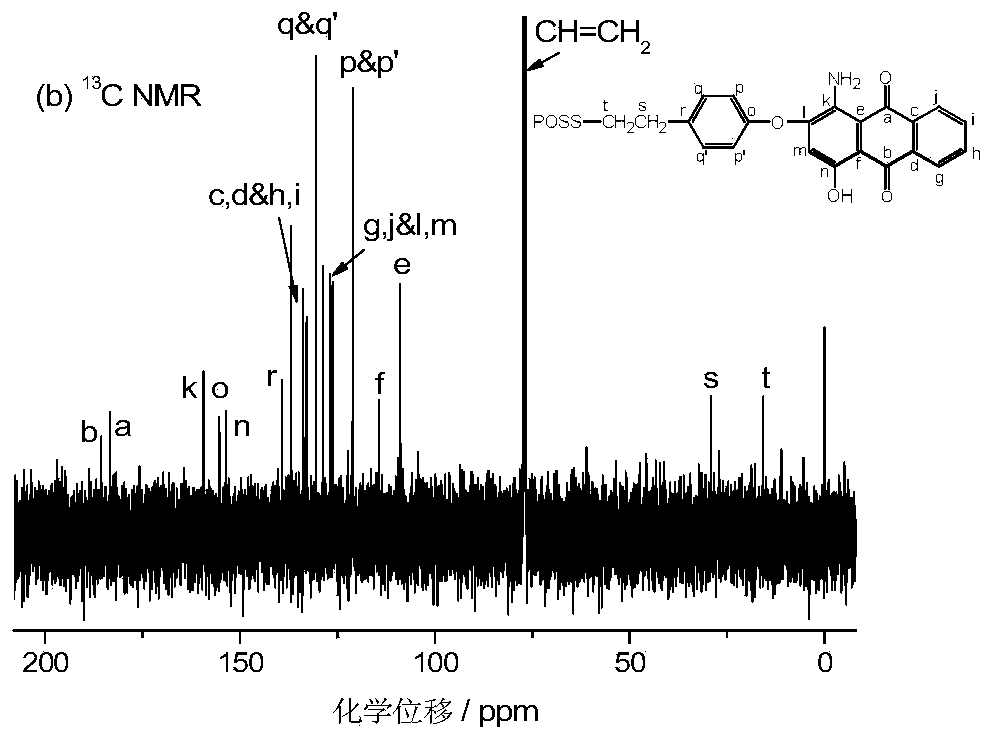
Figure 3
Abstract
Description
technical field
[0001] The invention belongs to the technical field of an anti-ultraviolet agent treatment agent and its preparation, in particular to an anti-ultraviolet treatment agent based on disperse dye modification and a preparation method thereof. Background technique
[0002] Aromatic high-performance fibers such as wholly aromatic polyamide (aramid) and polyparaphenylene 1,3,4-oxadiazole (p-POD) have excellent physical and mechanical, thermal stability, electrical insulation, Solvent resistance, special electrical conductivity and electroluminescence properties are often used as high temperature resistant filter cloths, permeable membranes and insulating protective materials (Zhang Z, Ye G, Li W, Li T, Xu J. Influence of sulfuric acid bath on morphological structure and mechanicalproperties of poly(p-phenylene-1,3,4-oxadiazole)fibers[J].Journal of AppliedPolymer Science,2009,114(3):1485-1493;Schulz B, Bruma M, Brehmer L. AromaticPoly(1,3,4-Oxadiazoe)s as Advanced ...
Examples
Embodiment 1
[0035] Mix 0.3 part of octavinyl silsesquioxane, 0.3 part of octapropenyl silsesquioxane and 0.8 part of disperse red 60 dye, which are respectively ground into powders with a particle size of 0.5-1 μm, under nitrogen atmosphere, together with 0.15 part of Parts of anhydrous aluminum chloride were added together in 60 parts of carbon disulfide and 60 parts of carbon tetrachloride and stirred until fully dissolved, then heated to the boiling point of the mixed solvent, and the reaction was kept under reflux for 24 hours; after the heating was stopped, the mixed solution was cooled to 0 with ice water. ℃, then add 0.4 parts of triethylamine and 0.3 parts of diethylamine mixture and stir evenly, filter under reduced pressure to remove insoluble catalyst, and remove the solvent from the filtrate under reduced pressure to obtain a crude product of anti-ultraviolet treatment agent; add 250 parts of the crude product to the In dichloromethane, reflux extraction is performed in a Soxhl...
Embodiment 2
[0038] Mix 0.6 parts of octapropenyl silsesquioxane and 1.2 parts of disperse red 60 dye, respectively ground into powders with a particle size of 0.5-1 μm, and add 60 parts of benzene together with 0.15 parts of anhydrous ferric chloride under nitrogen atmosphere. Stir in medium until fully dissolved, then heat up to the boiling point of the mixed solvent, keep warm and reflux for 30 hours; after stopping heating, cool the mixture to 2°C with ice water, then add 1.9 parts of diethylamine, stir evenly, filter under reduced pressure, remove Insoluble catalyst, the filtrate was evaporated under reduced pressure to remove the solvent to obtain the crude product of anti-ultraviolet treatment agent; the crude product was added to 65 parts of methylene chloride and 65 parts of toluene, refluxed in a Soxhlet extractor for 30 hours, and then filtered under reduced pressure, The undissolved original dye is removed, and finally the filtrate is distilled under reduced pressure to obtain a...
Embodiment 3
[0041] Mix 0.6 parts of octabutenyl silsesquioxane and 3.2 parts of disperse yellow 42 dye, which are respectively ground into powders with a particle size of 0.5-1 μm, together with 0.22 parts of anhydrous ferric chloride and 0.23 parts of anhydrous under nitrogen atmosphere. Magnesium chloride was added to 300 parts of carbon disulfide and 200 parts of benzene and stirred until fully dissolved, then heated to the boiling point of the mixed solvent, and the reaction was kept under reflux for 18 hours; after the heating was stopped, the mixture was cooled to 4°C with ice water, and then 1.5 parts of diethyl The mixture of amine and 1.5 parts of dichloromethane was stirred evenly, filtered under reduced pressure to remove the insoluble catalyst, and the filtrate was distilled under reduced pressure to remove the solvent to obtain a crude product of anti-ultraviolet treatment agent; the crude product was added to 450 parts of dichloromethane and 340 parts of trichloromethane In m...