
Polysubstituted nitrogen-containing heteroaromatic compound, and preparation method and application thereof
A technology for aromatic heterocycles and compounds, applied in the field of multi-substituted nitrogen-containing aromatic heterocycles and their preparation, can solve the problems of insufficient fluorescence properties of compounds, inability to construct pyridinamine at one time, poor atom economy, etc.
Patent Information
- Authority / Receiving Office
- CN · China
- Current Assignee / Owner
- Publication Date
- 2019-09-06
Smart Images
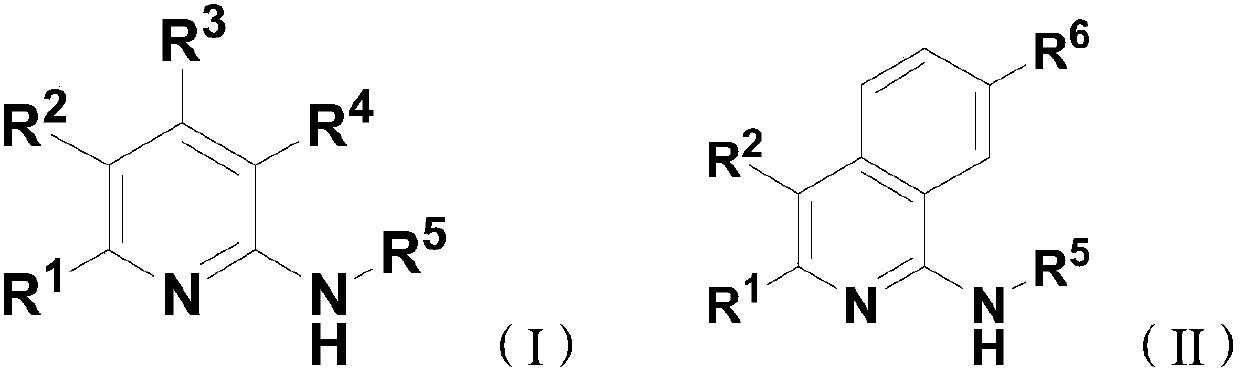
Figure 1 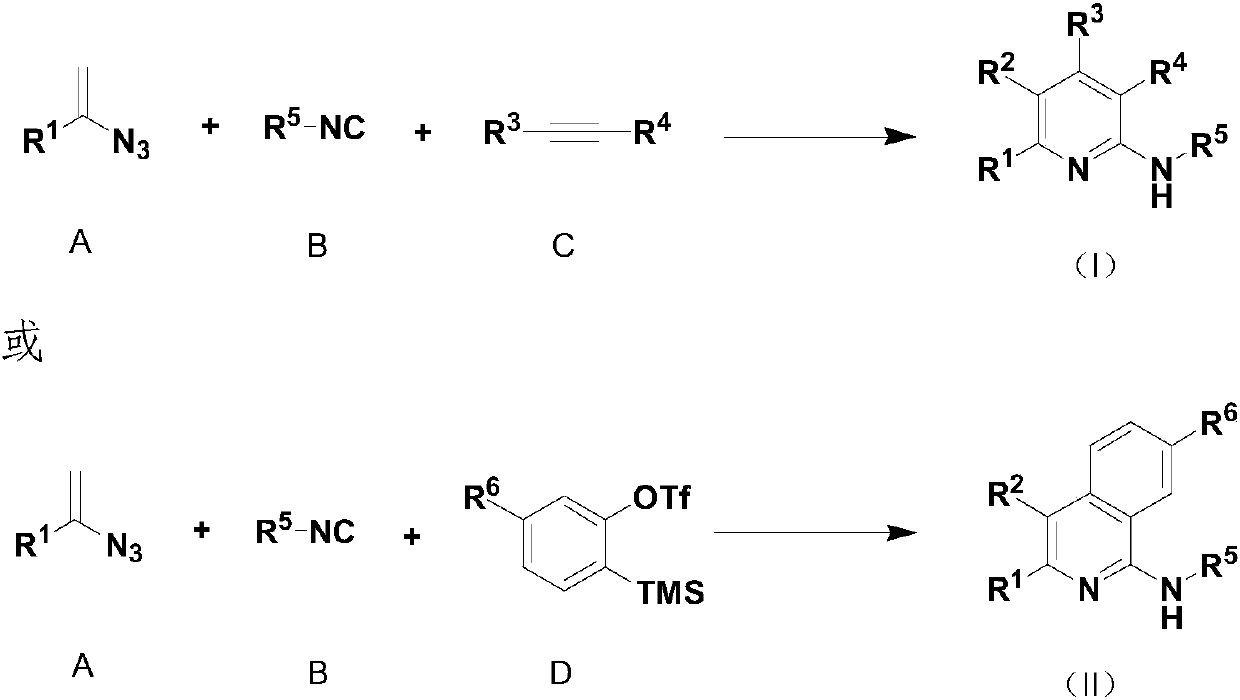
Figure 2 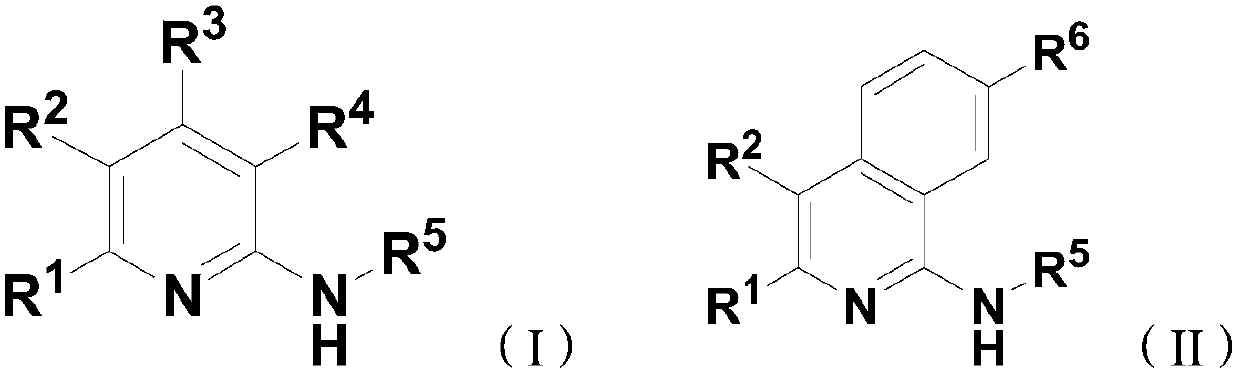
Figure 3
Abstract
Description
technical field
[0001] The invention relates to the field of organic synthesis, in particular to a multi-substituted nitrogen-containing aromatic heterocyclic compound and its preparation method and application. Background technique
[0002] Fluorescent molecular labeling detection technology is an efficient and fast detection method in biological detection and small molecule detection. Due to the difference in the fluorescence emission wavelength of each marker, different substances and different sites can be simultaneously labeled to achieve high throughput. Therefore, it is particularly important for the development of more fluorescently labeled molecules and the development of synthetic methods. Aminopyridine has a high fluorescence conversion rate (=0.6), and the advantages of simple and stable molecular structure. The light conversion rate can be further improved by modifying its structure with functional groups, and its absorption and emission wavelengths can be adjus...
Examples
Embodiment 1
[0050] This embodiment provides a new compound 2-tert-butylamino-6-phenylpyridine-3,4-dicarboxylic acid ethyl ester, its molecular formula is: C 21 h 26 N 2 o 4 , whose structure is:
[0051]
[0052] The compound is synthesized through the following specific steps:
[0053] Add {Rh(COD)Cl}2 (2mg, 0.0038mmol) and 2,2'-bipyridine (1mg, 0.0075mmol), 1,4-dioxane (2ml) in sequence to a 5ml reaction tube, and stir for 5min Afterwards, (1-azidovinyl)benzene (22mg, 0.15mmol) and tert-butylisonitrile (13mg, 17uL, 0.2mmol) were added using a syringe, and reacted at room temperature for 5h. After the reaction was complete, diethyl butynoate (51mg, 48uL, 0.3mmol) was added with a syringe, heated to 120°C for 5h, and TLC detected the complete reaction. The solvent was concentrated under reduced pressure, and the residue was separated and purified by flash column chromatography (petroleum ether: ethyl acetate = 50:1) to obtain 40 mg of a yellow-green solid with a yield of 71%.
[...
Embodiment 2
[0061] Prepare brand-new compound C according to the method described in Example 1 22 h 28 N 2 o 4, the product yield is 60%; the compound structural formula is:
[0062]
[0063] Characterization data for the obtained compounds include:
[0064] 1 H NMR (400MHz, CDCl 3 )δ7.99–7.91(m,3H),7.32–7.21(m,2H),6.94(s,1H),4.42–4.23(m,4H),2.41(s,3H),1.56(s,9H) ,1.42–1.30(m,6H).
[0065] 13 C NMR(101MHz,cdcl3)δ169.17,167.10,159.30,157.88,145.90,140.25,135.79,129.51,127.32,105.53,100.73,61.80,61.36,51.82,29.32,21.52,144.167
[0066] IR (neat) 2954.64, 1737.67, 1686.74, 1558.48, 1369.89, 1289.68, 1182.11, 1044.46.
[0067] HRMS(ESI+)calcd for C 22 h 29 N 2 o 4 :385.2127,found:385.2108.
Embodiment 3
[0069] Prepare brand-new compound C according to the method described in Example 1 22 h 28 N 2 o 4 , the product yield is 68%; the compound structural formula is:
[0070]
[0071] Characterization data for the obtained compounds include:
[0072] 1 H NMR (400MHz, CDCl 3 )δ7.97(s,1H),7.89–7.83(m,2H),7.39–7.33(m,1H),7.25(d,J=6.4Hz,1H),6.96(s,1H),4.36(q ,J=7.2Hz,2H),4.30(q,J=7.2Hz,2H),2.43(s,3H),1.56(s,9H),1.38(t,J=7.2Hz,3H),1.34(t ,3H).
[0073] 13 C NMR (75MHz, CDCl3) δ169.12, 167.09, 159.45, 157.85, 145.89, 138.52, 138.28, 130.77, 128.68, 128.05, 124.59, 105.88, 101.00, 61.80, 61.39, 51.812, 24.14, 29.3
[0074] IR (neat) 2917.53, 1737.76, 1686.83, 1559.92, 1369.89, 1255.88, 1229.12, 1178.37.
[0075] HRMS(ESI+)calcd for C 22 h 29 N 2 o 4 :385.2127,found:385.2112.