
A method for the comprehensive recovery of all elements by roasting biomass to reduce oceanic cobalt-rich crusts
A technology for cobalt-rich crusts and biomass, applied in the direction of improving process efficiency, can solve the problems of slow reduction rate of oceanic cobalt-rich crusts and high energy consumption for roasting, and achieve the effects of improving metal leaching rate and reducing rate.
Patent Information
- Authority / Receiving Office
- CN · China
- Patent Type
- Patents(China)
- Current Assignee / Owner
- Publication Date
- 2021-12-21
Smart Images
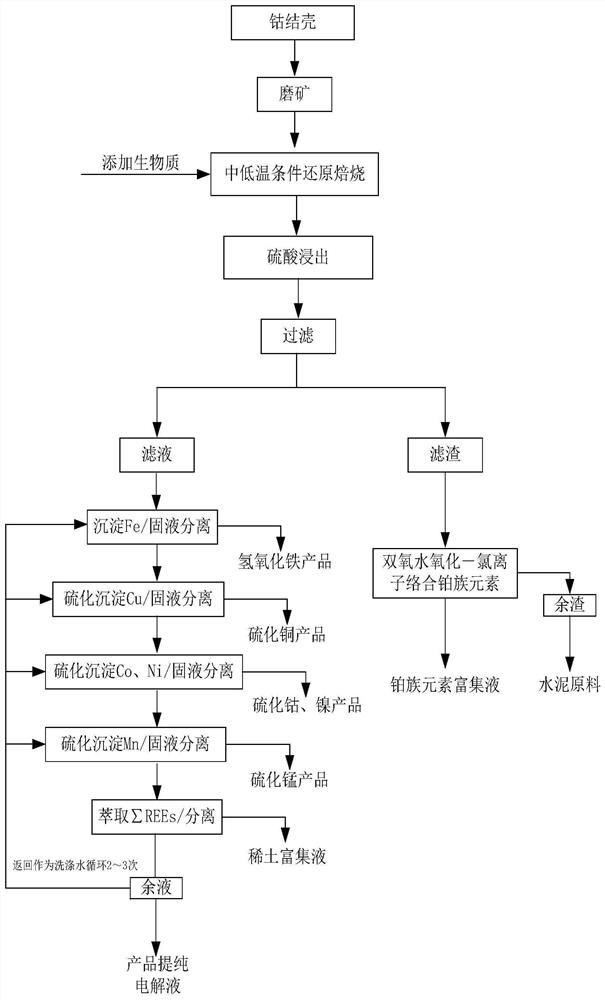
Figure 1 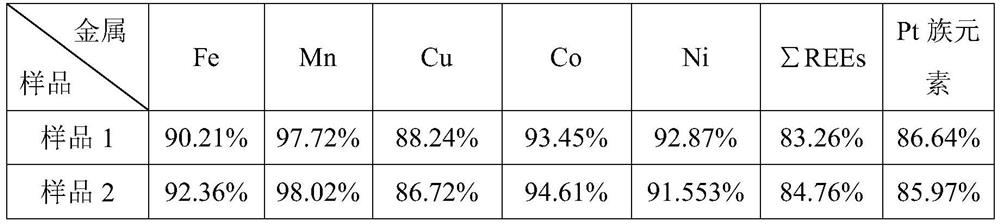
Figure 2
Abstract
Description
technical field
[0001] The invention belongs to the field of utilization of seabed mineral resources, and discloses a method for comprehensively recovering all elements by roasting biomass to reduce oceanic cobalt-rich crusts. Background technique
[0002] Cobalt-rich crusts, also known as cobalt crusts and iron-manganese crusts, are crust-like iron-manganese oxides and hydroxides that grow on the surface of seabed rocks or debris. Because it is rich in cobalt, it is called cobalt-rich crust. It is mainly produced on the tops and slopes of seamounts and sea platforms with a water depth of 800-3000 meters. The bases on which it grows include basalt, glass clastic basalt and montmorillonite rock. Cobalt-rich crusts are widely distributed in the ocean, and are distributed on the seabeds of the Pacific Ocean, the Atlantic Ocean, and the Indian Ocean. The exit area mainly includes several large seamount chains such as Magellan Seamount, Marcus-Wake Seamount, Marshall Seamount, ...
Examples
Embodiment 1
[0070] Such as figure 1 Shown, a kind of biomass roasting reduction oceanic cobalt-rich crust comprehensively recovers the method for all elements, comprising the following steps:
[0071] Step 1. Dry-grind the oceanic cobalt-rich crust until -200 mesh accounts for more than 90%;
[0072] Step 2. Mix the fine-grained cobalt-rich crusts obtained in step 1 with 15% to 20% of dried biomass, and roast in a roasting device at 450 to 500°C for 6 to 10 minutes. Nitrogen gas is introduced at a certain flow rate during the roasting process. Prevent oxidation of reduced products;
[0073] Step 3, leaching the roasted slag obtained by pyrolysis of step 2 at room temperature, in a sulfuric acid solution with a liquid-solid ratio of 3:1 to 5:1, and a sulfuric acid concentration of 1.0 to 1.4 mol / L, at a stirring speed of 300 to 400 rpm / min for 40 Filter after ~60min;
[0074] Step 4, adjust the pH value of the filtrate obtained in step 2 with 0.1mol / L NaOH solution to be 2 to 3.2, after...
Embodiment 2
[0082] A method for comprehensively recovering all elements by roasting biomass to reduce oceanic cobalt-rich crusts. The samples of cobalt-rich crusts from two different stations on the ocean floor are respectively taken, and experiments are carried out according to the method described in Example 1.
[0083] Grind samples 1 and 2 to -200 mesh, accounting for more than 90%, and dry them for later use, and dry the sawdust for later use. Samples 1 and 2 were mixed evenly with 15% dried sawdust, and roasted in a roasting device at 4500°C for 60 minutes. Nitrogen gas was introduced at a certain flow rate during the roasting process to prevent the reduction products from being oxidized.
[0084] The roasted slag was leached for 40 minutes at room temperature, in a sulfuric acid solution with a liquid-solid mass ratio of 3:1 and a sulfuric acid concentration of 1.0 mol / L, and filtered at a stirring speed of 350 rpm / min for 40 minutes to obtain filtrate 1 and filter residue 1. The f...