

Method for recycling silver and gold from silver and gold containing anode sludge
A technology of anode slime and reaction, applied in the direction of improving process efficiency, etc., can solve the problems of high energy consumption and harsh recovery conditions
Patent Information
- Authority / Receiving Office
- CN · China
- Patent Type
- Applications(China)
- Current Assignee / Owner
- Publication Date
- 2021-04-20
Smart Images

Figure 1 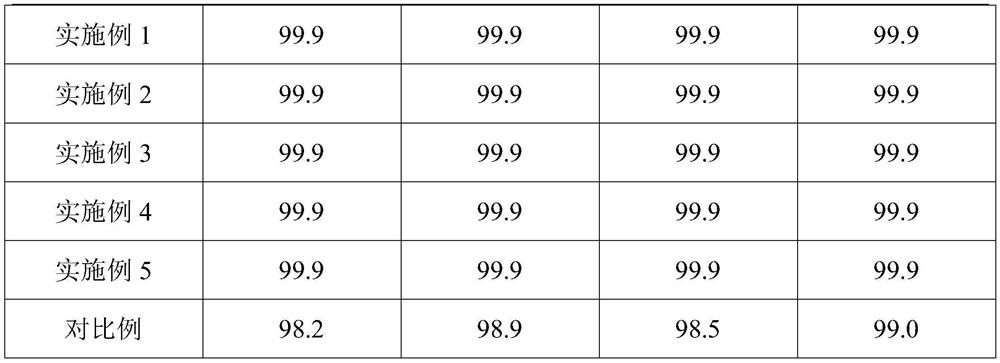
Figure 2
Abstract
Description
Technical field:
[0001] The invention relates to the field of metal recovery, in particular to a method for recovering silver and gold from anode slime containing silver and gold Background technique:
[0002] In the electrolytic refining or electrolytic extraction of soluble anodes, in addition to the main metal, the anode also contains a small or trace amount of other metals or elements, which exist in the anode in the form of simple substances, alloys or compounds. When the anode is polarized, these metals or elements become anode slime due to the following reasons: (1) its equilibrium potential is positive to the anode potential, so it cannot be ionized into the electrolyte; (2) although it can be ionized into the In the electrolyte, but immediately form an insoluble salt with the electrolyte and precipitate from the electrolyte; (3) Partial oxidation forms an insoluble compound or elemental element. The generated anode slime exists in the form of dispersed fine-grained...
Examples
Embodiment 1
[0026] (1) After grinding the anode slime with absolute ethanol, dry it, and slowly add the obtained powder into aqua regia, the mass ratio of aqua regia to anode slime is 1:2, stir and dissolve at 35°C and 1000rpm for 1 hour; finally carry out Filter to obtain filtrate and solid residue;
[0027] (2) Add 0.5g of zirconium chloride and 0.5g of 2-aminoterephthalic acid into 100ml of DMF and stir until the solid dissolves, then add 2ml of acetic acid, perform ultrasonic treatment, and finally heat and stir in an oil bath at 100°C and 1000rpm for reaction After 3h, cool to room temperature after the reaction, and filter the reaction solution, wash and dry the obtained solid to obtain an amino-modified Zr-MOF material with an average particle size of 50±5nm and a specific surface area of 1045.5m 2 / g;
[0028] (3) The filtrate obtained above is added to an adsorption column loaded with an amino-modified Zr-MOF material, and multi-stage cyclic adsorption treatment is carried out...
Embodiment 2
[0032] (1) After grinding the anode slime with absolute ethanol, dry it, and slowly add the obtained powder into aqua regia, the mass ratio of aqua regia to anode slime is 1:4, stir and dissolve at 55°C and 1500rpm for 3 hours; finally carry out Filter to obtain filtrate and solid residue;
[0033] (2) Add 1g of zirconium chloride and 0.8g of 2-aminoterephthalic acid into 100ml of DMF and stir until the solid dissolves, then add 5ml of acetic acid, perform ultrasonic treatment, and finally heat and stir in an oil bath at 100°C and 1500rpm to react 3 -7h, cool to room temperature after the reaction, and filter the reaction solution, wash and dry the obtained solid to obtain an amino-modified Zr-MOF material; the average particle size is 50±5nm, and the specific surface area is 1046.3m 2 / g;
[0034] (3) The filtrate obtained above is added to an adsorption column loaded with an amino-modified Zr-MOF material, and multi-stage cyclic adsorption treatment is carried out until no ...
Embodiment 3
[0038] (1) After grinding the anode slime with absolute ethanol, dry it, and slowly add the obtained powder into aqua regia, the mass ratio of aqua regia to anode slime is 1:3, stir and dissolve at 40°C and 1200pm for 2 hours; finally carry out Filter to obtain filtrate and solid residue;
[0039] (2) Add 0.8g of zirconium chloride and 0.6g of 2-aminoterephthalic acid into 100ml of DMF and stir until the solid dissolves, then add 3ml of acetic acid, ultrasonically treat, and finally heat and stir in an oil bath at 100°C and 1500pm for reaction After 5h, cool to room temperature after the reaction, and filter the reaction solution, wash and dry the obtained solid to obtain an amino-modified Zr-MOF material; the average particle size is 50±5nm, and the specific surface area is 1045.8m 2 / g;
[0040] (3) The filtrate obtained above is added to an adsorption column loaded with an amino-modified Zr-MOF material, and multi-stage cyclic adsorption treatment is carried out until no g...