
Organic electroluminescent device
An electroluminescent element and electroluminescent technology, applied in electrical elements, luminescent materials, organic chemistry, etc., can solve problems such as insufficient, low driving voltage luminous efficiency, and reduced element characteristics.
Patent Information
- Authority / Receiving Office
- CN · China
- Patent Type
- Applications(China)
- Current Assignee / Owner
- Publication Date
- 2021-09-14
Smart Images
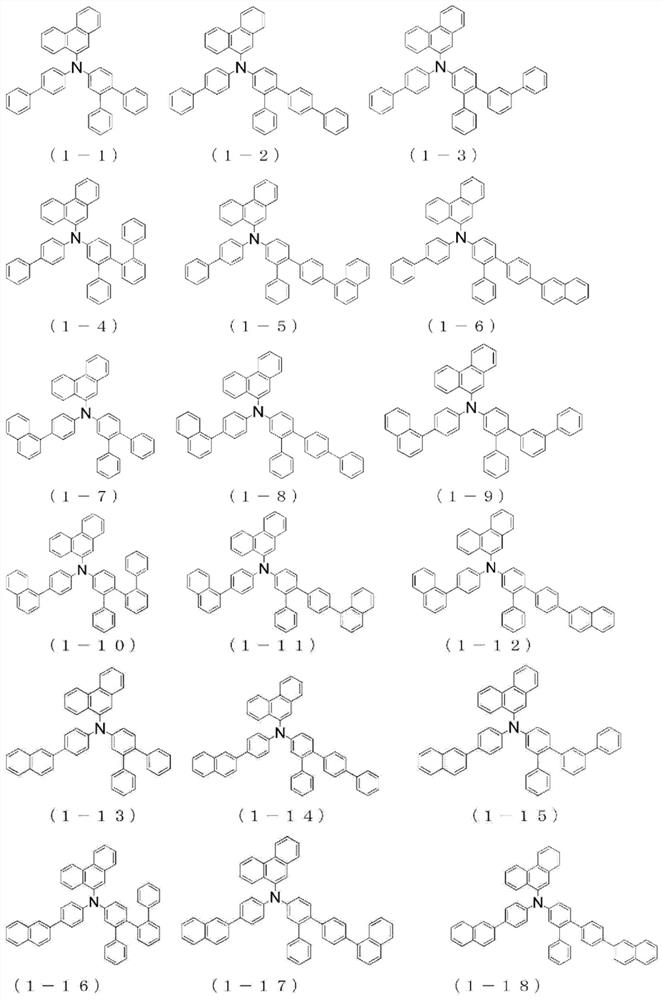
Figure 1 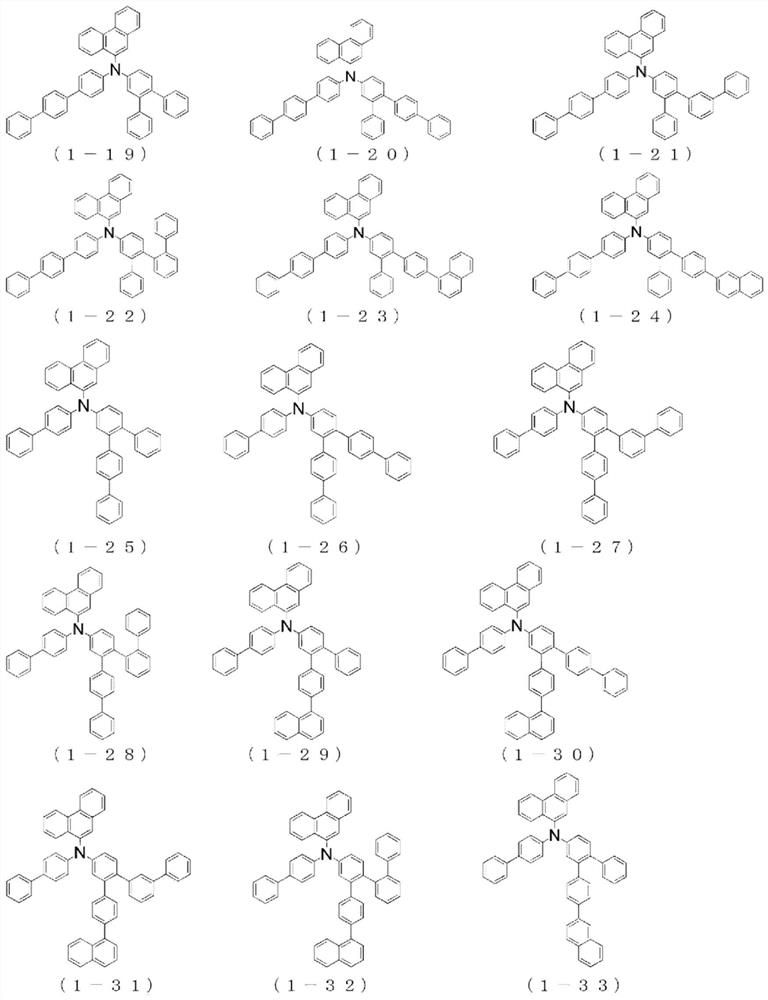
Figure 2 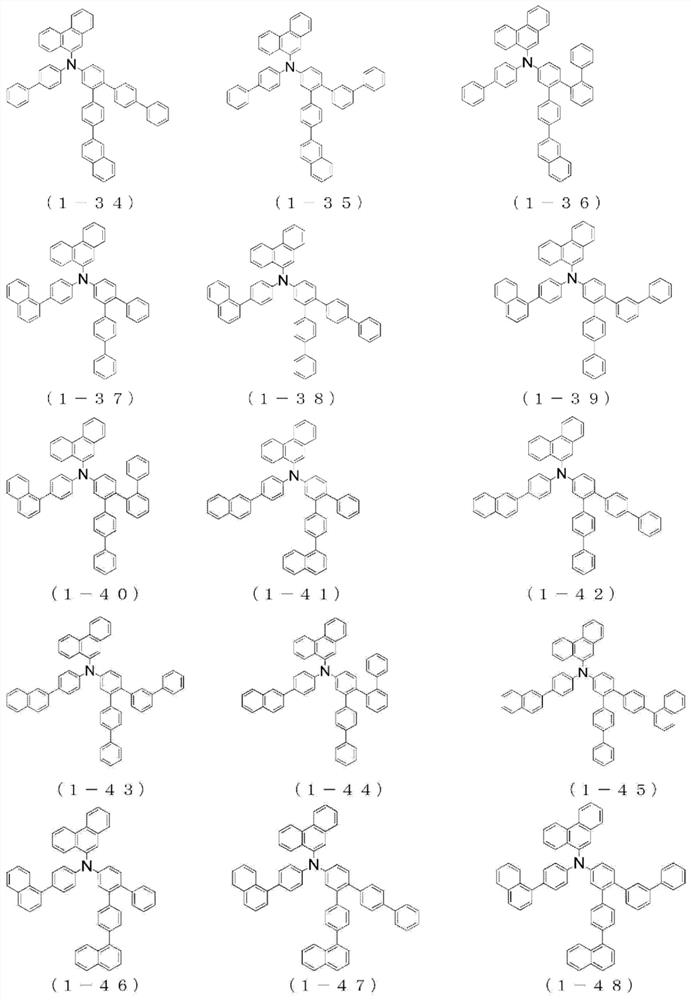
Figure 3
Abstract
Description
technical field
[0001] The present invention relates to an organic electroluminescent element as a self-luminescent element suitable for various display devices, and in detail, relates to an organic electroluminescent element (hereinafter, simply referred to as an organic EL element) using a specific arylamine compound. . Background technique
[0002] Since the organic EL element is a self-luminous element, it is brighter than a liquid crystal element, has excellent visibility, and can realize a clear display, so it has been actively studied.
[0003] In 1987, C.W.Tang of Eastman Kodak Company developed a laminated structural element in which each material shared various functions, thus making the organic EL element using organic materials a practical element. They laminated a phosphor capable of transporting electrons and an organic substance capable of transporting holes, injected the charges of the two into the phosphor layer to make it emit light, and obtained 1000 cd / m...
Examples
Embodiment 1
[0227]
[0228] 22.4 g of 4-(naphthalen-1-yl)aniline, 19.8 g of 3-bromobiphenyl, 12.2 g of sodium tert-butoxide, and 230 mL of toluene were added to a nitrogen-substituted reaction vessel, and nitrogen gas was blown in while irradiating ultrasonic waves for 30 minutes. 0.8 g of tris(dibenzylideneacetone)dipalladium and 0.5 g of 2,2'-bis(diphenylphosphine)-1,1'-binaphthyl were added, heated, and stirred at 110°C for 16 hours. After removing insoluble matter by filtration, the filtrate was concentrated. The residue was purified by column chromatography to obtain 25.4 g (yield 75.6%) of 4-(naphthalen-1-yl)phenyl-biphenyl-3-amine as a light yellow viscous substance.
[0229] 23.9 g of 4-(naphthalen-1-yl)phenyl-biphenyl-3-amine and 240 mL of dimethylformamide were added to the nitrogen-substituted reaction vessel, and cooled in an ice bath. 11.6 g of N-bromosuccinimide was added in portions over 30 minutes, followed by stirring at 5° C. for 4 hours. Water was added, extracted w...
Embodiment 2
[0238]
[0239] Add (1,1':2',1"-terphenyl-4'-yl)amine 17.2g, 2-(4-bromophenyl)naphthalene 18.0g, tert-butoxy Sodium 9.2g, toluene 270mL, while irradiating ultrasonic waves for 30 minutes, pass nitrogen gas. Add tris(dibenzylideneacetone) dipalladium 1.2g, 2,2'-bis(diphenylphosphine)-1,1'-bis 0.8 g of naphthalene was heated and stirred at 110° C. for 16 hours. After removing the insolubles by filtration, the filtrate was heated, and at 80° C., adsorption purification using activated clay and silica gel was carried out, and heating and filtration was carried out. The filtrate was concentrated and passed through toluene-heptyl The residue was purified by recrystallization in alkanes to obtain {4-(naphthalene-2-yl)phenyl}-(1,1':2',1"-terphenyl-5'-yl)amine as a yellow-white powder Body 24.3g (yield 85.4%).
[0240] Add 24.3 g of {4-(naphthalene-2-yl)phenyl}-(1,1':2',1"-terphenyl-5'-yl)amine, 9-bromo 15.4g of phenanthrene, 10.4g of sodium tert-butoxide, 240mL of toluene, while i...
Embodiment 3
[0247]
[0248] The {4"-(naphthalene-1-yl)-1,1':2',1"-terphenyl-5'-yl}-{4-(naphthalene-1-yl)phenyl group of Example 1 } amine to {4"-(naphthalen-1-yl)-1,1':2',1"-terphenyl-5'-yl}-{4-(naphthalen-2-yl)phenyl} Amines, the same procedure was performed to give {4-(naphthalene-2-yl)phenyl}-(phenanthrene-9-yl)-{4"-(naphthalene-1-yl)-1,1':2', 4.9 g of white powder of 1"-terphenyl-5'-yl}amine (compound 1-17) (yield 40%).
[0249] The structure of the obtained white powder was identified using NMR.
[0250] use 1 H-NMR (CDCl 3 ) detected the following 39 hydrogen signals.
[0251] δ(ppm)=8.76-8.86(2H), 8.24-8.28(1H), 8.06(1H), 7.85-7.95(8H), 7.36-7.78(19H), 7.19-7.31(8H).
[0252] [chem 21]
[0253]