
Compound having pyrimidine ring structure and organic electroluminescent element
A technology of pyrimidine ring and compound, which is applied in the field of compounds with pyrimidine ring structure and organic electroluminescence elements, can solve the problems of insufficient film stability, insufficient hole blocking function, and inability to fully exert the function, etc.
Patent Information
- Authority / Receiving Office
- CN · China
- Patent Type
- Applications(China)
- Current Assignee / Owner
- Publication Date
- 2020-05-01
Smart Images
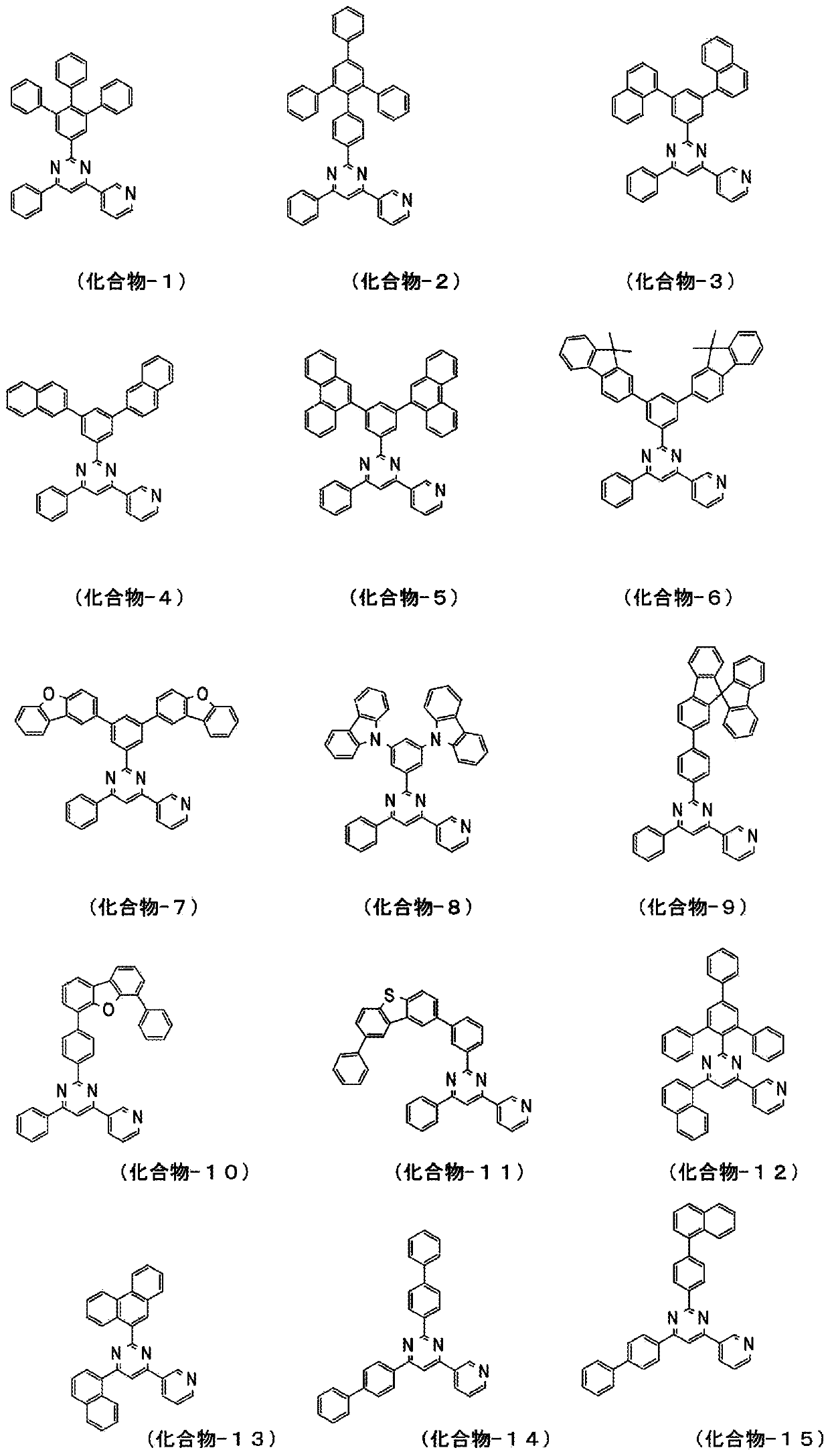
Figure 1 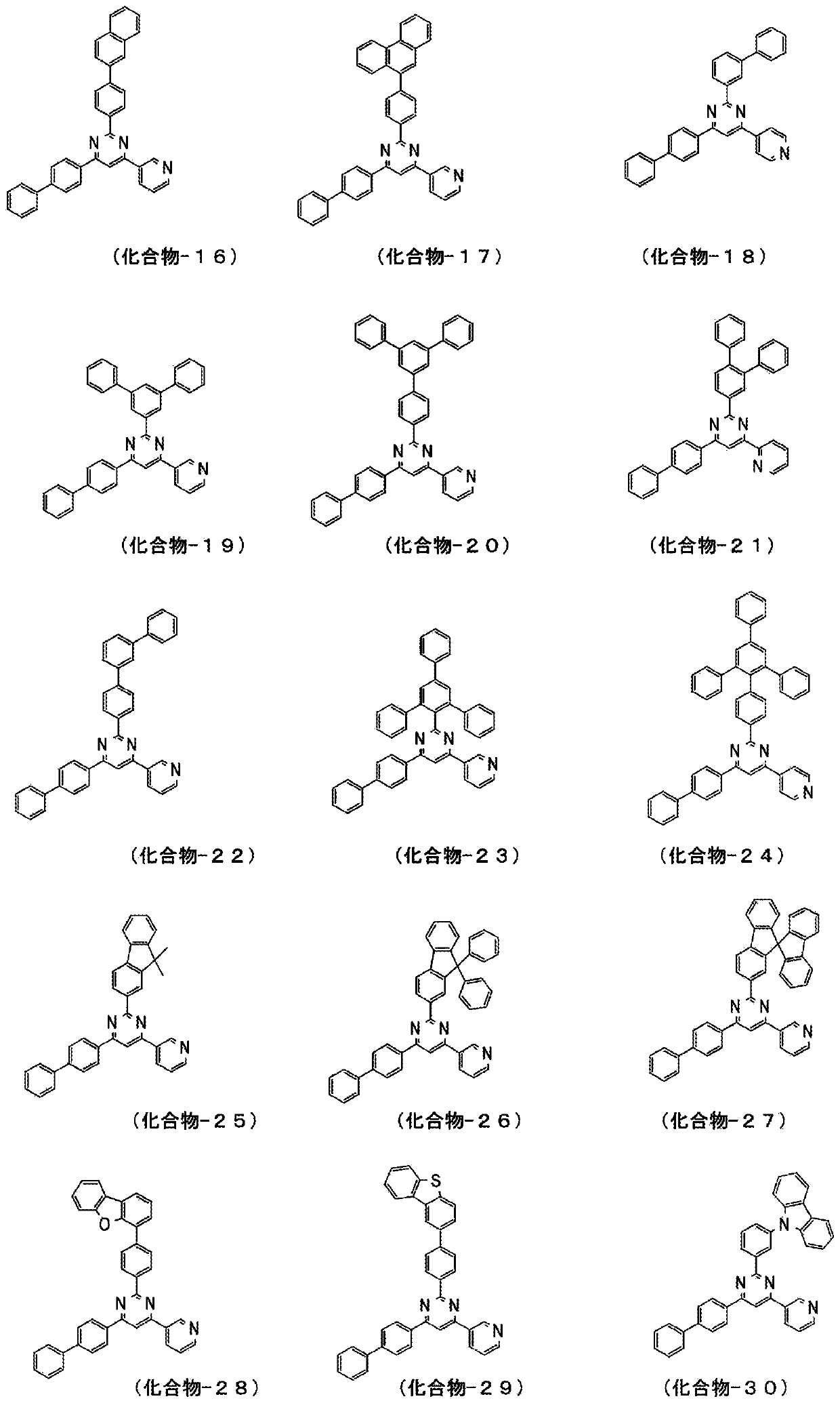
Figure 2 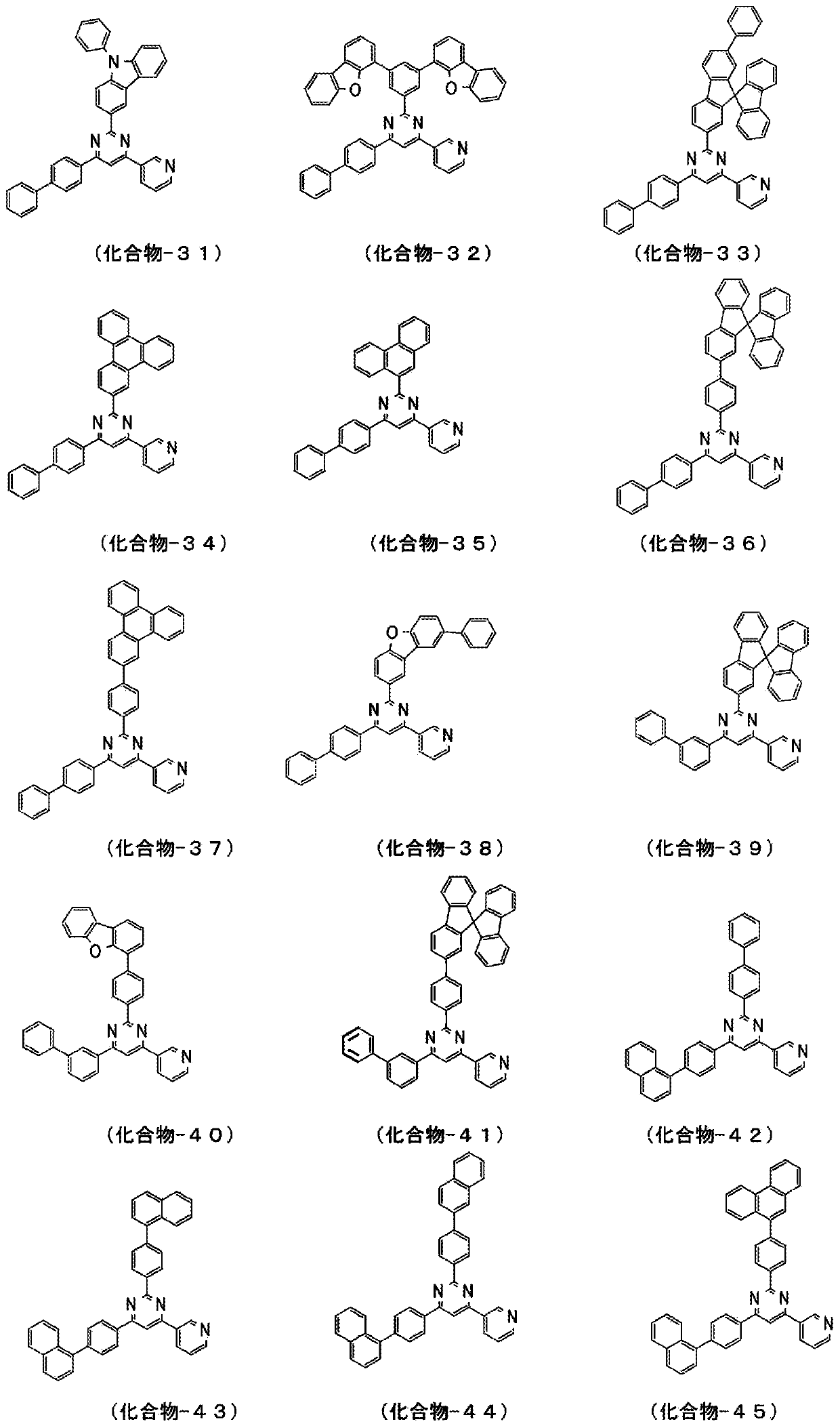
Figure 3
Abstract
Description
technical field
[0001] The present invention relates to compounds and elements suitable for use in organic electroluminescence elements (hereinafter simply referred to as organic EL elements) as self-luminous elements suitable for various display devices. Specifically, it relates to compounds having a pyrimidine ring structure and using Organic EL elements of this compound. Background technique
[0002] Since the organic EL element is a self-luminous element, it is brighter than a liquid crystal element, has excellent visibility, and can perform a clear display, so active research has been conducted.
[0003] In 1987, C.W.Tang and others from Eastman Kodak developed a layered structure device in which various functions are distributed to each material, thus making the organic EL device using organic materials a practical device. . They layered a phosphor capable of transporting electrons and an organic substance capable of transporting holes, and injected the charges of th...
Examples
Embodiment 1
[0119]
[0120] 6-(biphenyl-4-yl)-2-chloro-4-(pyridin-3-yl)-pyrimidine: 7.5 g, 4-(phenanthrene-9-yl)-phenylboronic acid: 7.2g, four (triphenylphosphine) palladium (0): 0.5g, potassium carbonate: 6.0g, in toluene, ethanol, H 2 O mixed solvent under reflux and stirred overnight. After cooling naturally, the organic layer was extracted by a liquid separation operation, and then concentrated under reduced pressure. Purify the obtained crude product by column chromatography (carrier: silica gel, eluent: toluene / ethyl acetate) to obtain 6-(biphenyl-4-yl)-2-{4-(phenanthrene-9 White powder of -yl)-phenyl}-4-(pyridin-3-yl)-pyrimidine (compound-17): 1.5 g (yield 12%).
[0121] [chemical 6]
[0122]
[0123] The structure of the obtained white powder was identified using NMR.
[0124] use 1 H-NMR (CDCl 3 ) detected the following 27 hydrogen signals.
[0125] δ(ppm)=9.55(1H), 8.90(2H), 8.85(1H), 8.82(1H), 8.78(1H), 8.70(1H), 8.46(2H), 8.15(1H), 8.04(1H), 7.97(1H), 7.86(2H), 7...
Embodiment 2
[0127] Synthesis of
[0128] Charge 6-(biphenyl-4-yl)-2-chloro-4-(pyridin-3-yl)-pyrimidine in the reaction vessel: 5.0 g, 2-(9,9-diphenyl[9H]fluorene ) boric acid: 6.8g, tetrakis (triphenylphosphine) palladium (0): 0.3g, potassium carbonate: 2.4g, in toluene, ethanol, H 2 O mixed solvent under reflux and stirred overnight. After cooling naturally, the organic layer was extracted by a liquid separation operation, and then concentrated under reduced pressure. By purifying the obtained crude product by column chromatography (carrier: silica gel, eluent: toluene / ethyl acetate), 6-(biphenyl-4-yl)-2-(9,9-diphenyl Light gray brown powder of [9H]fluoren-2-yl)-4-(pyridin-3-yl)-pyrimidine (compound-26): 6.6 g (yield 73%).
[0129] [chemical 7]
[0130]
[0131] The structure of the obtained light gray-brown powder was identified using NMR.
[0132] use 1 H-NMR (DMSO-d6) detected the following 31 hydrogen signals.
[0133] δ(ppm)=9.63(1H), 8.81(2H), 8.77(1H), 8.69(2H), 8.58(2H...
Embodiment 3
[0135] Synthesis of
[0136] Charge 6-(biphenyl-4-yl)-2-chloro-4-(pyridin-3-yl)-pyrimidine in the reaction vessel: 7.0 g, 2-(9,9'-spirobis[9H]fluorene ) boric acid: 8.1g, tetrakis (triphenylphosphine) palladium (0): 0.5g, potassium carbonate: 3.4g, in toluene, ethanol, H 2 O mixed solvent under reflux and stirred overnight. After natural cooling, the organic layer was extracted by a liquid separation operation, and then concentrated under reduced pressure. Purify the obtained crude product by column chromatography (carrier: silica gel, eluent: dichloromethane / ethyl acetate) to obtain 6-(biphenyl-4-yl)-4-(pyridine-3- White powder of yl)-2-(9,9'-spirobis[9H]fluoren-2-yl)-pyrimidine (compound-27): 5.5 g (yield 43%).
[0137] [chemical 8]
[0138]
[0139] The structure of the obtained white powder was identified using NMR.
[0140] use 1 H-NMR (CDCl 3 ) detected the following 29 hydrogen signals.
[0141] δ(ppm)=9.37(1H), 8.85(1H), 8.75(1H), 8.46(1H), 8.26(2H), 8.06(1H)...