
Multi-wavelength pulse laser for atmospheric exploration
A pulsed laser and atmospheric detection technology, applied in lasers, laser components, phonon exciters, etc., can solve the problems of insufficient ultraviolet light energy, limited detection distance, and single output wavelength, so as to improve the light-to-light conversion efficiency, The effect of small size and optimized layout parameters
Patent Information
- Authority / Receiving Office
- CN · China
- Current Assignee / Owner
- Publication Date
- 2022-04-08
Smart Images
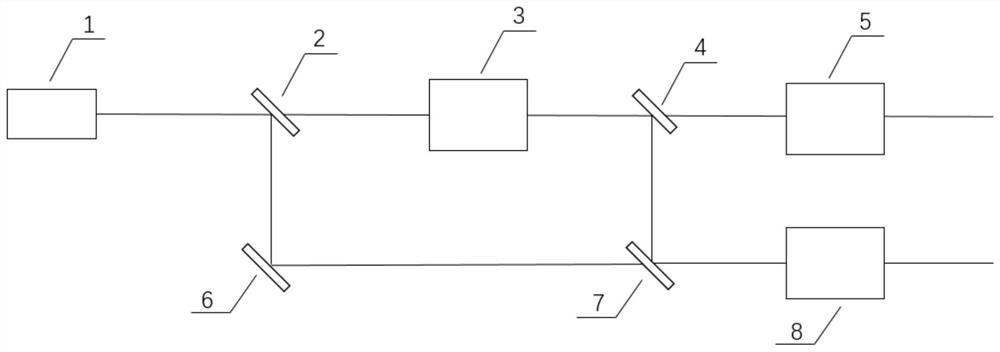
Figure 1 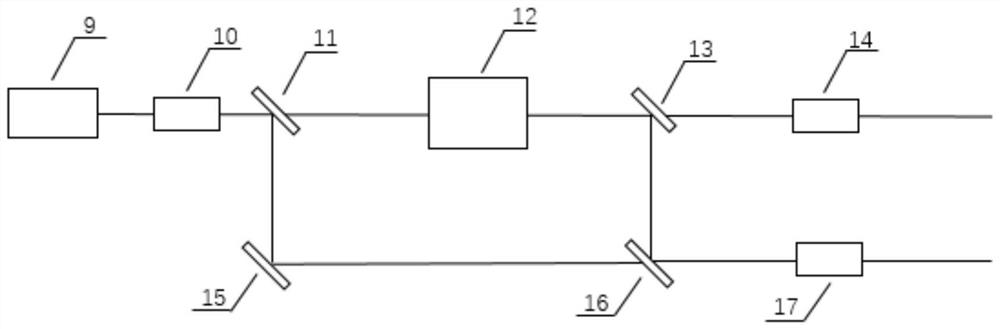
Figure 2 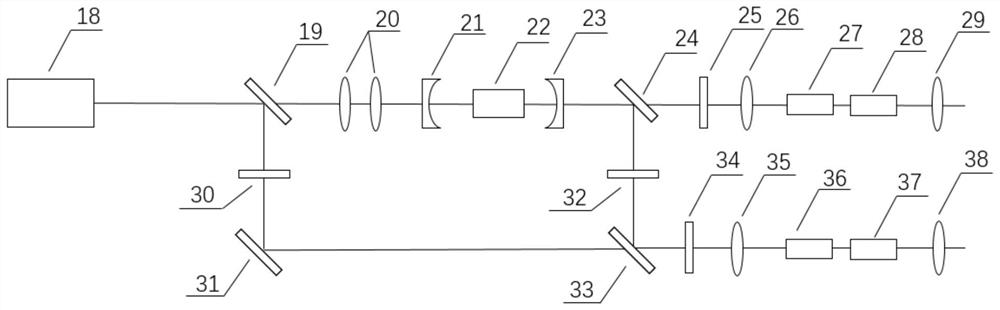
Figure 3
Abstract
Description
technical field
[0001] The invention relates to the field of pulsed lasers, in particular to a multi-wavelength pulsed laser used for atmospheric detection. Background technique
[0002] Ozone is an environmentally important trace gas in the atmosphere. Ozone in the troposphere has become the second largest air pollutant after particulate matter in my country. Ozone has a relatively wide continuous absorption line in the ultraviolet band from 200 to 350nm. Atmospheric aerosols are solid or liquid particles suspended in the air, with particle sizes ranging from 0.001 to 100 μm. Aerosols affect atmospheric radiation through scattering and absorption, affecting urban air quality and reducing atmospheric visibility. Therefore, the monitoring of ozone and aerosol pollution weather cannot be ignored. The main way to measure it is to calculate the concentration of the two by emitting a variety of ultraviolet absorption light with a wavelength between 200 and 350nm and correction...
Examples
Embodiment 1
[0086] The first multi-wavelength pulsed laser for atmospheric detection includes: a first pump source 1, a first beam splitter 2, a first Raman cavity 3, a first dichroic mirror 4, a frequency quadrupling module 5, a first Mirror 6, first film polarizer 7, triple frequency module 8, refer to figure 1 .
[0087] Wherein, the Raman crystal in the Raman cavity adopts diamond crystal. The pump light emitted by the first pump source 1 is split into two beams at the first beam splitter 2, one of which enters the first Raman cavity 3, causing the diamond crystal to produce stimulated Raman scattering and output first-order Stokes light . The first-order Stokes light passes through the first dichroic mirror and enters the quadrupling frequency module 5 to output ultraviolet light (fourth harmonic) and corrected light (second harmonic).
[0088] The pump light not absorbed by the Raman cavity is reflected by the first dichroic mirror 4 and then combined with another pump light spli...
Embodiment 2
[0093] This embodiment has the same structure as the above-mentioned first multi-wavelength pulsed laser for atmospheric detection, and describes the construction components of the optical path in detail, see image 3 .
[0094] The first all-solid-state multi-wavelength ultraviolet laser includes: a third pump source 18, a second beam splitter mirror 19, a first lens group 20, a first concave mirror 21, a first diamond crystal 22, a second concave mirror 23, The fifth dichroic mirror 24, the first half wave plate 25, the first convex lens 26, the third double frequency crystal 27, the fourth double frequency crystal 28, the second convex lens 29, the second half wave Plate 30, the third reflection mirror 31, the third half-wave plate 32, the second film polarizer 33, the fourth half-wave plate 34, the third convex lens 35, the fifth double frequency crystal 36, the second Two and frequency crystal 37, the fourth convex lens 38;
[0095] Wherein, the third pump source 18 emi...
Embodiment 3
[0099] Supplementary description of the parameters of the components in the above-mentioned embodiment 2:
[0100] Wherein, the third pumping source 18 adopts a pulsed laser with an output wavelength of 1064 nm.
[0101]Wherein, in the Raman cavity, the size of the first diamond crystal 22 is 8×4×1.4 mm, the radius of curvature of the first concave mirror 21 is -100 mm, the radius of curvature of the second concave mirror 23 is -69 mm, and the cavity length is 171 mm. In order to improve the Raman conversion rate, measures are taken to coat the Raman cavity. Wherein the two sides of the first diamond crystal 22 are coated with high-transparency films of 1064nm and first-order Stokes light 1240nm; Transparent, a partially transparent film with a transmittance of 40% for first-order Stokes light at 1240nm.
[0102] For the selection of double-frequency crystals and sum-frequency crystals, after considering the damage threshold of the crystal, the power density of the incident ...