
Polymer electrolyte, polymer electrolyte composition, battery, and electronic apparatus
a technology of polymer electrolyte and electrolyte, which is applied in the direction of batteries, sustainable manufacturing/processing, cell components, etc., can solve the problems of difficult to ensure the lithium ion conduction property, difficult to improve the ion conduction property, and the inability to ensure the capacity of a lithium battery
Patent Information
- Authority / Receiving Office
- US · United States
- Patent Type
- Patents(United States)
- Current Assignee / Owner
- Publication Date
- 2019-10-22
Smart Images
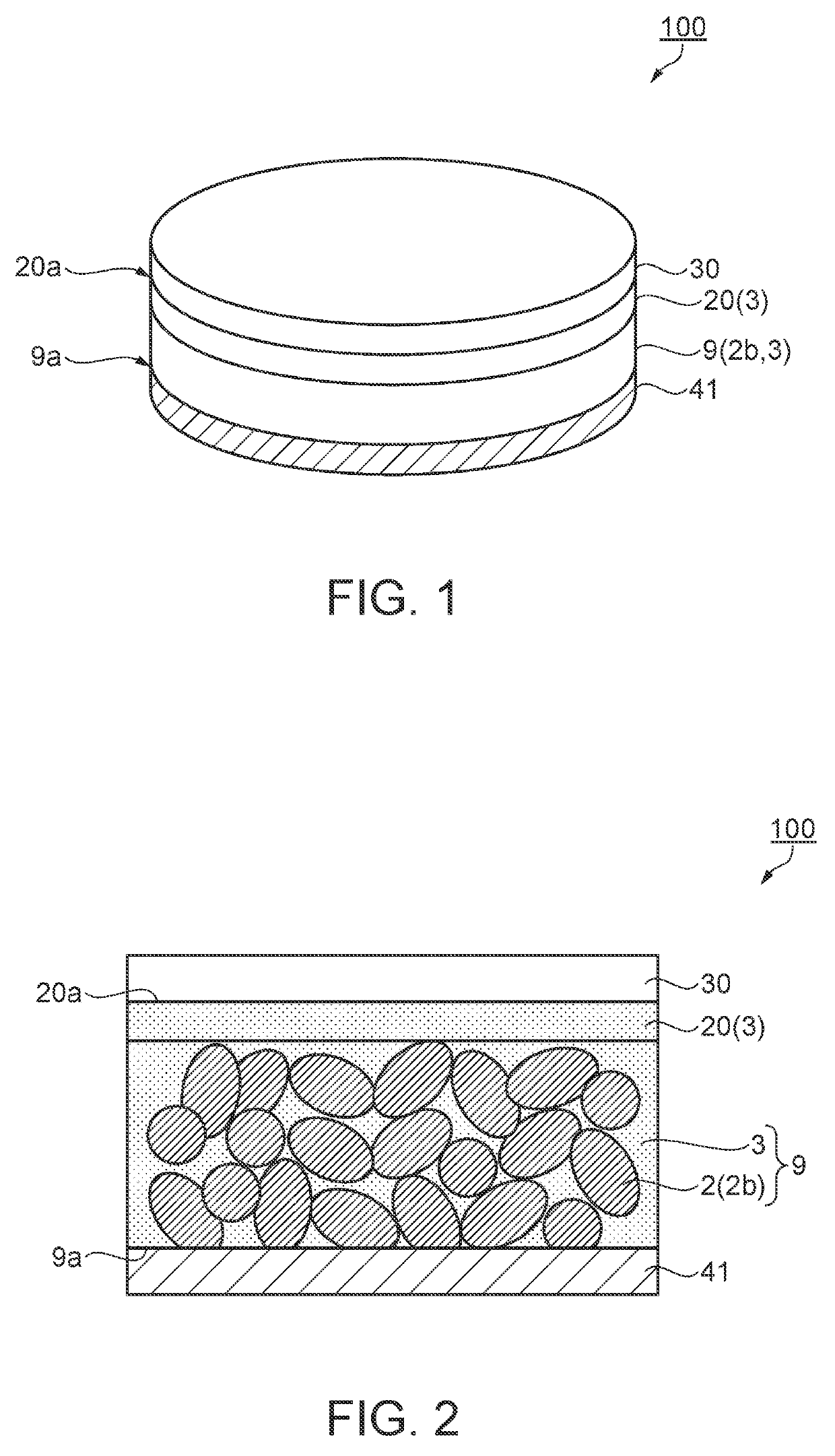
Figure 1 
Figure 2 
Figure 3
Abstract
Description
BACKGROUND1. Technical Field
[0001] The present invention relates to a polymer electrolyte, a polymer electrolyte composition, a battery, and an electronic apparatus.2. Related Art
[0002] Heretofore, an all-solid-state battery using a solid electrolyte in place of an organic electrolytic solution as an electrolyte has been known. For example, in JP-A-2008-117694 (Patent Document 1), a solid polymer electrolyte composition (polymer electrolyte composition) which is a specific copolymer has been proposed.
[0003] However, the solid polymer electrolyte composition disclosed in Patent Document 1 has a problem that it is difficult to improve the ion conduction property as compared with an electrolyte using an organic electrolytic solution. Therefore, when the solid polymer electrolyte composition is used in a lithium battery or the like, it is difficult to ensure a lithium ion conduction property, and there is a fear that a sufficient battery capacity as a lithium battery cannot be ensured.SUMM...
Examples
first embodiment
Battery
[0064]First, a battery according to this embodiment will be described with reference to FIG. 1. In this embodiment, a lithium battery will be described as an example of the battery. FIG. 1 is a schematic perspective view showing a configuration of a lithium battery as the battery according to the first embodiment.
[0065]As shown in FIG. 1, a lithium battery 100 of this embodiment includes an electrolyte section 20 which contains a polymer electrolyte composition 3, a positive electrode 9 as an assembly which is provided in contact with the electrolyte section 20 and contains an active material 2b and the polymer electrolyte composition 3 as an electrolyte, and a first current collector 41 as a current collector which is provided for the electrolyte section 20 through the positive electrode 9. The first current collector 41 is provided in contact with one surface 9a of the positive electrode 9. Further, the lithium battery 100 includes a negative electrode 30 which is provided ...
example 1
[0143]The lithium battery 100 of Example 1 was produced using the production method and the forming materials of the first embodiment described above. Here, the procedure from the preparation of a precursor solution 3X of a polymer electrolyte composition 3 to the formation of a positive electrode 9 and an electrolyte section 20 will be specifically described. As shown in FIG. 5, in the polymer electrolyte composition 3 (precursor solution 3X) of Example 1, PPGAc and methacrylonitrile were mixed in equimolar amounts. That is, in the above formula (1), when m and n are set as follows: m+n=10, m and n satisfy the following formula: m=n=5.
[0144]In a reagent bottle made of PYREX (volume: 5 mL), PPGAc (1.3870 g, 2.92×10⁻³ mol) and Li-TFSI (0.4134 g, 1.44×10⁻³ mol) were weighed and placed. Here, the amount: 1.44×10⁻³ mol of Li-TFSI corresponds to a molar ratio of about 2.47 when m and n are set as follows: m+n=10 in the above formula (1). The reagent bottle was immersed in an ultrasonic g...
example 2
[0148]With respect to the lithium battery 100 of Example 2, the same procedure as in Example 1 was performed except that the precursor solution 3X was prepared using methacrylonitrile (0.0839 g, 1.25×10⁻³ mol), Li-TFSI (0.2957 g, 1.03×10⁻³ mol), and AIBN (0.0028 g, 1.73×10⁻⁵ mol) as shown in FIG. 5 in contrast to Example 1, whereby an ion conductivity sample and the lithium battery 100 of Example 2 were produced. Therefore, in the polymer electrolyte (precursor solution 3X) of Example 2, in the above formula (1), when m and n are set as follows: m+n=10, m and n satisfy the following formulae: m=3 and n=7, and the molar ratio of Li-TFSI corresponds to about 1.76, and the molar ratio of AIBN corresponds to about 0.030.