
Lotion-treated tissue and towel
a technology of paper towels and lotions, applied in the field of paper towels, can solve the problems of affecting the production rate of lotions, affecting so as to improve the converting process and production rate, and prevent the adhesion of “stickies”
Patent Information
- Authority / Receiving Office
- US · United States
- Patent Type
- Applications(United States)
- Current Assignee / Owner
- Publication Date
- 2006-05-25
- Estimated Expiration
- Not applicable · inactive patent
Smart Images
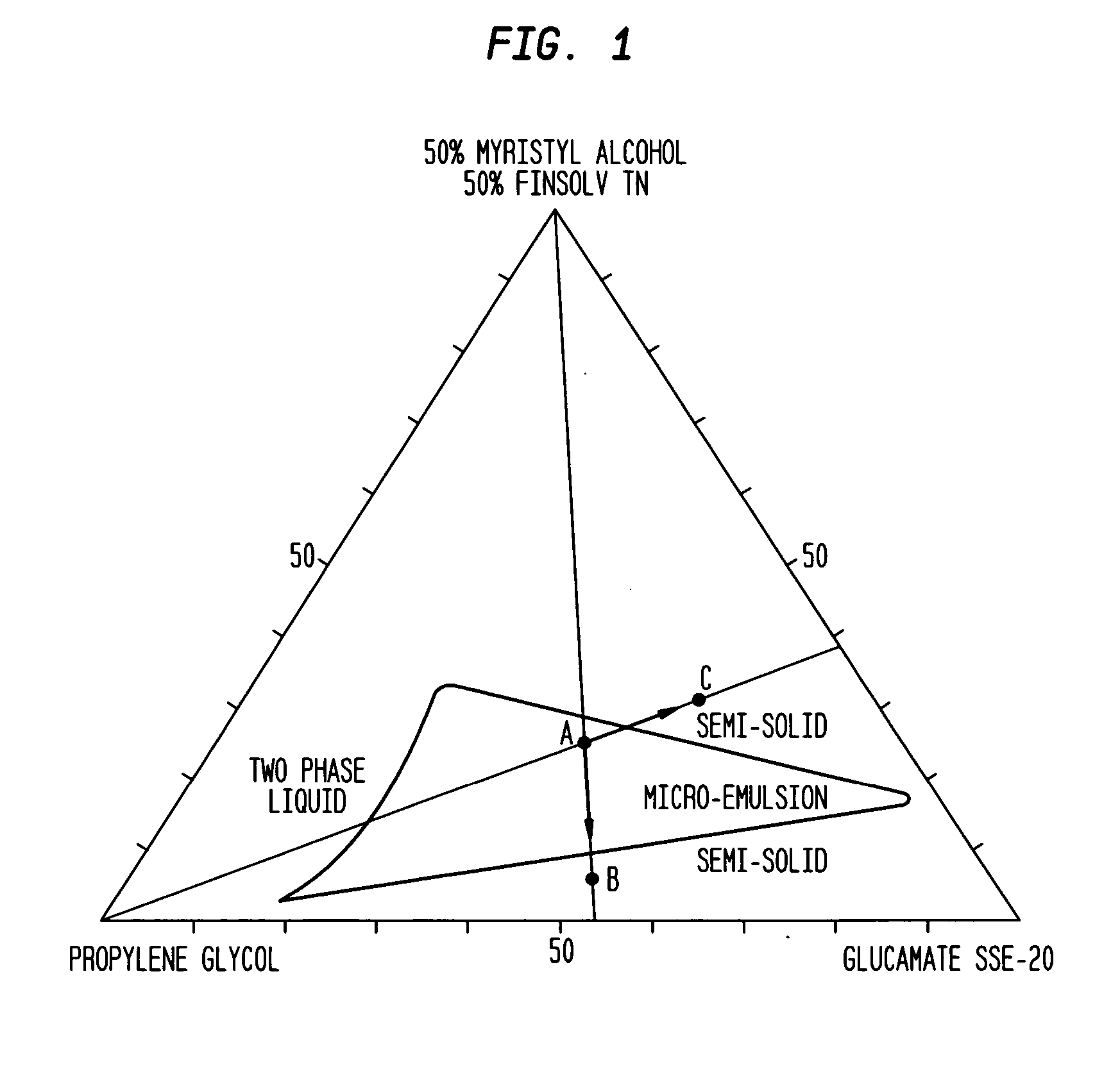
Figure 1 
Figure 2
Abstract
Description
Claim of Priority
[0001] This application is a continuation-in-part of co-pending application U.S. Ser. No. 10 / 141,442 entitled “Waterless Lotion and Lotion-Treated Substrate,” (Attorney Docket No. 12216) filed on May 7, 2002. The disclosure of U.S. patent application Ser. No. 10 / 141,442 is hereby incorporated in its entirety into this application by reference thereto and priority thereof is claimed in accordance with 37 CFR 1.78.TECHNICAL FIELD
[0002] The present invention relates to a paper tissue and towel having a skin-conditioning lotion thereon that is predominantly comprised of an emollient composition and a surfactant composition. In a preferred embodiment, the lotion is a waterless micro-emulsion lotion which is substantially liquid at room temperature and semi-solid or solid upon contact with the towel such that the lotion becomes immobilized on the towel surface. The immobilized lotion emulsion is capable of forming an aqueous gel upon contact with water when the towel is...
Examples
examples
[0046] Formulations of the waterless lotion of the present invention were prepared in which, the components, their ratios and the conditions selected to provide micro-emulsion subject to in-situ phase change upon contact with a cellulosic substrate were varied as shown in the following Examples.
[0047] In preparing each formulation the following, a general procedure was used. The polar phase propylene glycol was mixed with surfactant and co-surfactant in a heated container at about 60° C. to about 70° C. until the chemicals were completely melted. The non-polar oil phase was added to the mixture with moderate agitation for about 10 minutes, then cooled to room temperature. At this point the lotion was in clear liquid form and ready to apply to the substrate. The micro-emulsion formed spontaneously without the need for a high shear mechanical device and is stable indefinitely.
examples 1-7
[0048] Examples 1 to 7 were prepared in accordance with the present invention.
[0049] These lotion formulas were liquid at room temperature, transparent, very stable and accordingly the lotion ingredient ratios were inside the micro-emulsion region of phase diagrams such as FIG. 1 which is a partial phase diagram of the composition of Example 1. Surprisingly, the lotion of the present invention is characterized as having a good hand-feel perception and non-greasy hand-feel, which is thought to be due to the particle size of the micro-emulsion being too small to be detected in the oil phase by the fingertips.
TABLE 1Ex. 1Ex. 2Ex. 3Ex. 4Ex. 5Ex. 6Ex. 7Ingredients(%)(%)(%)(%)(%)(%)(%)Propylene glycol3535515153035Finsolv TN(1)12.5016030150Carnation oil(2)00000012.5Isopropyl myristate015030000Lambert CE 2000(3)0040000Myristyl12.515000012.5alcohol(C14)Kalcol 1618(4)007.505.55.50Glucam P-200067.5049.549.50Distearate(5)Glucamate SSE-20(6)40350550040
(1)Finsolv TN: C12-C15 alkyl benzoate est...
example 8
[0050] The lotion prepared in Example 1 was applied to a tissue basesheet at a 5% add-on level, then converted to a two ply tissue product. The product was tested for the amount of lotion transferred to the skin. The results were compared with commercially available lotioned tissues by comparing the light reflection of cold lotion residual on glass relative to that from two other products. The scattering of light caused by lotion smeared onto the glass microscope slide was measured by using the UV / visible spectrophotometer in the wavelength region from 700 nm to 400 nm. Lotion was transferred to the slide by holding it between two layers of lotioned tissue for 30 seconds and then rubbing the tissue over the slide 20 times in 15 seconds. The lotion smeared glass slide was placed in the sample beam of a double beam UVNisible spectrometer to measure the light scattering. The results show that scattering of light caused by lotion smeared onto the slide rubbed with the tissue treated wit...