
Methods of validating candidate compounds for use in treating COPD and other diseases
Patent Information
- Authority / Receiving Office
- US · United States
- Current Assignee / Owner
- Publication Date
- 2010-08-05
- Estimated Expiration
- Not applicable · inactive patent
Smart Images
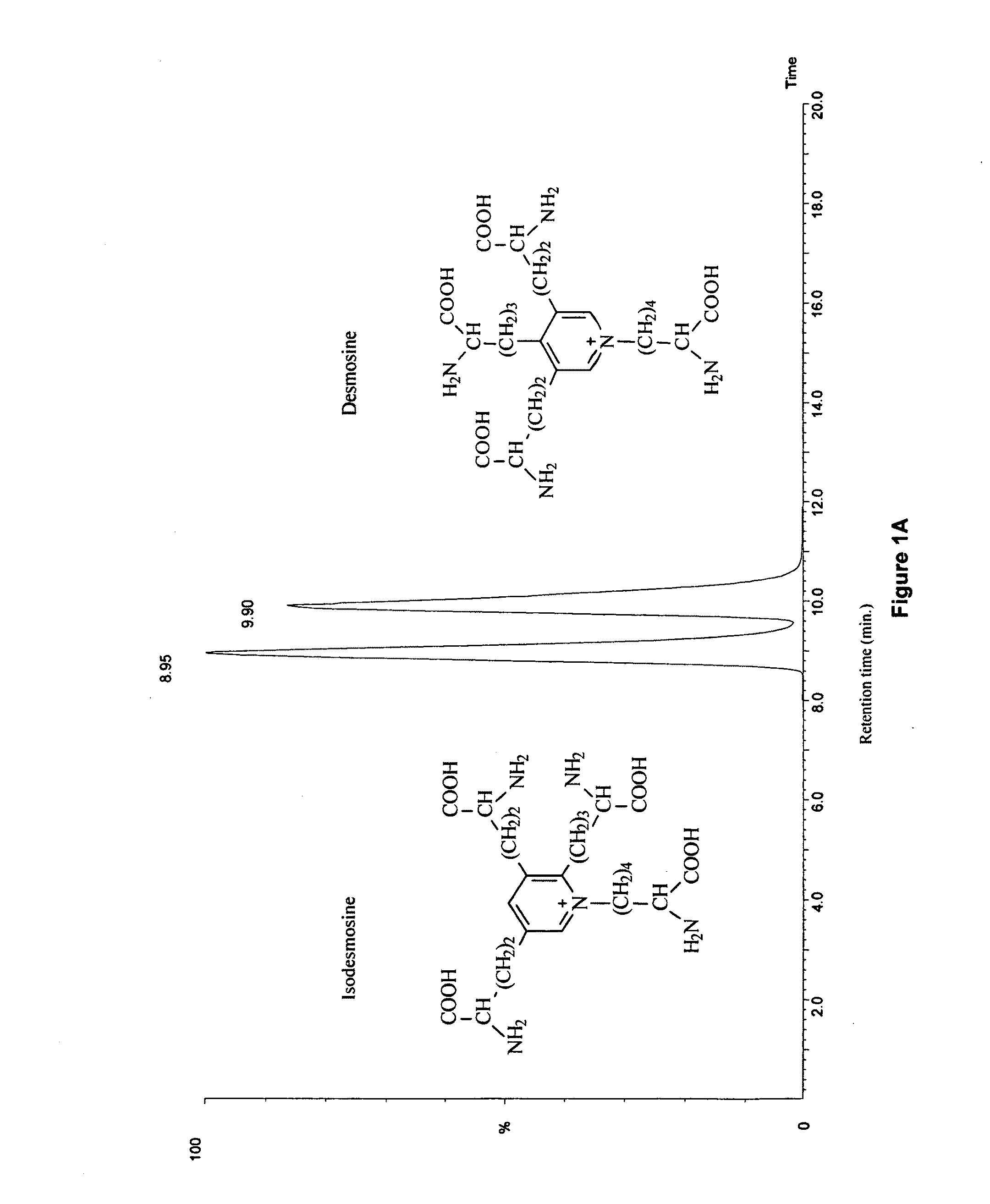
Figure 1 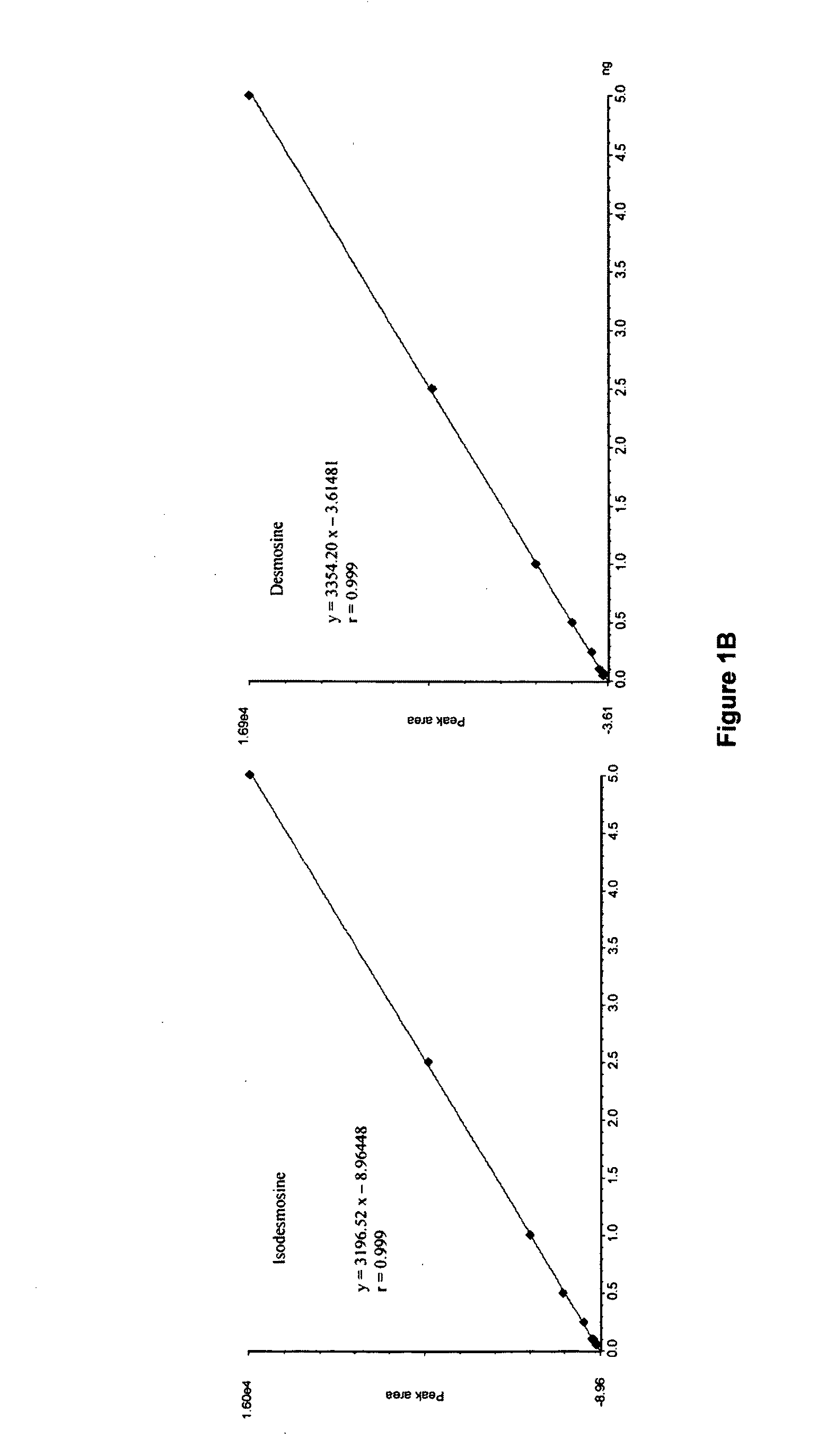
Figure 2 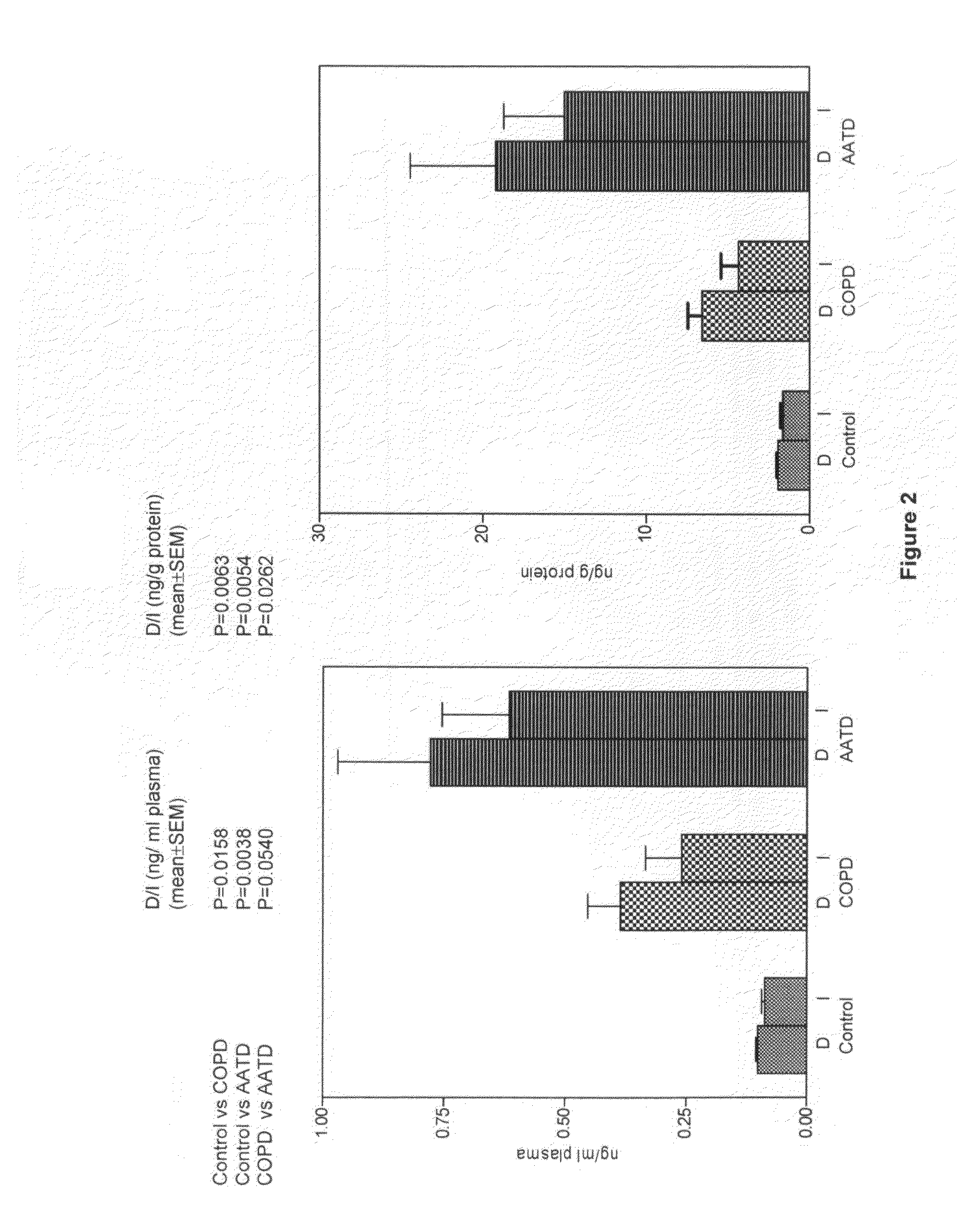
Figure 3
Abstract
Description
FIELD OF THE INVENTION
[0001] The present invention relates to the field of elastin fiber injuries and, more particularly, methods of diagnosing and treating elastin fiber injuries. Still further, the present invention relates to methods of validating candidate compounds for use in treating elastin fiber injuries, such as those injuries caused by chronic obstructive pulmonary disease (COPD), chronic bronchitis, emphysema, refractory asthma, and other related diseases.BACKGROUND OF THE INVENTION
[0002] Lung elastin degradation occurs with the development of pulmonary emphysema in patients with Chronic Obstructive Pulmonary Disease (COPD) related to smoking or alpha-1 antitrypsin deficiency.
[0003] Desmosine and Isodesmosine (D and I), the crosslinking amino acids present only in elastin in the human, offer the prospect of assessing elastin degradation in disease by their measurement in certain body fluids. Thus far, D and I have been measured in urine of patients with COPD and found to be ...
Examples
example 1
Materials and Methods
[0027]The mass spectrometric method was used for direct measurement of D / I in urine, plasma and sputum as markers of elastin degradation in healthy controls, patients with α1-antitrypsin deficiency (AATD) and non-AATD-related COPD. Preparation of specimens of urine and sputum and measurements by mass spectrometry (LC / MS) were performed as previously described in Ma S, Lieberman S, Turino G M and Lin Y Y: The detection and quantitation of free desmosine and isodesmosine in human urine and their peptide-bound forms in sputum. PNAS 2003, 100:12941-12943, which is incorporated by reference as if recited in full herein. D and I standard (mixed 50% D and 50% I) were purchased from Elastin Products (Owensville, Mich.), and all other reagents were from Sigma (St. Louis, Mo.). MCX cation exchange cartridges (3 ml) were obtained from Waters (Milford, Mass.), and CF1 cellulose powders were purchased from Whatman (Clifton, N.J.).
[0028]Urine samples. Twenty-four hour urine s...
example 2
Results
[0039]Results in normal subjects are presented in Table 1 below (C=Caucasian; A=Asian).
TABLE 1Controls without Lung DiseaseDesmosine / IsodesmosineUrinePlasmaFree Formng / gμg / gFree / TotalSubjectsSexAgeRaceng / mlproteincreatinineTotal%1M33C0.11 / 0.101.89 / 1.801.85 / 1.119.64 / 5.9019 / 192M35C0.07 / 0.091.06 / 1.363F58C0.10 / 0.082.17 / 1.743.73 / 2.7610.22 / 7.65 36 / 364M27A0.09 / 0.071.31 / 1.020.60 / 0.502.85 / 2.7021 / 195F31A0.10 / 0.062.22 / 1.296F69C0.09 / 0.081.62 / 1.441.80 / 1.6911.77 / 8.37 15 / 207M54A0.11 / 0.132.02 / 2.270.51 / 0.645.17 / 3.9610 / 168M72A0.09 / 0.131.94 / 2.800.75 / 0.355.16 / 4.1015 / 9 9M79C0.12 / 0.052.43 / 1.010.42 / 0.386.17 / 4.677 / 810M65A0.11 / 0.102.23 / 2.030.99 / 0.666.59 / 3.8915 / 1711F38A0.13 / 0.082.27 / 1.310.89 / 0.885.19 / 4.2617 / 2112F28C0.11 / 0.091.83 / 1.502.48 / 1.5812.69 / 6.64 20 / 2413M32C0.10 / 0.081.87 / 1.491.59 / 1.567.29 / 5.6822 / 27mean0.10 / 0.091.91 / 1.621.42 / 1.107.52 / 5.2618 / 20±SEM±0.01 / ±0.01±0.11 / ±0.14±0.31 / ±0.22±0.94 / ±0.53±2 / ±2
[0040]The mean levels and standard error (S.E.M.) of D and I (D / I) in plasma in 13 subjects were 0.10±0...
example 3
[0047]An early insight into the mechanisms leading to alveolar disruption in pulmonary emphysema is that lung matrix elastin is a target for chemical degradation from cellular elastases. Lung elastin content, determined chemically, has been demonstrated to be low in pulmonary emphysema related to smoking or to the Z-phenotype AATD, and morphologically, lung elastin fibers have been shown to be fragmented and disordered. Also intratracheal administration of elastases has uniquely produced animal models of pulmonary emphysema. In addition, elastin peptides have been shown to be chemotactic for neutrophils and macrophages and could be a factor in the progression of human pulmonary emphysema once elastin degradation has occurred.
[0048]Current methods of measuring elastin peptides in blood plasma require radioimmunoassay techniques which depend on antibodies to elastin peptides which vary in specificity and sensitivity, which affects the standardization and quantification of...