
Copolymer-1, process for preparation and analytical methods thereof
a technology of glatiramer acetate and process, applied in the field of analytical methods, can solve the problems of slow reaction speed, increase production cost, and reduce the quality and yield of desired products, and achieve the effect of saving considerable tim
Patent Information
- Authority / Receiving Office
- US · United States
- Patent Type
- Applications(United States)
- Current Assignee / Owner
- Publication Date
- 2013-12-05
- Estimated Expiration
- Not applicable · inactive patent
Smart Images
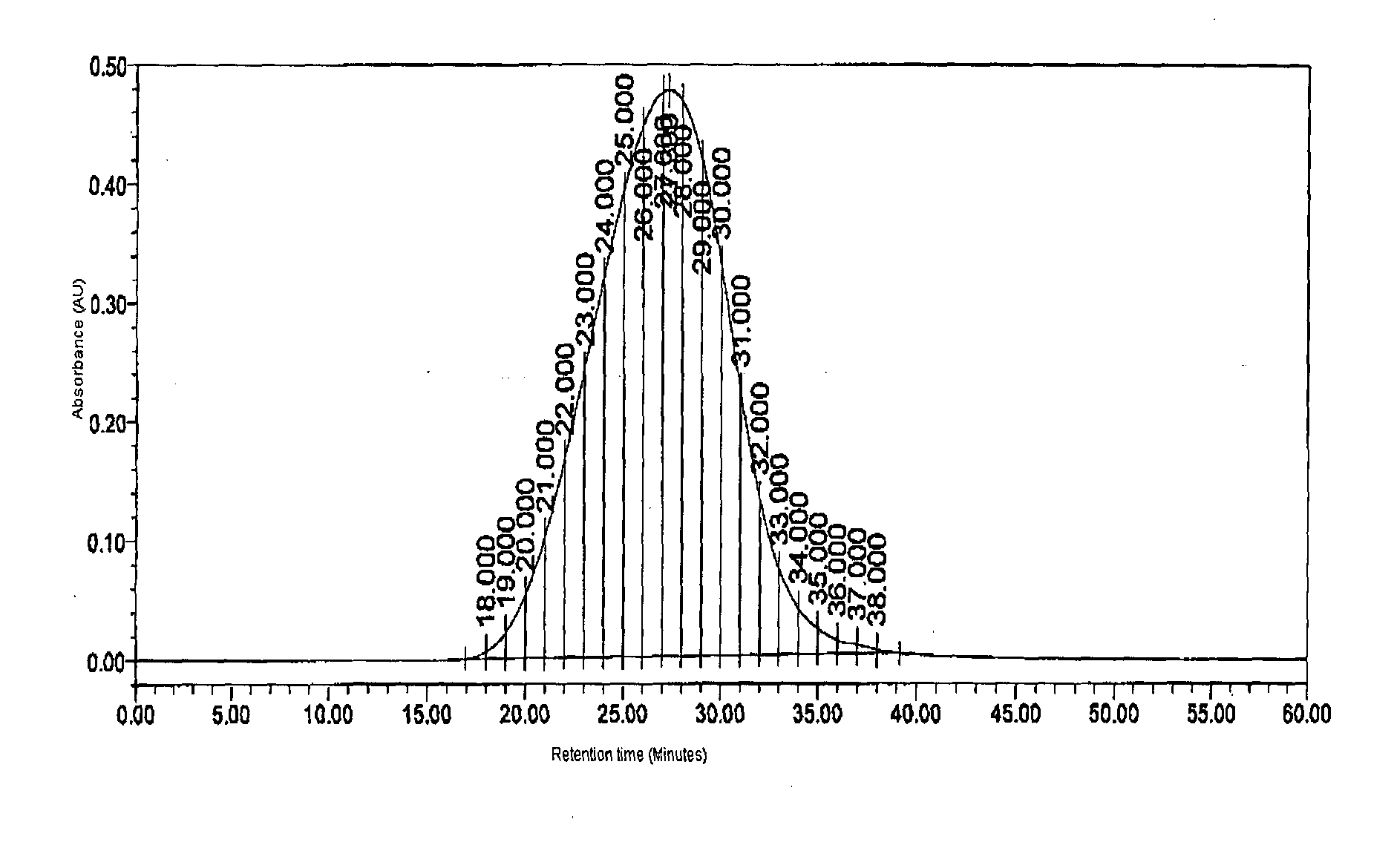
Figure 1 
Figure 2 
Figure 3
Abstract
Description
RELATED APPLICATION
[0001] This application claims benefits of Indian Provisional Application No. 409 / MUM / 2011 filed on 14 Feb. 2011.FIELD OF THE INVENTION
[0002] The present invention relates to analytical methods such as molecular weight determination of polypeptide, in particular Glatiramer acetate. The present invention further relates to an improved process for preparation of polypeptides or pharmaceutically acceptable salts thereof, particularly Glatiramer acetate also known as Copolymer-1. The present invention further relates to characterization of Glatiramer acetate by peptide mapping.BACKGROUND OF THE INVENTION
[0003] One of the more common neurologic diseases in human adults is multiple sclerosis. This condition is a chronic, inflammatory CNS disease characterized pathologically by demyelination in the brain and spinal cord. Glatiramer acetate (GA), also known as Copolymer-1, has been shown to be effective in treating multiple sclerosis (MS). Daily subcutaneous injections of Gl...
Examples
example 1 (
Example 1(B)
Molecular Weight Determination of Glatiramer Acetate Batches
a) Fractionation of Glatiramer Acetate Obtained by the Process of the Present Invention:
[0234]Glatiramer acetate about 40 mg was subjected to GPC on a Superose 12 (10 / 300 GL), System: Acta purifier using 0.2M Ammonium acetate pH 5.0 as mobile phase, at a flow rate of 0.5 ml / min.[0235]Glatiramer peak started eluting after about 20 min and ended after about 40 min.[0236]30 individual fractions were collected within an interval gap of 0.5 minute (FIG. 5) starting from the 21st minute and ending at about 41st min.[0237]Around 15 fractions were analyzed for polydispersity and molecular weight.[0238]Fractions were selected in such a way that one of these fractions represents the peak apex molecular weight and other fractions were distributed on either side of the peak apex molecular weight.[0239]Fractions having polydispersity of less than 1.2 were selected and lyophilized.[0240]Fractions having polydispersity of more...
example 2
[0250]200 g (0.84 moles) of γ-benzyl L-glutamate and 10 g of activated charcoal were suspended in 2.4 L of tetrahydrofuran (THF). 124.6 g (0.42 moles) of triphosgene was added to the obtained mixture and stirred for 0.5 hr at 50-55° C. After the completion of reaction, the reaction mixture was cooled to room temperature, filtered through hyflo bed and nitrogen gas was purged through the obtained filtrate for 2 hr below 35° C. The filtrate was concentrated under vacuum to get an oil. The obtained oil was stripped thrice with 1 L of hexane to get the solid. The obtained solid was stirred with 2 L hexane, filtered, washed with 2 L hexane and dried under vacuum at below 45° C. The dried material was passed through 30 mesh and again re-dried. The re-dried solid was stored at −20° C. in a air-tight container.
[0251]Yield: 200 g (100% w / w w.r.t. amino acid), m.p: 92°-94° C.
example 3
[0252]110 g (0.552 moles) of L-tyrosine and activated charcoal (5.5 g) were suspended in 1.32 L of tetrahydrofuran (THF). 89.76 g (0.302 moles) of triphosgene was added to it. The reaction mixture was stirred for 2 hr at 50-55° C. After the completion of reaction, the reaction mixture was cooled to room temperature, filtered through hyflo bed. Nitrogen gas was purged through the obtained filtrate for 2 hr below 35° C. The reaction mixture was then concentrated under vacuum to get a solid mass. The obtained solid mass was stripped thrice with 0.55 L hexane and further stirred with 1.1 L hexane, filtered, washed with 1.1 L hexane and dried under vacuum below 45° C. The dried material was passed through 30 mesh and again re-dried. The re-dried solid was stored at −20° C. in a air-tight container.
[0253]Yield: 80 g (73% w / w w.r.t. amino acid). The compound decomposed at 250° C. to 270° C.