
Catalyst and manufacturing method thereof, and electrode catalyst layer using the catalyst
a catalyst and manufacturing method technology, applied in the field of catalysts, can solve problems such as the reduction of catalytic activity, and achieve the effect of excellent power generation performan
Patent Information
- Authority / Receiving Office
- US · United States
- Patent Type
- Applications(United States)
- Current Assignee / Owner
- Publication Date
- 2016-03-10
Smart Images
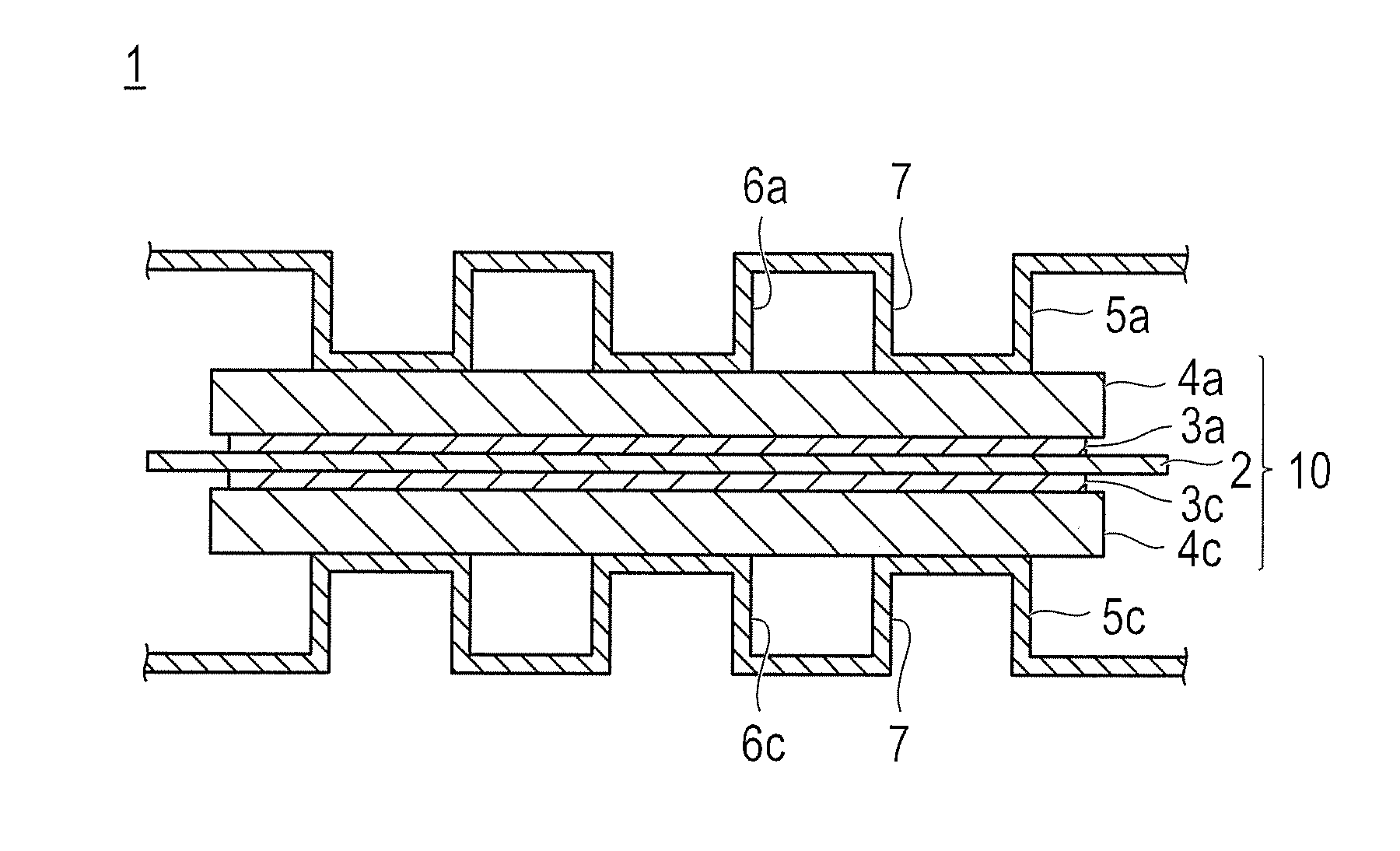
Figure 1 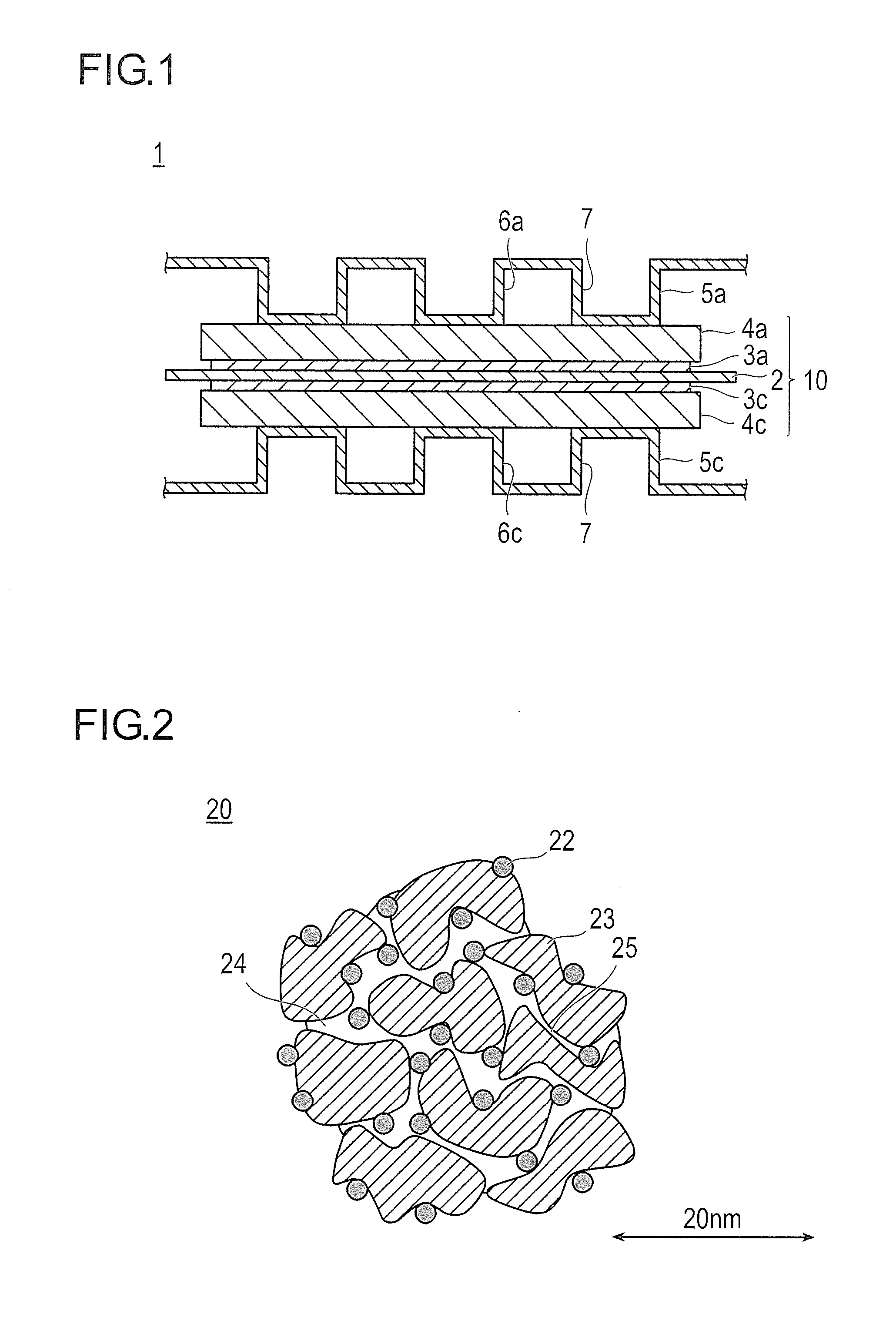
Figure 2 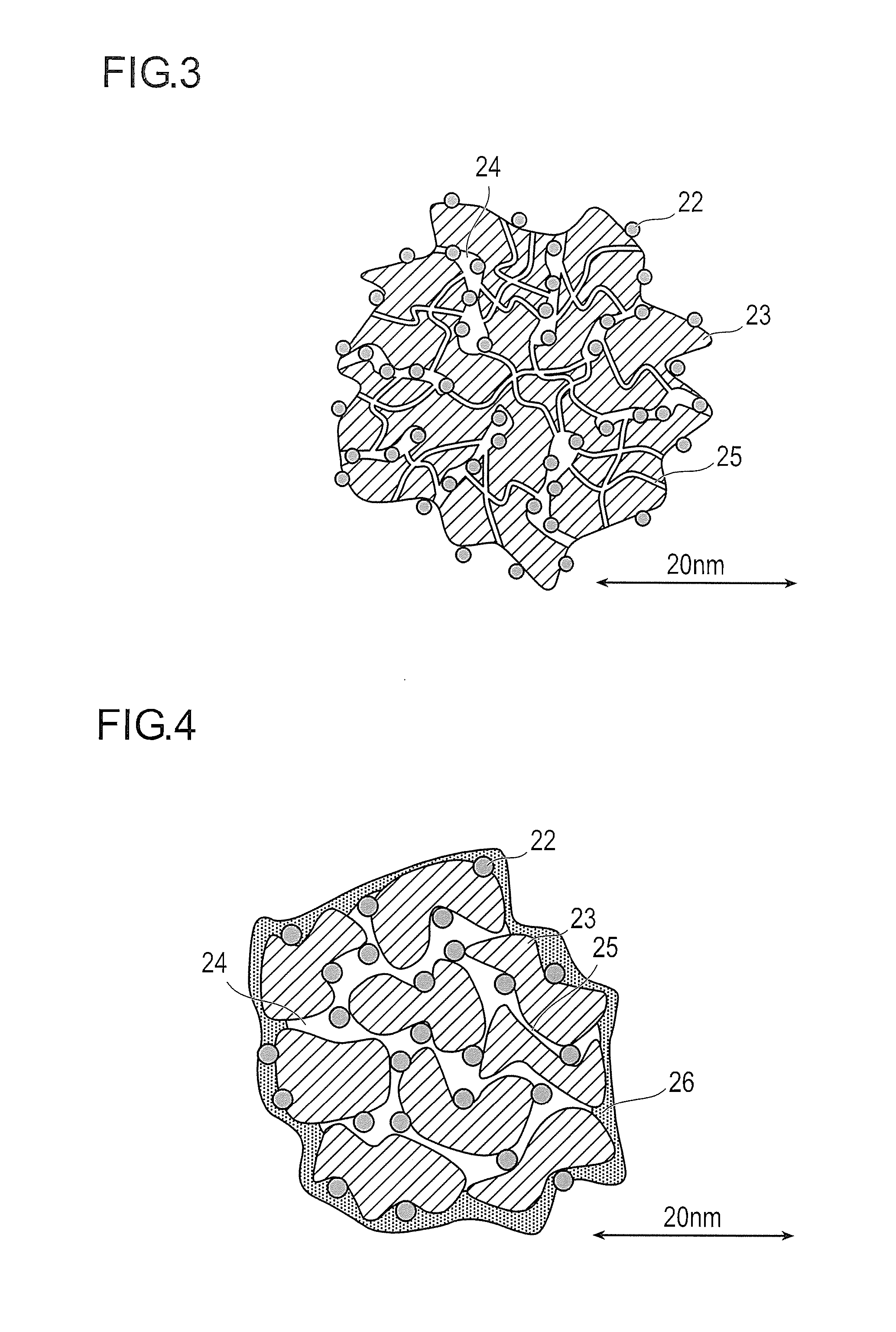
Figure 3
Abstract
Description
TECHNICAL FIELD
[0001] The present invention relates to a catalyst, particularly, an electrode catalyst used for a fuel cell (PEFC) and a manufacturing method thereof, and an electrode catalyst layer using the catalyst.BACKGROUND ART
[0002] A polymer electrolyte fuel cell using a proton conductive solid polymer membrane operates at a low temperature in comparison to other types of fuel cells, for example, a solid oxide fuel cell or a molten carbonate fuel cell. For this reason, the polymer electrolyte fuel cell has been expected to be used as a power source for energy storage system or a driving power source for a vehicle such as a car, and practical uses thereof have been started.
[0003] In general, such a polymer electrolyte fuel cell uses expensive metal catalyst represented by platinum (Pt) or a Pt alloy, which leads to high cost of the fuel cell. Therefore, development of techniques capable of lowering the cost of the fuel cell by reducing a used amount of noble metal catalyst has be...
Examples
example 1
[0147]In this example, Black pearls (registered trademark) 2000 (produced by Cabot) (support A) was used as a support. The support A was produced according to the method disclosed in U.S. Pat. No. 6,398,858.
[0148]The pore characteristics of the support A were as follows:
[0149]a pore volume, surface area, and average pore radius of micropores were found to be 0.494 cc / g, 1042 m2 / g, and 0.47 nm, respectively;
[0150]a pore volume, surface area, and average pore radius of mesopores were found to be 1.616 cc / g, 649 m2 / g, and 5 nm respectively; and
[0151]a BET specific surface area was found to be 1444 m2 / g.
[0152]The resultant support A was used, and platinum (Pt) having an average particle diameter of 3.8 nm as the catalyst metal was supported on the support at a support ratio of 30 wt %, to prepare a catalyst powder A. To be specific, 46 g of the support A was immersed into 1000 g of a dinitrodiammine platinum nitric acid solution having a platinum concentration of 4.6 wt % (platinum cont...
example 2
[0153]A catalyst powder B was obtained by the same processes as those of Example 1, except that platinum (Pt) having an average particle diameter of 3.9 nm was used instead as the catalyst metal in Example 1. The catalyst powder B was tested for pore volumes of micropores and the mesopores before and after the supporting of the catalyst metal. As a result, both decreases in volumes of mesopores and micropores before and after the supporting exceeded 0, and the decrease in volume of mesopores before and after the supporting was larger than the decrease in volume of micropores before and after the supporting.
example 3
[0154]The support A manufactured by the above-described Synthesis Example 1 was used, a platinum-cobalt alloy having an average particle diameter of 4.1 nm as the catalyst metal was supported on the support A at a support ratio was 30 wt %, to prepare a catalyst powder C. To be specific, 5 g of the support A was immersed into a metal salt solution prepared by dissolving a predetermined amount of Pt dinitrodiamine nitric acid solution (Pt (NO2)2(NH3)2) and a predetermined amount of cobalt chloride (CoCl2.6H2O) in 100 mL of ion-exchanged water, and the resulting mixture was stirred with a magnetic stirrer. Next, 500 mL of sodium borohydride (SBH) solution having a concentration of 1 wt % was dropped in the mixture, and subjected to reduction treatment under stirring, so that platinum and cobalt were supported on the support A. After that, the support A having platinum and cobalt supported thereon was filtered, washed, and dried, and heat-treated under a hydrogen gas flow at a temperat...