
Method for preparing chemical digester and its use for the treatment of organic matter
Patent Information
- Authority / Receiving Office
- US · United States
- Current Assignee / Owner
- Publication Date
- 2019-07-04
Smart Images
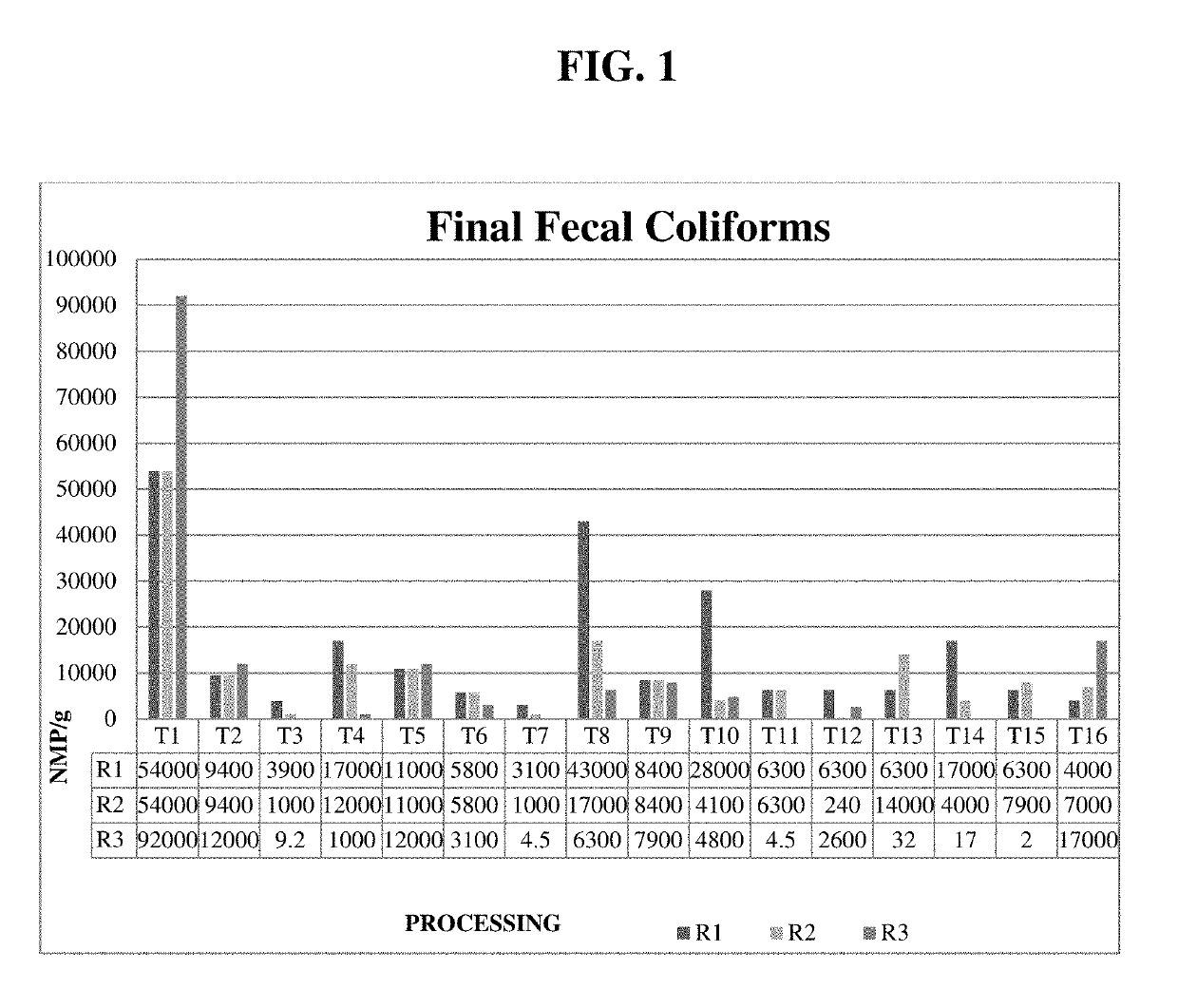
Figure 1
Abstract
Description
CROSS-REFERENCE TO RELATED APPLICATION
[0001] This application is a continuation-in-part of U.S. application Ser. No. 16 / 168,716, filed on Oct. 23, 2018, which claims priority to and the benefit of El Salvador Patent Application No. 20170022516, filed in El Salvador on Oct. 25, 2017, the entire contents of which are incorporated herein by reference.FIELD OF THE INVENTION
[0002] This invention refers to a method for the preparation of a chemical digester and its use for water treatment, soil fertilization, elimination of pollutants and acceleration of agricultural, livestock and agro-industrial waste decomposition, among other applications.
[0003] This invention has action over a wide spectrum of situations and technical problems that are mentioned below. They are represented by: a) wastewater treatment; b) soil fertilization; c) elimination of pollutants, and d) acceleration of agricultural, livestock and agro-industrial waste decomposition. Likewise, pollutants derived from the latter ar...
Examples
example no.1
Example No. 1: Application of Chemical Digester to Decrease Fecal Coliform Populations in Ordinary Sludge from the Wastewater Treatment Plant (“PTAR”) of San Juan De Talpa, La Paz, El Salvador
[0032]The work consisted in comparing the fecal coliform reduction in the PTAR mentioned according to the Official Mexican Standard NOM-004-SEMARNAT-2002. A sample of sludge from the WWTP contains, according to a study (Aviles Sacoto 2015), the following elements:
Organic Matter:40%-80%Nitrogen:2.5% StPhosphorus1.6% StP2O5Potassium K2O:0.4% St
[0033]Likewise, the pathogens frequently found in the sludges are fecal coliforms, Salmonella spp, helminth eggs, E. Coli; Enterobacter; Klebsiella and citrobacter among others. The treatment of these sludge in PTAR is highly recommended.
[0034]It is known in the literature that stubble digesters release carbohydrate energy by accelerating bacterial growth, thus reducing nitrogen needs for waste digestion (Aguillón Martinez et al 1993). Also, for the present...
example no.2
Example No. 2: Blocking Ammonia (NH3) in Poultry Plants in El Salvador
[0038]We worked on poultry factories with tunneling sheds of broiler chickens by spraying or applying the chemical digester to the soil directly. Applications of 0.4 cc / Mt2 were made, direct to the soil for 3 days, prior to the entry of chicks in their production cycles. It was observed that by blocking ammonia the fattening cycle of the chicks was reduced from 35 to 30 days, observing reduction of bad odors, reduction of number of flies by visual method, elimination of waste in 30 days producing an energy saving in the poultry fattening. Reduction in ammonia (NH3) levels below 10 ppm in the soil was observed, thus reducing the potential for respiratory diseases.
example no.3
Example No. 3: Decomposition of Dead Poultry Residues in El Salvador
[0039]It was applied by means of aspergeo and / or by direct application to the remains in layers over dead birds and poultry litter. A mixture of 40 cm3 of the chemical digester presented in this invention plus 200 cm3 of molasses was provided in 40 liters of water. Subsequently, dead birds covered with poultry litter were moistened. In less than 20 days the dead birds covered with chicken manure previously wetted with the mixture kept under observation and it was proved the absence of bad odors and absence of ammonia (NH3).
[0040]Although this invention has been described in detail with particular reference to the preferred embodiments, other embodiments can achieve almost the same results. Variations and modifications of this invention will be considered “obvious” to those skilled in the art and all modifications and equivalents of this type are intended to be covered in the appended claims.
[0041]It is noted that an...