
Resist compositions and patterning process
Patent Information
- Authority / Receiving Office
- US · United States
- Current Assignee / Owner
- Publication Date
- 2005-03-15
Smart Images
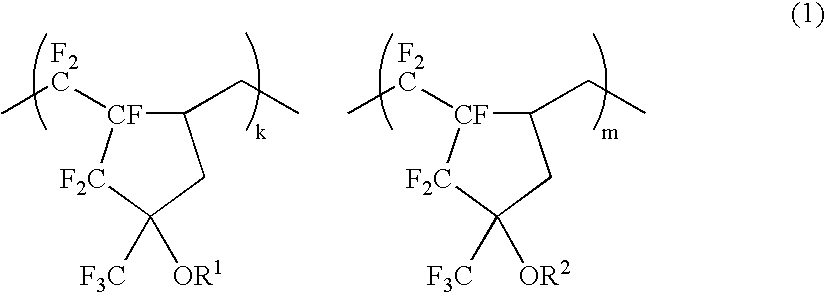
Figure 1 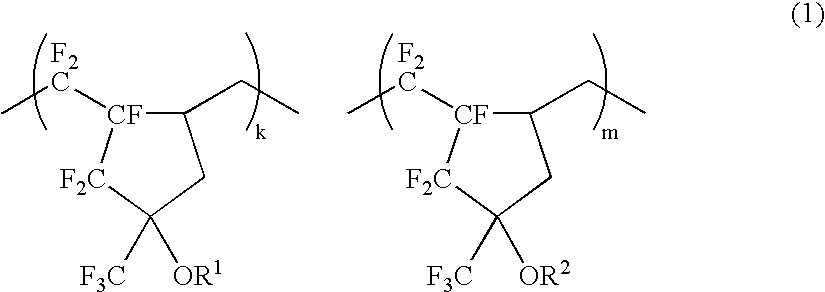
Figure 2 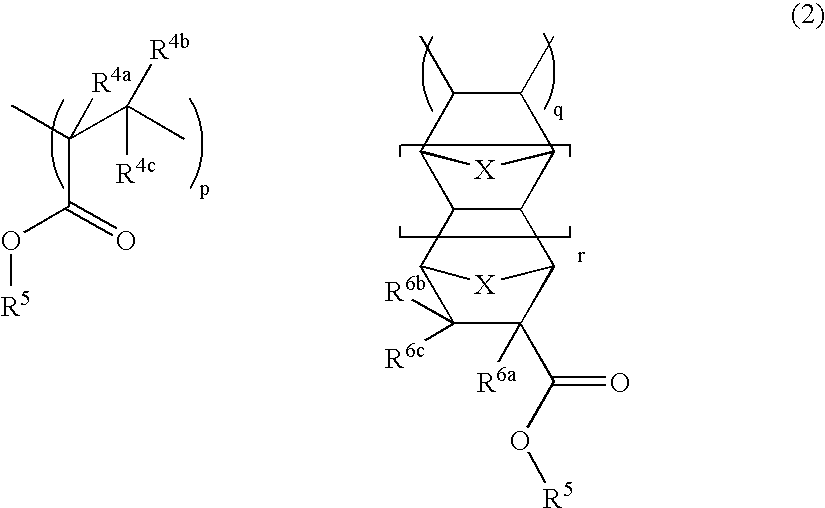
Figure 3
Abstract
Description
This invention relates to resist compositions suited for microfabrication, especially chemical amplification resist compositions, and a patterning process using the same.BACKGROUND OF THE INVENTIONIn the drive for higher integration and operating speeds in LSI devices, the pattern rule is made drastically finer. The rapid advance toward finer pattern rules is grounded on the development of a projection lens with an increased NA, a resist material with improved performance, and exposure light of a shorter wavelength. To the demand for a resist material with a higher resolution and sensitivity, chemical amplification positive working resist materials which are catalyzed by acids generated upon light exposure are effective as disclosed in U.S. Pat. No. 4,491,628 and U.S. Pat. No. 5,310,619 (JP-B 2-27660 and JP-A 63-27829). They now become predominant resist materials especially adapted for deep UV lithography.Also, the change-over from i-line (365 nm) to shorter wavelength KrF excimer ...
Examples
example
Examples of the invention are given below by way of illustration and not by way of limitation.
Evaluation
Polymer Transmittance Measurement
Polymers 1-7 shown below and blends thereof (in a weight ratio as shown in Table 1) were determined for transmittance.
Each polymer or polymer blend, 1 g, was thoroughly dissolved in 12 g of propylene glycol monomethyl ether acetate (PGMEA), and passed through a 0.2-μm Teflon® filter, obtaining a polymer solution. The polymer solution was spin coated onto a MgF2 substrate and baked on a hot plate at 100° C. for 90 seconds, forming a polymer film of 200 nm thick on the substrate. Using a vacuum ultraviolet spectrometer (VUV-200S by Nihon Bunko K.K.), the polymer film was measured for transmittance at 248 nm, 193 nm and 157 nm. The results are shown in Table 1.
TABLE 1Polymer blendTransmittance (%)(weight ratio)248 nm193 nm157 nmPolymer 1 + Polymer 2 (8:2)939163Polymer 1 + Polymer 2 (6:4)939055Polymer 1 + Polymer 3 (8:2)929061Polymer 1 + Polymer 4 (8:...