
Method for quick estimating rate and distortion in H.264/AVC video coding
A video coding and rate technology, applied in digital video signal modification, television, electrical components, etc., can solve problems such as no distortion estimation algorithm given, no self-adaptive method proposed, inverse quantization and inverse transformation unavoidable, etc.
- Summary
- Abstract
- Description
- Claims
- Application Information
AI Technical Summary
Problems solved by technology
Method used
Image

Examples
Embodiment Construction
[0027] The rate-distortion estimation algorithm proposed by the present invention and its application in encoding mode and transform block size are further described as follows with reference to the accompanying drawings and embodiments.
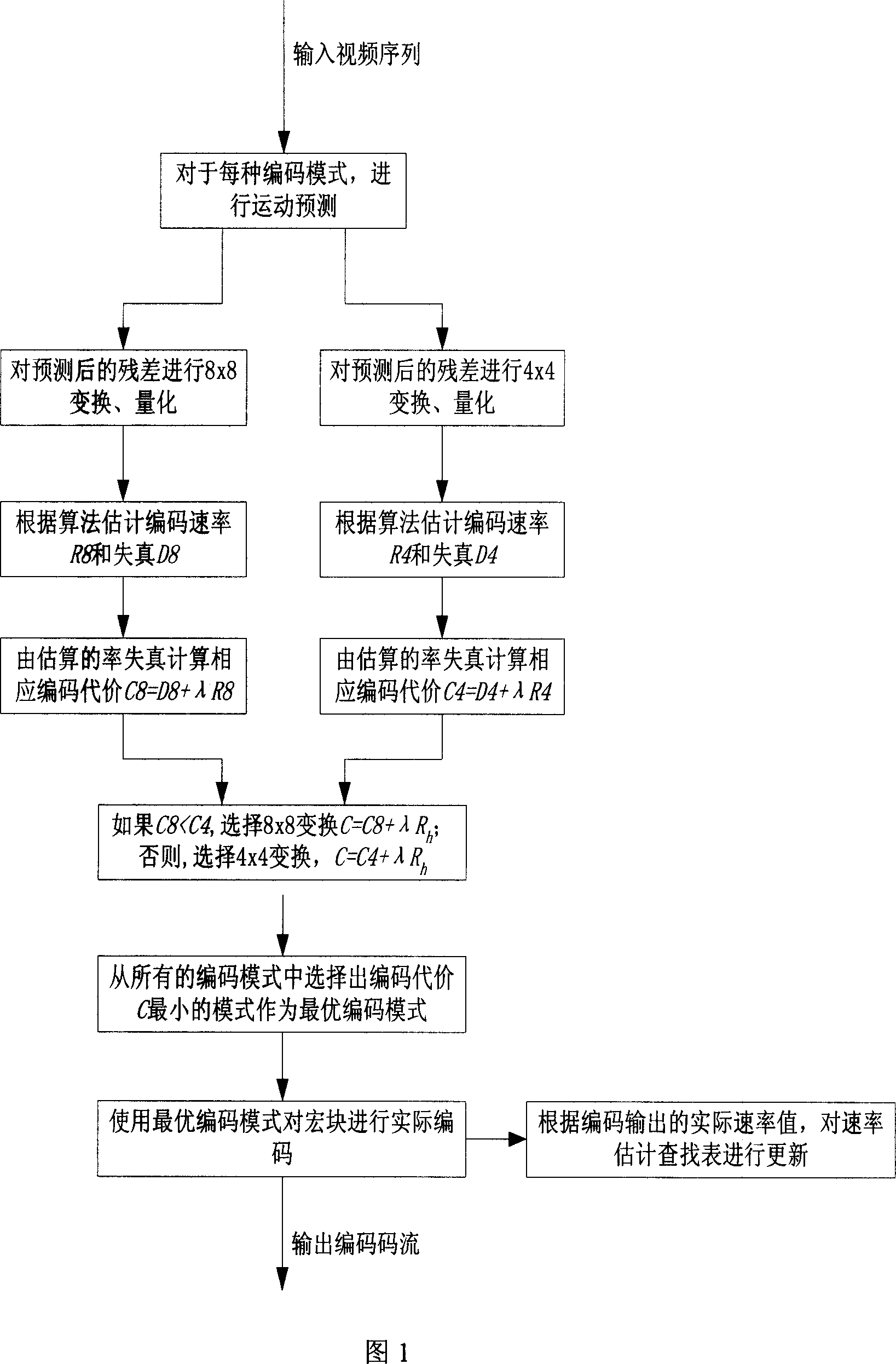
[0028] The present invention, as shown in accompanying drawing 1, comprises the following steps:
[0029] (1) For each alternative coding mode, perform motion estimation on the current coded macroblock, which can be carried out by using the full search or fast search method specified in the H.264 / AVC standard; obtain the residual signal S res =|S orig -S ref |, S orig is the original coded block signal, S ref a reference block signal determined for motion estimation;
[0030] (2) In each encoding mode, for the luminance residual signal S obtained in step (1) res Carry out 8×8 and 4×4 integer transformations respectively. The integer transformation adopts the method specified in the H.264 / AVC standard, and the formula is X ...
PUM
 Login to View More
 Abstract
Description
Claims
Application Information
 Login to View More