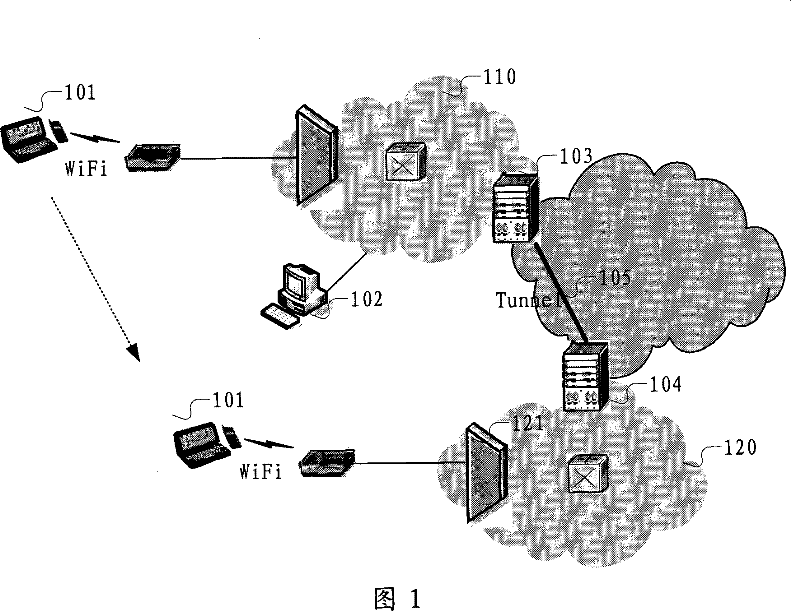
Layer 2 / 3 network access devices 121 such as DSLAM (Digital Subscriber Office Equipment) usually listen to DHCP (Dynamic Host Configuration Protocol) messages, and extract
MAC address information, IP addresses, And other network parameters (such as the default router) and
record port information, establish and maintain the corresponding FIB (
Forwarding Information Base) and forward the uplink and downlink IP data packets according to the FIB, but the
DHCP snooping method is very important to the mobile There will be the following problems when the IPv4 data packet is forwarded: when the mobile node 101 moves to the visited network 120, obtains a
foreign agent care-of address FACOA by receiving an agent advertisement message from the FA 104 and registers with the FA 104, the aforementioned
DHCP snooping method obtains The FIB of the mobile node does not include the mapping relationship between the current port of the mobile node and the HoA (home address), so that the mobile IPv4 data packet from the
foreign agent FA cannot be correctly forwarded to the mobile node 101
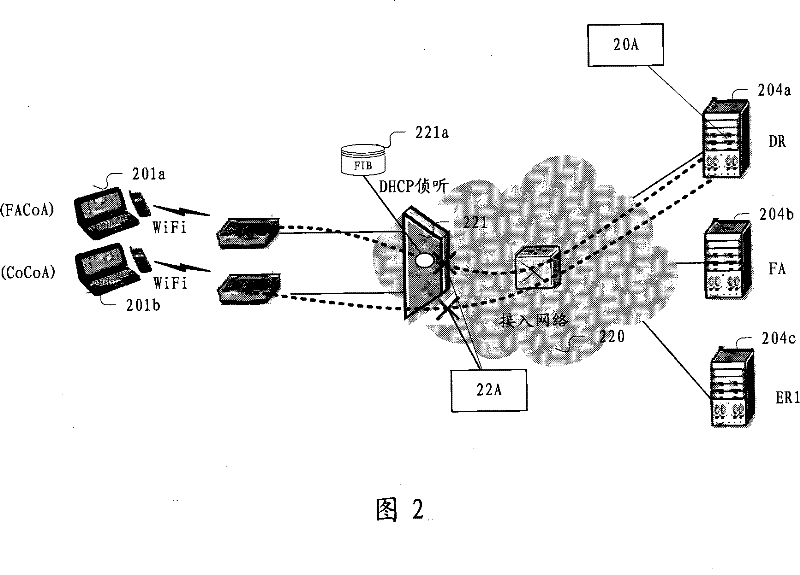
[0004] In addition, with the development of mobile services, the number of mobile nodes will increase day by day. figure 2 In the illustrated
mobile IP communication network
system structure, the new
foreign agent 204b and the edge router 204c will be deployed at the edge of the
access network. Registration or
data exchange, or when the mobile node 201b with a configured care-of address CoCoA expects to register and exchange data with the home agent through the foreign agent 204b (or edge router 204c), the mobile IPv4 control message sent by the mobile node 201a, 201b And the IP data packet will first be forwarded to the default router 204a by the
network access device 221 according to the FIB established in the aforementioned
DHCP snooping mode, rather than directly forwarding to the foreign agent 204b, which the mobile node 201a data packet destination
IP address points to. And the foreign agent 204b (or edge router 204c) that mobile node 201b data packet destination
IP address points to, will make the default router 204a in the access network system 220 be in overload state (shown in figure 20A) like this; Another problem is, in In the communication network access system, the allocation of
IP address pools (subnet space) is generally adjusted according to specific usage conditions. When an IP
address pool is exhausted, it is allocated to another new
address pool. The
address pool space owned by default router 204a, foreign agent 204b, and edge router 204c may be different and non-continuous. Network access equipment 221 such as DSLAM forwards the destination
network address issued by mobile node 201a to foreign agent During the mobile IPv4 control message and IP data packet of 204b, or when forwarding the destination
network address that mobile node 201b sends is the mobile IPv4 control message and IP data packet of foreign agent 204b (or edge router 204c), if the default router 204a is set "Secured ARP option" does not respond to ARP requests that are not in the same subnet range, and the
network access device 221 cannot obtain the
MAC address corresponding to the default router 204a interface, and will not be able to forward the aforementioned data packets and discard them (Fig. Show 22A)


 Login to View More
  Login to View More