
Device and method for measuring living body electric conductivity of plant leaf
A plant leaf and measurement method technology, which is applied in the field of measuring plant physiological and biochemical indicators, can solve the problems of time-consuming, complicated test methods, and inability to measure the electrical conductivity of living plant leaves, so as to achieve the effect of ensuring accuracy and simple test methods
- Summary
- Abstract
- Description
- Claims
- Application Information
AI Technical Summary
Problems solved by technology
Method used
Image

Examples
Embodiment Construction
[0039] The specific implementation manners of the present invention will be further described in detail below in conjunction with the accompanying drawings and embodiments. The following examples are used to illustrate the present invention, but are not intended to limit the scope of the present invention.
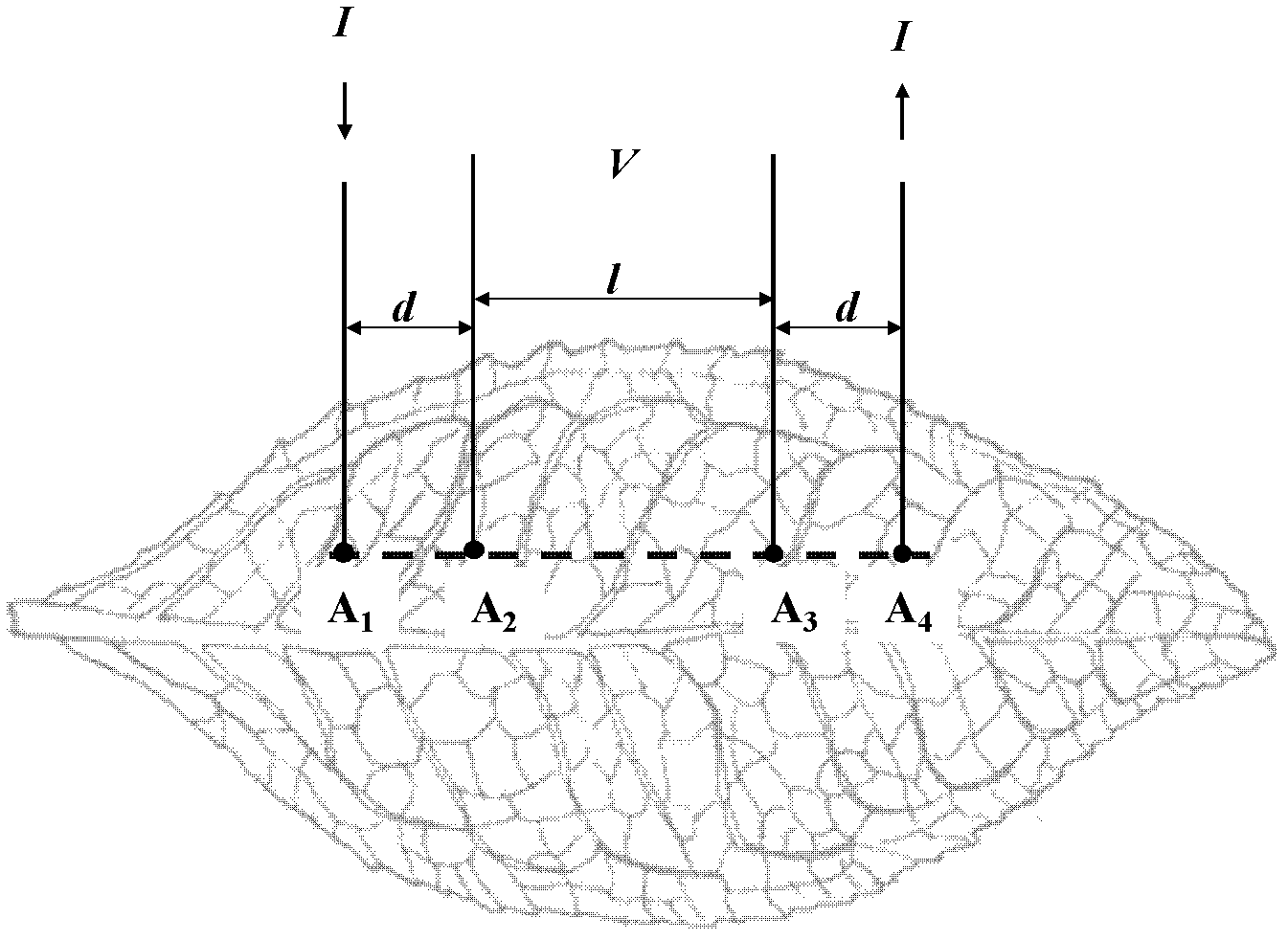
[0040] Generally, for a regular wire (the cross-sectional area does not change), the electrical conductivity (σ) has the following relationship with the current (I) passing through the wire and the voltage drop (V) at both ends of the wire.
[0041] σ = k I V - - - ( 1 )
[0042] In the formula, k is a constant related to the cross-sectional area and length of a regular wire. For a fixed wire, k is constant, and the conductivity (σ) is easy to find.
[0043] However, when applied to plants, since the living plant leaf is ...
PUM
 Login to View More
 Abstract
Description
Claims
Application Information
 Login to View More