Electrocerebral time-frequency component dual positioning normal form quick character input method

A character input and EEG technology, which is applied in the input/output of user/computer interaction, the input/output process of data processing, and electronic digital data processing, etc., can solve problems such as difficult potential and character input speed bottleneck, and achieve Improve the ITR, omit the shift key operation, and improve the overall performance of the system

CN102609090BActive Publication Date: 2014-06-04NAT UNIV OF DEFENSE TECH
3 Cites 0 Cited by

Patent Information

Authority / Receiving Office
CN · China
Patent Type
Patents(China)
Current Assignee / Owner
Publication Date
2014-06-04

Smart Images

  • Figure 1
    Figure 1
  • Figure 2
    Figure 2
  • Figure 3
    Figure 3
Patent Text Reader

Abstract

The invention discloses an electrocerebral time-frequency component dual positioning normal form quick character input method, which includes the steps: (1) exerting visual stimulation on a time domain and a frequency domain after a character input phase is started; (2) dividing channels of EEG (electroencephalogram) signals acquired in real time into two groups according to time-frequency components including SSVEP (steady-state visual evoked potentials) and P300 so as to perform signal processing respectively while a user pays attention to a target character; (3) judging whether the user executes character input operation or not, determining the target character by means of the step (2) and displaying the target character on a character input result display area if the user is judged to execute character input operation, and if the user is judged not to execute character input operation, shifting to a character input interface rather than performing character input, and then shifting to the step (1) so that the user reselects the target character. The method has the advantages of simplicity in principle, convenience in operation, capabilities of improving target identification accuracy rate and increasing character input speed and the like.
Need to check novelty before this filing date? Find Prior Art

Description

technical field

[0001] The invention mainly relates to the technical field of brain-computer interface, in particular to a fast character input system designed by adopting dual positioning paradigms of EEG time-domain components and frequency-domain components. Background technique

[0002] Brain-Computer Interface (BCI) is a new communication system that does not depend on the participation of peripheral nerves and muscles. It recognizes people's intentions by detecting and distinguishing the spatiotemporal patterns of different brain activities in EEG signals, so as to realize the communication and control between the human brain and the outside world. BCI does not require the participation of human body activities or language expressions, and is non-action and non-contact. The original intention of its research is to serve patients with motor neurological diseases. At present, BCI has broad application prospects in the fields of disability assistance, rehabilitation engi...

Examples

Embodiment Construction

[0036] The present invention will be described in further detail below in conjunction with the accompanying drawings and specific embodiments.

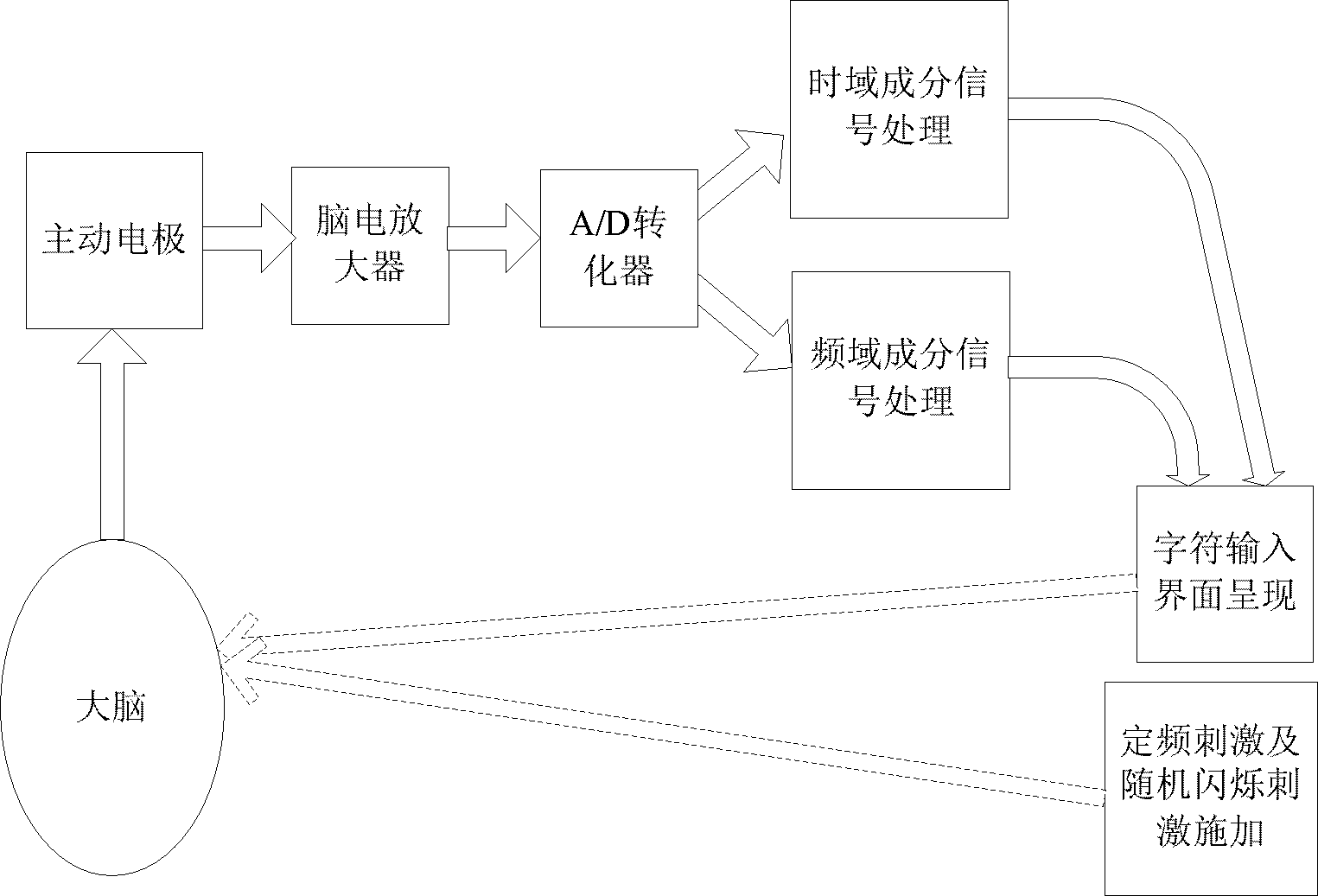
[0037] Such as figure 1 and Figure 5 As shown, the present invention adopts the fast character input method of double positioning paradigm of EEG time-frequency component, and its steps are:

[0038] (1) After entering the character input stage, apply the visual stimulation of time domain and frequency domain simultaneously;

[0039] (2) While the user pays attention to the target character, the EEG signal collected in real time is divided into two groups according to the time-frequency components SSVEP and P300 for signal processing;

[0040] (3) Judging whether the user is performing a character input operation, if the judgment result is yes, then adopt the method of step (2) to determine the target character, and display it in the character input result display area; if the judgment result is no, then do not proceed Character o...