A method for batch induction of turbot tetraploid fry
What is AI technical title?
AI technical title is built by Patsnap AI team. It summarizes the technical point description of the patent document.
A technology of turbot and tetraploid, applied in the field of chromosome manipulation
Inactive Publication Date: 2015-09-23
INST OF OCEANOLOGY - CHINESE ACAD OF SCI
View PDF5 Cites 0 Cited by
Summary
Abstract
Description
Claims
Application Information
AI Technical Summary
This helps you quickly interpret patents by identifying the three key elements:
Problems solved by technology
Method used
Benefits of technology
Problems solved by technology
[0004] In view of the situation that the treatment time cannot be accurately determined in the previous tetraploid induction experiment and the induction efficiency is affected, the purpose of the present invention is to provide a method for batch induction of turbot tetraploid fry
Method used
the structure of the environmentally friendly knitted fabric provided by the present invention; figure 2 Flow chart of the yarn wrapping machine for environmentally friendly knitted fabrics and storage devices; image 3 Is the parameter map of the yarn covering machine
View more
Image
Smart Image Click on the blue labels to locate them in the text.
Viewing Examples
Smart Image
Click on the blue label to locate the original text in one second.
Reading with bidirectional positioning of images and text.
Smart Image
Examples
Experimental program
Comparison scheme
Effect test
Embodiment 1
[0026] In this embodiment, the fertilization period, the incubation period, and the induction period. The seawater temperature used in the three periods is constant and the water temperature suitable for fertilization and incubation of turbot eggs, that is, the seawater temperature in the three periods of fertilization, incubation, and induction is 14.5± 0.1°C.
[0027] 1) Collection of gametes
[0028] Select the broodstock that is in the expectation of spawning and spawning and gently lay it flat on a soft cushion, wipe off the water and dirt around its body surface and genital opening, and then slowly squeeze it from back to front, and the sperm and eggs are respectively squeezed into the beaker Or spare in the basin. Observed under a dissecting microscope, the eggs are spherical, transparent, oil balls are concentrated, the egg diameter is moderate, and the size is uniform; the semen is milky white and the concentration is appropriate. The sperm has high motility and long swim...
Embodiment 2
[0044] In this embodiment, the fertilization period, the incubation period, and the induction period. The seawater temperature used in the three periods is constant and suitable for the fertilization and incubation of turbot eggs, that is, the seawater temperature in the three periods of fertilization, incubation, and induction is 15.0± 0.1°C.
[0045] 1) Collection of gametes
[0046] Select the broodstock that is in the expectation of spawning and spawning and gently lay it flat on a soft cushion, wipe off the water and dirt around its body surface and genital opening, and then slowly squeeze it from back to front, and the sperm and eggs are respectively squeezed into the beaker Or spare in the basin. Observed under a dissecting microscope, the eggs are spherical, transparent, oil balls are concentrated, the egg diameter is moderate, and the size is uniform; the semen is milky white and the concentration is appropriate. After activation under the microscope, the sperm has high m...
Embodiment 3
[0062] In this embodiment, the fertilization period, the incubation period, and the induction period. The seawater temperature used in the three periods is a constant water temperature suitable for fertilization and incubation of turbot eggs, that is, the seawater temperature in the three periods of fertilization, incubation, and induction is 15.5± 0.1°C.
[0063] 1) Collection of gametes
[0064] Select the broodstock that is in the expectation of spawning and spawning and gently lay it flat on a soft cushion, wipe off the water and dirt around its body surface and genital opening, and then slowly squeeze it from back to front, and the sperm and eggs are respectively squeezed into the beaker Or spare in the basin. Observed under a dissecting microscope, the eggs are spherical, transparent, oil balls are concentrated, the egg diameter is moderate, and the size is uniform; the semen is milky white and the concentration is appropriate. After activation under the microscope, the sper...
the structure of the environmentally friendly knitted fabric provided by the present invention; figure 2 Flow chart of the yarn wrapping machine for environmentally friendly knitted fabrics and storage devices; image 3 Is the parameter map of the yarn covering machine
Login to View More
PUM
Login to View More
Abstract
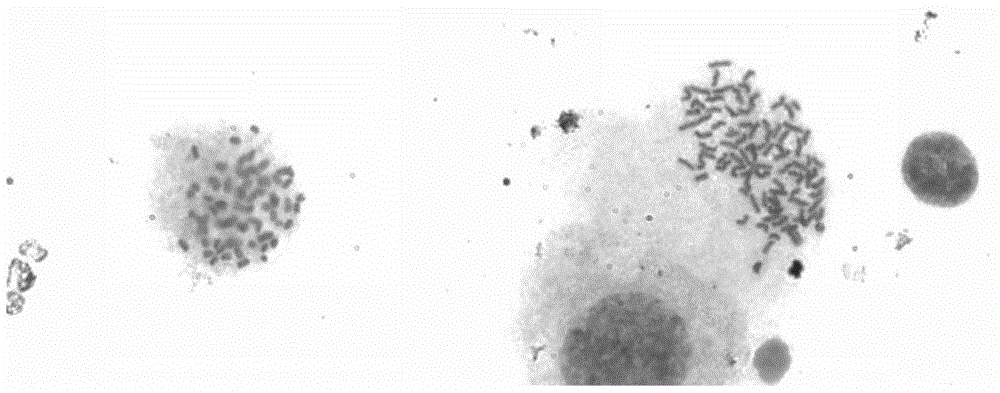
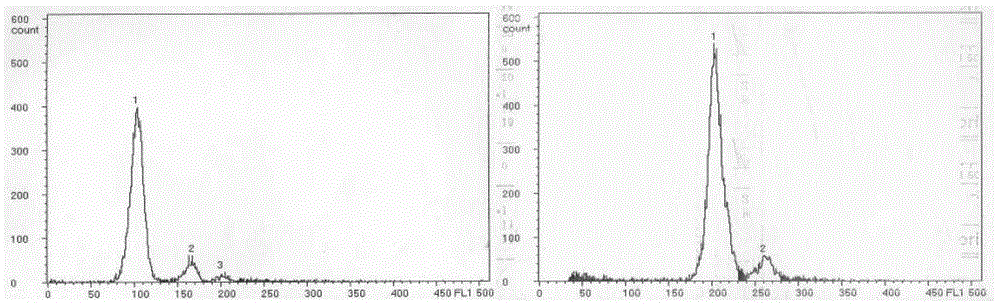
The invention relates to a chromosome manipulation technique, in particular to a method for batch induction of scophthalmus maximus tetraploid fries. The method comprises the steps as follows: selecting pubescent scophthalmus maximus parent fishes, and respectively collecting seminal fluid and fish eggs for standby use; taking the seminal fluid and the fish eggs at the volume ratio of 1:(100-200) to perform fertilization, the process of which is used as a control group; after artificial fertilization is performed for 15-25 min in the control group, taking collected seminal fluid and fish eggs at a volume ratio of 1:(100-200) to perform fertilization, the process of which is used as an induction group; taking the time when 70-80 percent of fertilized eggs in the control group generate egg cracks for the first time as the time when fertilized eggs in the induction group generate egg cracks for the first time, and in the time period of 10-20 min before egg cracks are generated for the first time in the induction group, putting the fertilized eggs in the induction group into a pressurizing vessel of a hydrostatic press, performing pressure shock treatment for 6-8 min under the hydrostatic pressure of 60-70 MPa and performing pressure relief, taking out the fertilized eggs and putting into seawater for continuous culturing; measuring the tetraploid rate in the gastrula period and fry period. By adopting the method, the tetraploid rate can be up to 90 percent, and scophthalmus maximus tetraploid fries can be obtained efficiently and stably through induction.
Description
Technical field [0001] The invention relates to chromosome manipulation technology, in particular to a method for inducing turbot tetraploid fry in batches by using the principle of hydrostatic pressure to inhibit cleavage of fertilized eggs. Background technique [0002] Turbot (Scophthalmus maximus) belongs to the Scophthalmidae and Scophthalmus genus. It grows fast and has become the main marine aquaculture species in northern my country. The breeding technology and industrial chain are relatively complete. However, in recent years, turbot breeding industry has caused serious degradation of germplasm due to repeated breeding and inbreeding. Therefore, it has become an urgent task to adopt effective methods to genetically improve turbot, and to fundamentally solve the problem of improving turbot breeding industry. Polyploidy has always attracted the attention of researchers and aquaculture industry due to its short cycle, quick effect and high safety. Among them, triploid fis...
Claims
the structure of the environmentally friendly knitted fabric provided by the present invention; figure 2 Flow chart of the yarn wrapping machine for environmentally friendly knitted fabrics and storage devices; image 3 Is the parameter map of the yarn covering machine
Login to View More
Application Information
Patent Timeline
Application Date:The date an application was filed.
Publication Date:The date a patent or application was officially published.
First Publication Date:The earliest publication date of a patent with the same application number.
Issue Date:Publication date of the patent grant document.
PCT Entry Date:The Entry date of PCT National Phase.
Estimated Expiry Date:The statutory expiry date of a patent right according to the Patent Law, and it is the longest term of protection that the patent right can achieve without the termination of the patent right due to other reasons(Term extension factor has been taken into account ).
Invalid Date:Actual expiry date is based on effective date or publication date of legal transaction data of invalid patent.



 Login to View More
  Login to View More