
Soft tissue deformation method based on mixing of gridding method and non-gridding method
A mesh-free, soft-tissue technology, applied in instrumentation, computing, electrical digital data processing, etc., can solve problems such as the calculation amount affecting the system running speed and affecting the real-time performance of the simulation
- Summary
- Abstract
- Description
- Claims
- Application Information
AI Technical Summary
Problems solved by technology
Method used
Image

Examples
Embodiment Construction
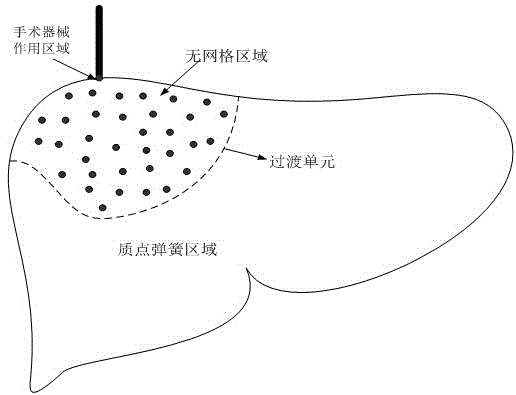
[0051] The technical solution of the present invention will be specifically described below in conjunction with the accompanying drawings.
[0052] A soft tissue deformation method based on mesh and meshless mixture of the present invention comprises the following steps,
[0053] S1: Use the collision detection algorithm to complete the confirmation of the meshless modeling position with variable regions;
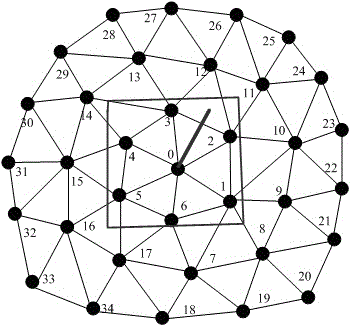
[0054] S2: Establish a layer of mesh-free model according to the stored virtual soft tissue geometric connection topology information;
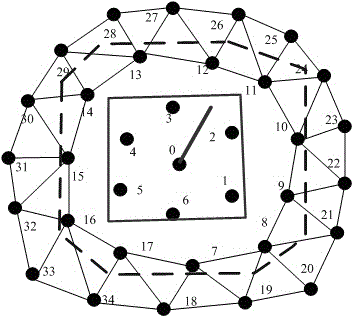
[0055] S3: Expand the meshless model that cannot cover the large deformation area in the deformation simulation and cannot meet the real effect;
[0056] S4: Repeat step S3 to complete the dynamic expansion of the region-variable meshless modeling area, form an N-layer meshless model, and establish a hybrid model that dynamically converts from mesh to meshless;
[0057] S5: Use a meshless model to model the local large deformation region...
PUM
 Login to View More
 Abstract
Description
Claims
Application Information
 Login to View More