
A Dynamic Matching Method for Maintaining Connectivity in Multi-Server DVE System
A multi-server, dynamic matching technology, applied in transmission systems, digital transmission systems, instruments, etc., can solve the problems of increasing the complexity of virtual world map maintenance and increasing the probability of client migration The effect of reducing communication overhead and ensuring connectivity
- Summary
- Abstract
- Description
- Claims
- Application Information
AI Technical Summary
Problems solved by technology
Method used
Image

Examples
Embodiment Construction
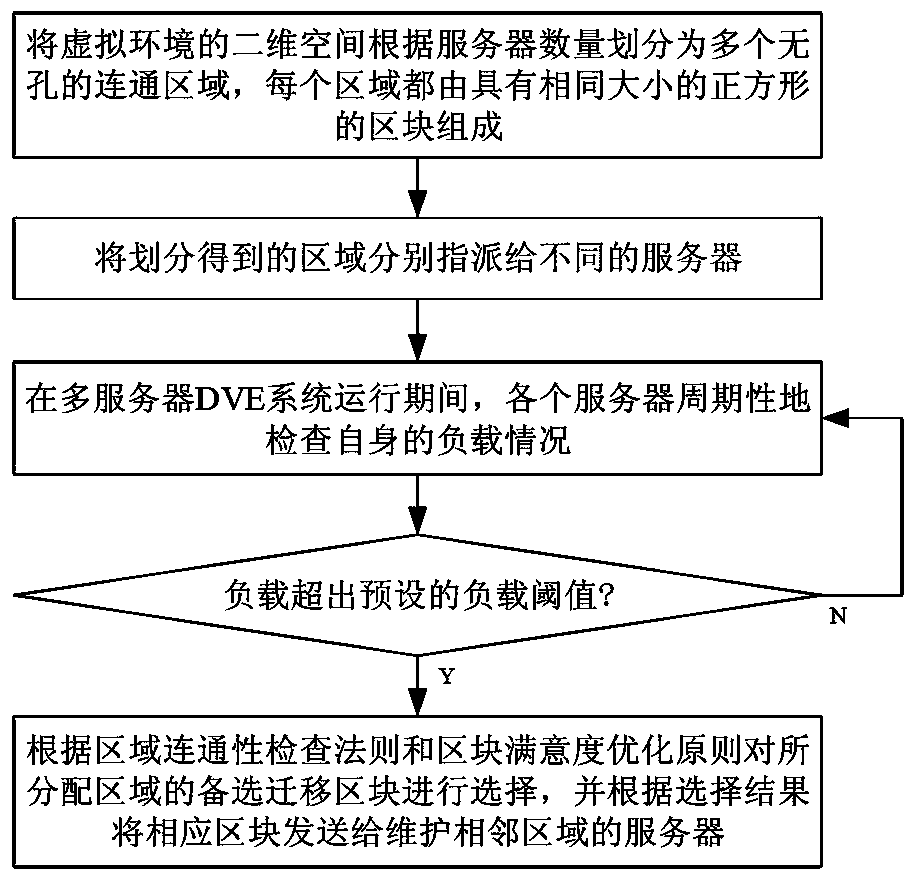
[0027] Such as figure 1 As shown, the steps of the dynamic matching method for maintaining connectivity in the multi-server DVE system of this embodiment include:
[0028]1) Before the operation of the multi-server DVE system, the two-dimensional space of the virtual environment of the multi-server DVE system is divided into multiple non-porous connected areas according to the number of servers, and each area is composed of square blocks with the same size , a block is the smallest unit of two-dimensional space migration between different servers in the load balancing process; a connected region means that all the blocks that make up the region can form a strongly connected subgraph, and for any two blocks in the region, both A path can be found in this area to connect the two blocks, and this path only includes the connecting lines in the horizontal and vertical directions, and does not include the oblique line at a 45-degree angle; the connected area without holes refers to ...
PUM
 Login to View More
 Abstract
Description
Claims
Application Information
 Login to View More