An Optimal Power Allocation Method for Increasing Secure Energy Efficiency in Bidirectional Relay Networks

A two-way relay and energy-efficient technology, applied in power management, wireless communication, electrical components, etc., can solve problems such as not taking system energy efficiency into consideration, and achieve the effect of simplifying operation and calculation process

CN106332259BActive Publication Date: 2019-02-26NORTHWESTERN POLYTECHNICAL UNIV
5 Cites 0 Cited by

Patent Information

Authority / Receiving Office
CN · China
Patent Type
Patents(China)
Current Assignee / Owner
Publication Date
2019-02-26

Smart Images

  • Figure 1
    Figure 1
  • Figure 2
    Figure 2
  • Figure 3
    Figure 3
Patent Text Reader

Abstract

The invention provides an optimal power allocation method for increasing safe energy efficiency in bidirectional relay networks, comprising the steps of first, performing process modeling for the two-way full-duplex relay network communication, and then considering to design the most optimized power allocation factor under limited conditions of the total power so that safety energy efficiency is maximized in order to improve the safe energy efficiency of the power-limited full-duplex bi-directional relay network.The method considers the energy efficiency that can be maximized under the limited conditions of total power and protects the users' information is decoded by the untrusted relay nodes as much as possible. In addition, the method simplifies the calculation process by Taylor expansion and simplifies operation to bring the estimated error of not more than 6%, which is negligible.
Need to check novelty before this filing date? Find Prior Art

Description

technical field

[0001] The invention relates to an optimal power allocation scheme for cooperative and safe transmission of a two-way relay network. Background technique

[0002] Multi-hop relay is identified as an energy-efficient transmission scheme, which is the optimal way to solve wireless communication security. The method of physical layer secure transmission has the advantages of low computational complexity and resource saving. In recent years, cooperative diversity technology has attracted the attention of many scholars because it can improve the security of the physical layer against eavesdropping.

[0003] In the physical layer, there is a game problem of power allocation between users and interference sources. The interference source hopes to transmit an interference signal with sufficient power to prevent eavesdroppers from eavesdropping on the user's transmission information, and the user also hopes that the transmitted signal has sufficient power to ensure ...

Examples

Embodiment Construction

[0054] The present invention will be further described below in conjunction with the accompanying drawings and embodiments, and the present invention includes but not limited to the following embodiments.

[0055] The present invention utilizes the optimal power allocation factor under the condition of limited total power to maximize the security energy efficiency and protect user information from eavesdropping and interference by untrustworthy relay nodes as much as possible.

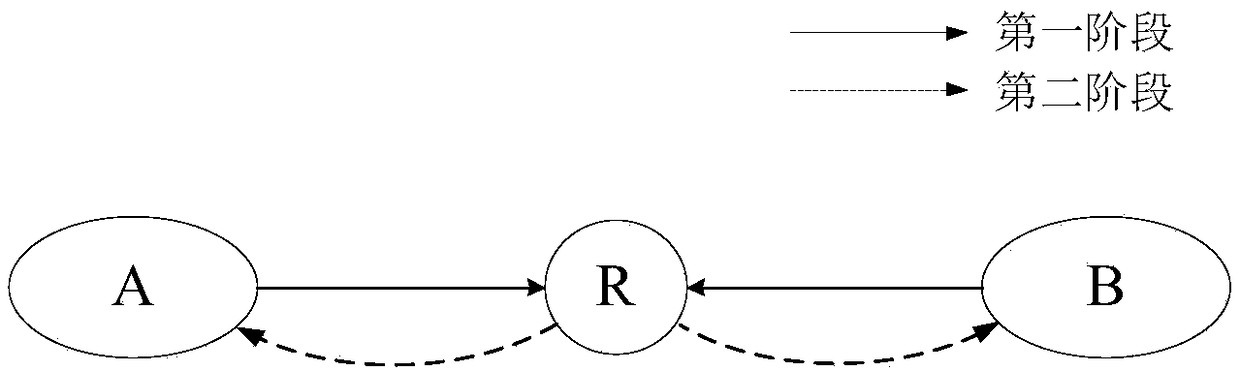
[0056] The system model used in the present invention is a full-duplex two-way relay network with three nodes, and its functional block diagram is as follows figure 1 shown. In this model, there is a user A and a user B. There is no direct communication link between A and B due to shadow fading or too far away, and they can only communicate through an untrusted relay node R. The relay node R can not only amplify-transmit the received signal, but also may be able to decode the encrypted information of ...