
A genetic detection kit for hereditary deafness
A technique for hereditary deafness and genetic testing, which is applied in the determination/inspection of microorganisms, biochemical equipment and methods, etc., and can solve the problems of few detection sites, complicated operation, time-consuming and laborious, and high cost
- Summary
- Abstract
- Description
- Claims
- Application Information
AI Technical Summary
Problems solved by technology
Method used
Image


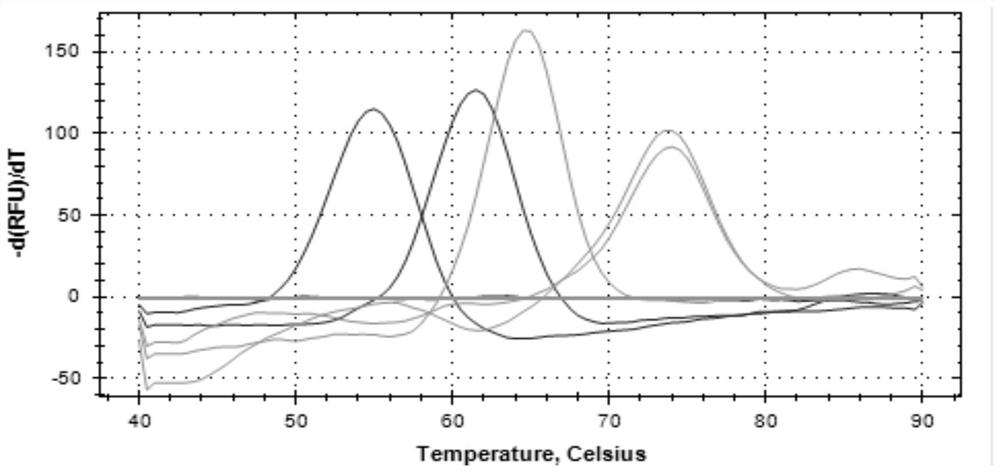
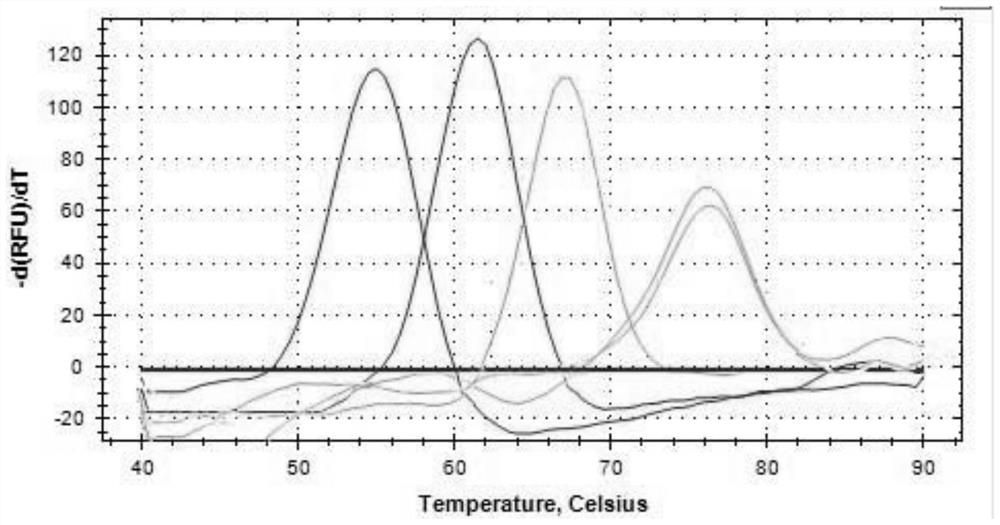
Examples
Embodiment 1
[0097] The kit of the present invention can simultaneously detect 30 mutation sites in four hotspot genes related to hereditary deafness, that is, GJB2 (35delG, 109G>A, 155delTCTG, 167delT, 176-191del16, 235delC, 299-300delAT, 512insAACG) , GJB3(538C>T, 547G>A), SLC26A4(281C>T, 589G>A, 749T>C, 754T>C, IVS7-2A>G, 1174A>T, 1226G>A, 1229C>T, 1975G> C, 2027T>A, IVS15+5G>A, 2162C>T, 2168A>G), mtDNA (961T>G, 1095T>C, 1494C>T, 1555A>G, 7444G>A, 7445A>G, 12201T>C ).
[0098] 1. Design and screening of primers
[0099] First, use the sequences of various mutation sites reported in the literature to design specific amplification LATE-PCR primers for the purpose of using multiple asymmetric PCR to detect multiple genotypes in the same tube (a total of five tubes), by randomly combining different Primers, optimize the annealing temperature gradient, and finally select a batch of primers with good specificity, which can meet the clinical needs of rapid and convenient detection of deafnes...
Embodiment 2
[0148] The hereditary deafness gene detection kit of the invention adopts LATE-PCR and multicolor fluorescent probe PCR melting curve technology. Design corresponding probes in the mutation region to be detected, and design an upstream primer and a downstream primer on the periphery of the designed probe, use the upstream primer and downstream primer to PCR amplify the fragment containing the region to be detected, and the PCR amplification ends followed by melting curve analysis. Subtract the corresponding Tm value of the standard control in each detection channel from the Tm value of the sample to be tested in each detection channel to obtain the ΔTm value of each detection channel, and judge whether there is a mutation and the type of mutation in the sample to be tested according to the ΔTm value.
[0149] 1. The main components of the hereditary deafness gene detection kit of the present invention are shown in Table 8, where the primers and probes are defined by the corres...
PUM
 Login to View More
 Abstract
Description
Claims
Application Information
 Login to View More