Speaker intelligibility detection method for cochlear implant signals in noisy environment

A technology of cochlear implants and detection methods, which is applied in speech analysis, speech recognition, instruments, etc., and can solve problems such as the decline of speech comprehension of cochlear implants

CN107767859BActive Publication Date: 2020-10-20JILIN UNIV
8 Cites 0 Cited by

Patent Information

Authority / Receiving Office
CN · China
Patent Type
Patents(China)
Current Assignee / Owner
Publication Date
2020-10-20

Smart Images

  • Figure 1
    Figure 1
  • Figure 2
    Figure 2
  • Figure 3
    Figure 3
Patent Text Reader

Abstract

The invention relates to a speaker understandability detection method of an artificial cochlea signal under the noise environment, and belongs to the field of voice signal processing. Firstly the artificial cochlea processing algorithm is performed on a pure reference voice signal and waveform reconstruction is performed so that the pure voice after artificial cochlea processing can be obtained. Then the voice model of the specific speaker is established after feature extraction; and as for the identification phase, the voice and the noise are purely identified and then the identified voice with noise is formed, and matching with the speaking understandability model is performed after feature extraction so that the final detection result can be obtained. The advantages are that the important theoretical basis can be provided for enhancing the voice perception capacity of the artificial cochlea user, the influence of the noise in the matching process can be reduced, the detection accuracy can be enhanced, and the noise robustness of the detection method can be further enhanced by using the combined feature parameters based on the dynamic Gammachirp filter bank.
Need to check novelty before this filing date? Find Prior Art

Description

technical field

[0001] The invention relates to the field of speech signal processing, in particular to a method for detecting the speech intelligibility of different speakers in a noise environment for the speech signal processed by a cochlear implant. Background technique

[0002] At present, research on cochlear implants mainly focuses on the method of cochlear implants for sound processing, the intelligibility of cochlear implant users to different voices, and the development and improvement of cochlear implants or systems, such as patents CN103892939A, CN101716108A, CN101953722A, etc. Research on sound processing methods from cochlear implants; patent CN101770549A discloses an automatic detection method and detection system for speech processing strategies based on a "virtual processor", which detects the correctness of the implementation of cochlear implant processing algorithms, etc. Most of the current research focuses on the improvement of different processing algor...

Examples

Embodiment Construction

[0069] Include the following steps:

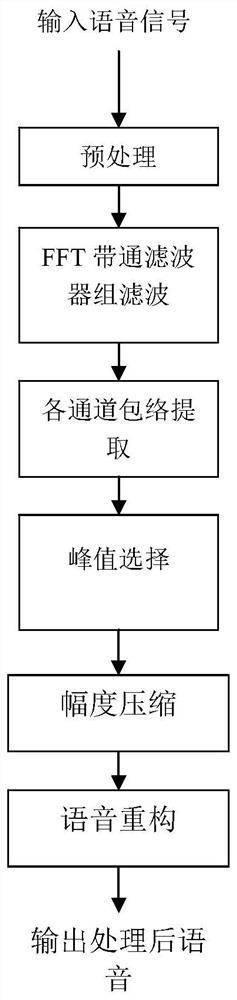
[0070] (1) The cochlear implant treatment process is as follows, such as figure 1 shown;

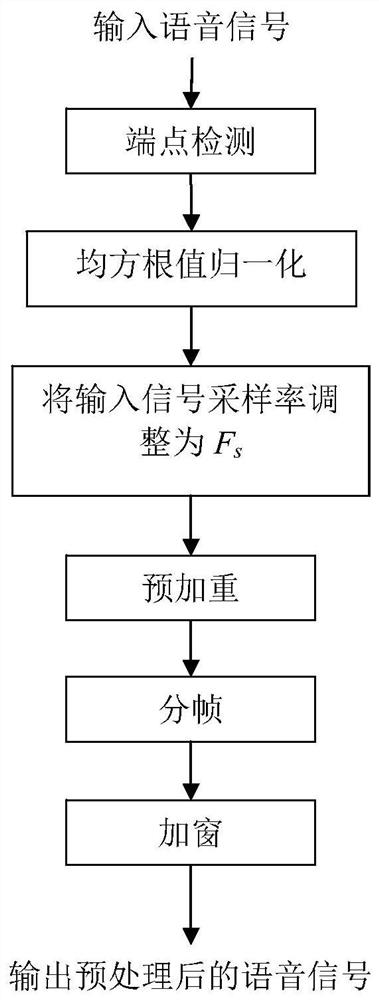
[0071] (1), preprocessing of speech signal

[0072] The preprocessing flow of the speech signal is as follows: figure 2 As shown, the process includes: input speech signal, endpoint detection, RMS normalization, adjusting the input signal sampling rate to F s , pre-emphasis, framing and windowing. Here, the energy detection method is used for endpoint detection; after the root mean square is normalized, the root mean square value of the input signal is 1; F s Take 16000Hz, if the sampling rate of the signal is not equal to F s , the signal needs to be resampled to F s ; Use a high-pass filter with a cutoff frequency of 1200Hz for pre-emphasis; use a Hamming window for frame division, wherein each frame is 8ms long (L=128 points), and N short-time frame signals with a frame length of L are obtained after preprocessing ;

[0073] (2), carry ou...