Green wave control method based on non-motor vehicles and buses

A non-motor vehicle, green wave control technology, applied in the field of intelligent transportation, can solve problems such as confusion, safety hazards, vehicle interference, etc.

CN108205904AActive Publication Date: 2018-06-26ZHEJIANG UNIV
8 Cites 10 Cited by

Patent Information

Authority / Receiving Office
CN · China
Current Assignee / Owner
Publication Date
2018-06-26

Smart Images

  • Figure 1
    Figure 1
  • Figure 2
    Figure 2
  • Figure 3
    Figure 3
Patent Text Reader

Abstract

The invention provides a green wave control method based on non-motor vehicles and buses. According to the method, the green wave design is performed by combination with the travel time of specific road section non-motor vehicles and buses passing through the adjacent intersections; in the process of calculating the flow ratio, the non-motor vehicles are no longer reduced as the roadside interference, but the flow of the non-motor vehicles is considered. At the same time, a calculation method for a maximum green wave band for the green waves of the non-motor vehicles and the buses is proposed.The per capita delay is used as an evaluation index; and on road segments suitable for green wave design for the non-motor vehicles and the buses, compared with a method for green wave design for cars, the green wave control method based on the non-motor vehicles and the buses can greatly reduce the per capita delay, which also reflects the shift of the transportation concept to people oriented.
Need to check novelty before this filing date? Find Prior Art

Description

technical field

[0001] The invention relates to a green wave control method based on non-motor vehicles and buses, which is used for urban road traffic management and control, and belongs to the technical field of intelligent transportation. Background technique

[0002] In recent years, my country's motor vehicles have grown rapidly, and urban congestion has become increasingly serious. Green wave control can effectively reduce vehicle delays at intersections, improve road traffic efficiency, and alleviate urban traffic congestion. But the current mainstream green wave control is designed for small cars. The low occupancy rate of cars leads to low operating efficiency of the road in a certain period. Combined with the development strategy of bus priority, many scholars have proposed a coordinated control method for bus priority signals.

[0003] At present, the common basic idea of ​​priority signal control for arterial buses is to dynamically monitor the bus vehicle info...

Examples

Embodiment Construction

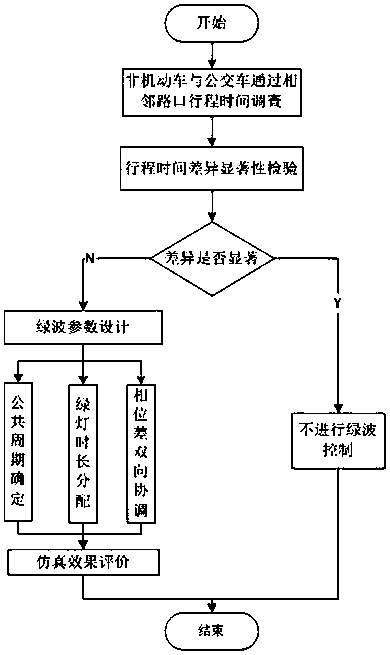
[0074] Attached below figure 1 The present invention is described in detail, and the concrete steps of the present invention are:

[0075] 1. Travel time investigation and analysis

[0076] (1), section selection

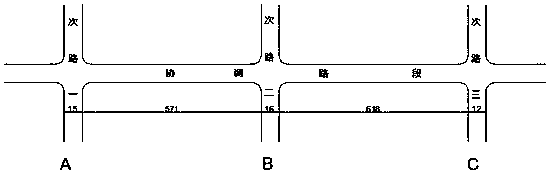
[0077] Three intersections on Moganshan Road in Hangzhou were selected as the research object. Moganshan Road is the main road leading to the center of Hangzhou in the west and north of Hangzhou City. It is a very important road in Hangzhou. , the traffic flow of motor vehicles and non-motor vehicles on Moganshan Road is very large, while the traffic of the three intersecting roads is relatively small, which is suitable for green wave control. The names of the investigated road sections and the distances between intersections are attached image 3 shown.

[0078] (2), travel time survey

[0079] Collect the flow of cars, buses, non-motorized vehicles (electric bicycles) and bus traffic at three consecutive intersections A, B, and C on Moganshan Road during the...