
A Two-Dimensional Turbulence Sensor with Orthogonal Cantilever Beam Structure
A technology of sensors and cantilever beams, applied in the field of turbulent flow sensors, can solve problems such as the inability to achieve single-point high-precision turbulent two-dimensional observations, sensor coupling disturbances, and cost issues, to meet the needs of multidisciplinary comprehensive observations, reduce sensor size, reduce The effect of manufacturing process complexity
- Summary
- Abstract
- Description
- Claims
- Application Information
AI Technical Summary
Problems solved by technology
Method used
Image

Examples
Embodiment Construction
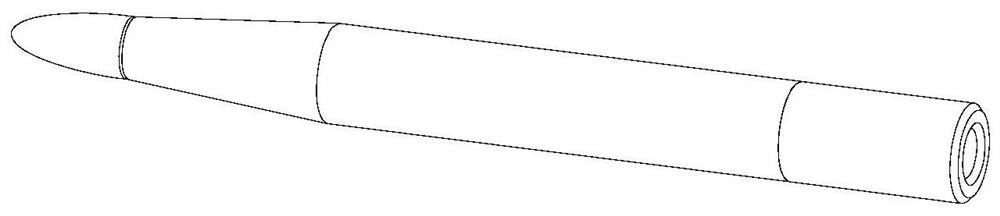
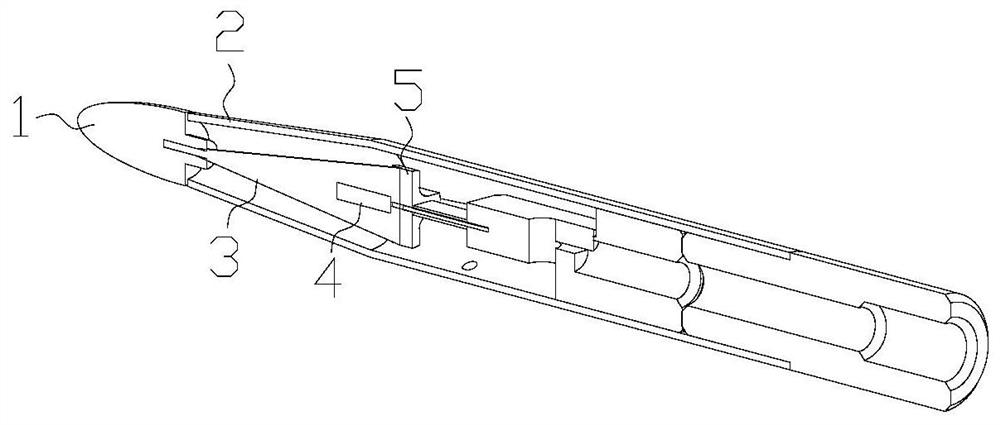
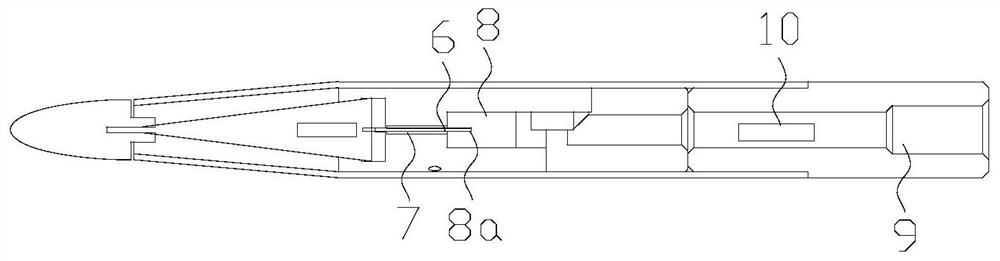
[0034] With reference to the accompanying drawings, a two-dimensional turbulence sensor with an orthogonal cantilever beam structure includes a probe 1, a sheath 2, a front beam 3, a first sensitive element 4, a conversion connector 5, a rear beam 6, a second sensitive element 7, a rear Seat 8, sealing rod 9 and conditioning circuit 10. The probe 1 is installed on the front end of the sheath 2, and a certain distance is reserved between the front end of the sheath 2 and the probe. The sheath 2 is a spindle-shaped shell structure with a hollow interior, and the front beam 3 is installed inside the front section of the sheath 2 . The front beam 3 is a plane triangular structure, placed vertically, the head tip of the front beam is provided with a connecting rod 3a, and the tail of the probe 1 is provided with a jack matched with the connecting rod, and the connecting rod is inserted into the jack. The first sensitive element 4 is mounted on the front beam 3 . The cross-section...
PUM
 Login to View More
 Abstract
Description
Claims
Application Information
 Login to View More