Face data identity recognition method based on generative adversarial network

A recognition method and generative technology, applied in the direction of character and pattern recognition, biological neural network model, neural learning method, etc., can solve the problems of loss of original face information, image quality degradation, etc., and achieve the effect of high image quality

CN112949535AActive Publication Date: 2021-06-11NANJING UNIV OF AERONAUTICS & ASTRONAUTICS
5 Cites 6 Cited by

Patent Information

Authority / Receiving Office
CN · China
Patent Type
Applications(China)
Current Assignee / Owner
Publication Date
2021-06-11

Smart Images

  • Figure 1
    Figure 1
  • Figure 2
    Figure 2
  • Figure 3
    Figure 3
Patent Text Reader

Abstract

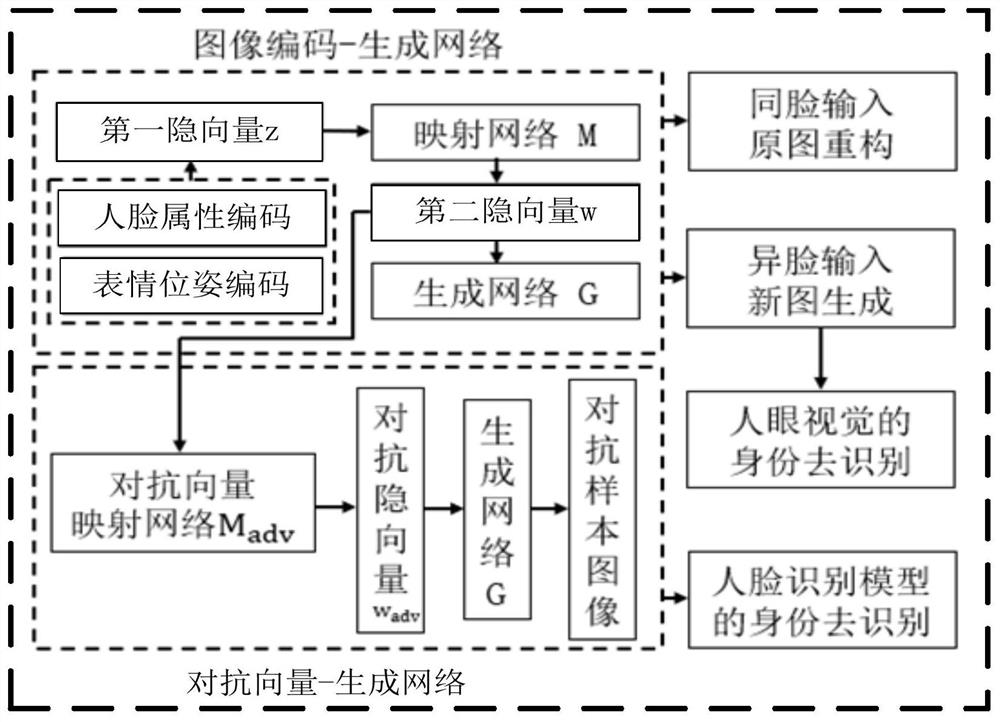
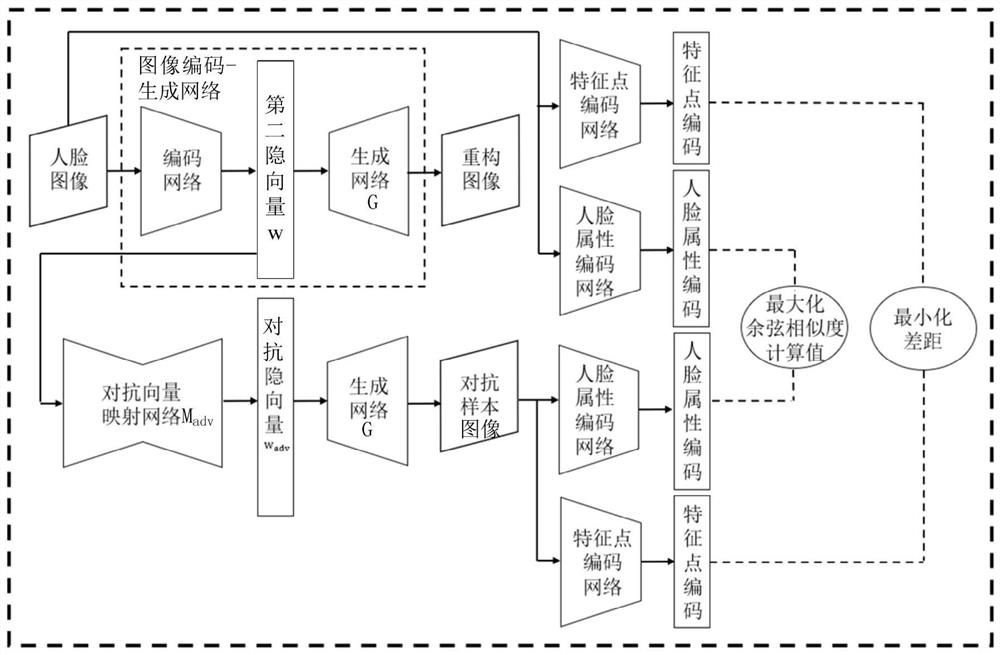
The invention discloses a face data identity recognition method based on a generative adversarial network, and relates to the technical field of biological feature recognition and artificial intelligence security, and the method comprises the steps: firstly constructing an image coding-generative network, respectively extracting an attribute feature code and an expression pose code of a face image through two coding networks; combining to obtain a first implicit vector, obtaining a second implicit vector through the mapping network, sending the second implicit vector into the generation network to obtain an output image, completing fusion of facial image attribute features and expression poses, and realizing identity recognition of human eye vision by using a face changing technology; and secondly, constructing an adversarial vector mapping network, inputting a second implicit vector into the adversarial vector mapping network to obtain an adversarial implicit vector, obtaining an adversarial sample image with a relatively large identification result difference of the face identification model and a relatively small human vision difference through a generative network, and realizing identity recognition of the face identification model through an adversarial sample technology.
Need to check novelty before this filing date? Find Prior Art

Description

technical field

[0001] The invention relates to the technical fields of biological feature recognition and artificial intelligence security, in particular to a face data identity de-recognition method based on a generative confrontation network. Background technique

[0002] In the era of artificial intelligence based on big data training, computer vision technology is widely used in security and tracking task scenarios, but the resulting security problems of misuse of face data have aroused people's concern about the necessity of protecting face privacy. Pay attention to. Traditional anonymized face technologies, such as mosaicing or blurring faces, have the disadvantage of large information loss, making it impossible for users or data developers to effectively use the anonymized face data. With the introduction of the concepts of adversarial samples and generative adversarial networks, two face recognition (De-identify, De-id) technologies represented by adding random noi...

Examples

Embodiment Construction

[0048] The specific embodiments of the present invention will be further described below in conjunction with the accompanying drawings.

[0049] This application discloses a face data identity de-identification method based on a generative confrontation network, the flow chart of which is as followsfigure 1 As shown, the de-identification method includes the following steps:

[0050] Step 1: Build an image encoding-generating network.

[0051] The image encoding-generating network is used to encode and decouple the face attributes and expression poses of the face image in the latent space. The face image includes the face attribute image and the expression pose image.

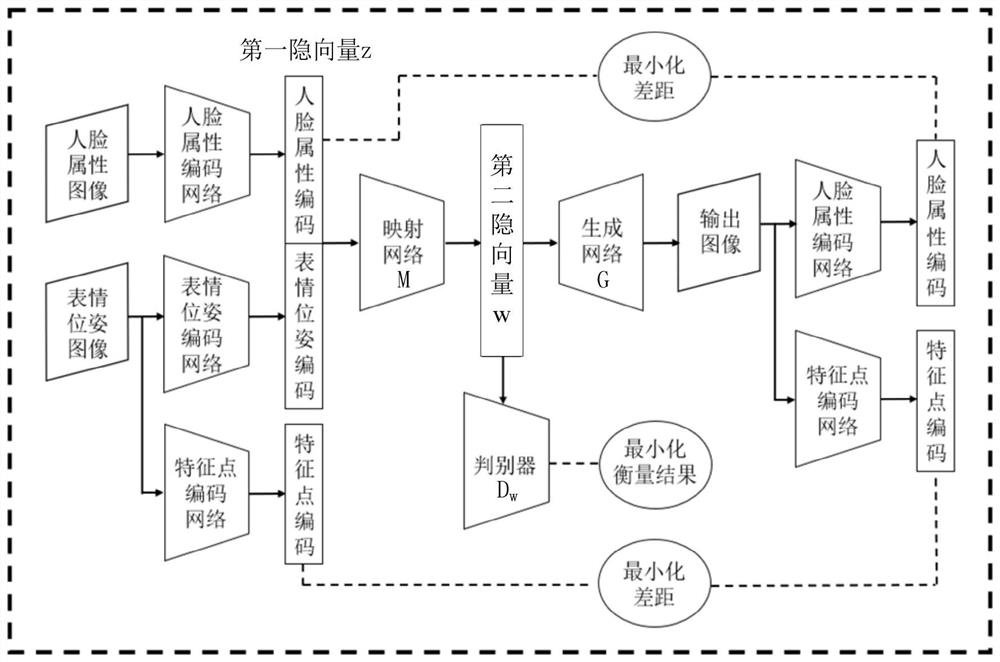
[0052] Such as figure 2 As shown, it specifically includes the following sub-steps:

[0053] Step 11: Build the model framework of image encoding-generating network, including:

[0054] The pre-trained ResNet-50 network is used as the face attribute encoding network, and the ResNet-50 network is pre-trained...