AI technical title is built by Patsnap AI team. It summarizes the technical point description of the patent document.
A spectacle lens and lens technology, which is applied in the direction of thin material processing, glasses/goggles, coating, etc., and can solve problems such as difficulty in handling lenses
Inactive Publication Date: 2012-07-18
ESSILOR INT CIE GEN DOPTIQUE
View PDF2 Cites 0 Cited by
Summary
Abstract
Description
Claims
Application Information
AI Technical Summary
This helps you quickly interpret patents by identifying the three key elements:
Problems solved by technology
Method used
Benefits of technology
Problems solved by technology
[0026] Difficulty handling such lenses by conventional means
Method used
the structure of the environmentally friendly knitted fabric provided by the present invention; figure 2 Flow chart of the yarn wrapping machine for environmentally friendly knitted fabrics and storage devices; image 3 Is the parameter map of the yarn covering machine
View more
Image
Smart Image Click on the blue labels to locate them in the text.
Viewing Examples
Smart Image
Click on the blue label to locate the original text in one second.
Reading with bidirectional positioning of images and text.
Smart Image
Examples
Experimental program
Comparison scheme
Effect test
example 1
[0124] deposited on CR39 performed on the substrate of the base ophthalmic lens, the CR39 The base ophthalmic lens comprises on both sides a polysiloxane type abrasion resistant coating corresponding to Example 3 of patent application EP614957. Wash the lenses in an ultrasonic cleaning vessel; and steam at a temperature of 100°C for a minimum of 3 hours. They are then ready for processing.
[0125] Two different types of lenses are processed:
[0126] - round lenses,
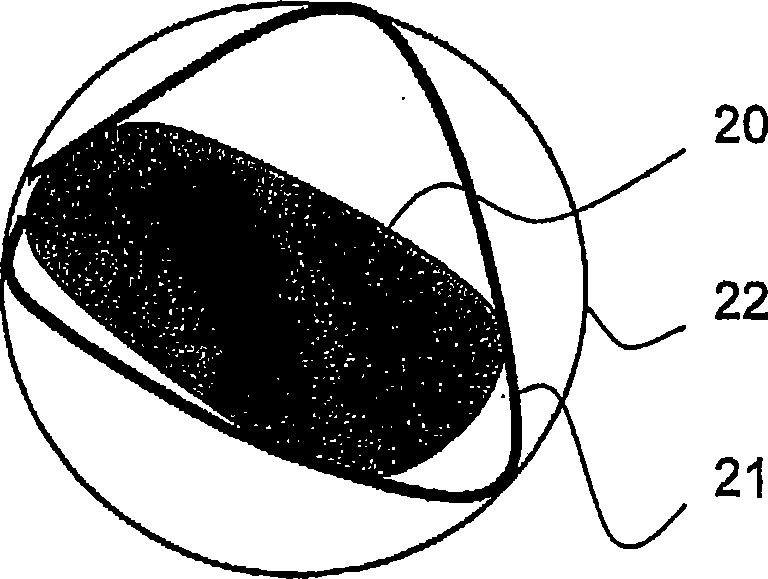
[0127] -Such as figure 2 Pre-calibrated lenses shown.
[0128] 1.1 Preparation of Lenses Comprising an Antireflective Hydrophobic and / or Oleophobic Coating
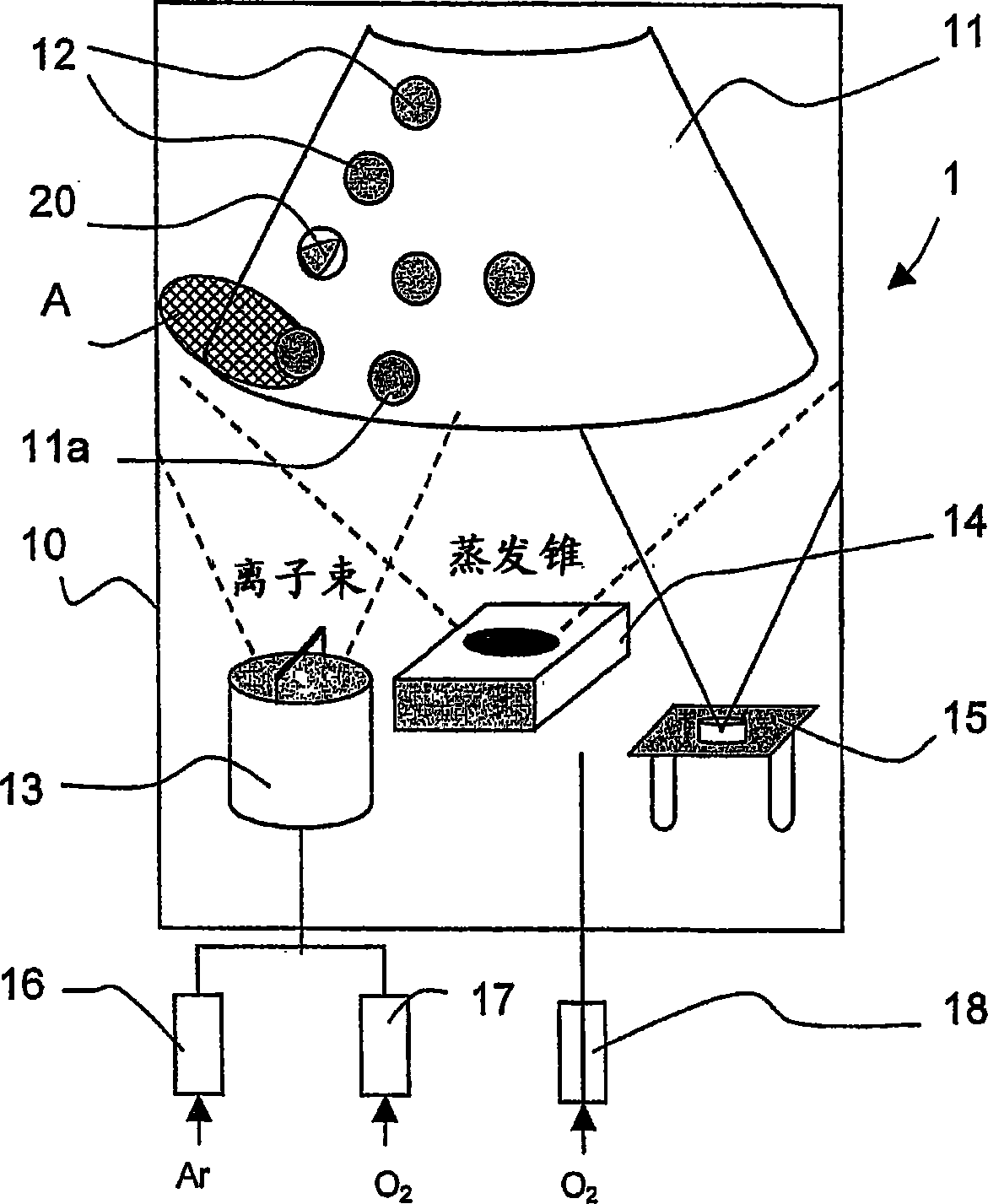
[0129] The vacuum processing unit used was a BalZers BAK 760 unit equipped with an electron gun, an "end-Hall" Mark 2 Commonwealth type ion gun and a Joule effect evaporation source.
[0130] The mirror is placed on a carousel with the concave side exposed to the evaporation source and ion gun.
[0131] The circular lenses are placed on the outer...
example 2
[0153] The substrates were the same painted CR39 as those used in Example 1 Spectacle lenses. They were washed in an ultrasonic cleaner and steamed at a temperature of 100°C for a minimum period of 3 hours.
[0154] 2.1 Preparation of Lenses Including Hydrophobic and / or Oleophobic Coatings
[0155] The vacuum processing apparatus used was a Leyhold LH1104 type apparatus equipped with an electron gun, a Mark2 type ion gun and a Joule effect evaporation source.
[0156] The mirror is placed on a carousel with the concave side exposed to the evaporation source and ion gun.
[0157] Circular lenses are placed on the outer crown (in the most sensitive zone for processing) of the carousel and in the central part of the carousel.
[0158] Pre-aligned lenses are also placed on the crown and center sections of the carousel.
[0159] Vacuum pumping is performed until a second vacuum is reached.
[0160] Thereafter, sequential evaporation was performed by heating the evaporation sour...
the structure of the environmentally friendly knitted fabric provided by the present invention; figure 2 Flow chart of the yarn wrapping machine for environmentally friendly knitted fabrics and storage devices; image 3 Is the parameter map of the yarn covering machine
Login to View More
PUM
Property
Measurement
Unit
thickness
aaaaa
aaaaa
thickness
aaaaa
aaaaa
thickness
aaaaa
aaaaa
Login to View More
Abstract
The present invention relates to a process for treating an ophthalmic lens comprising two main sides the first one of which comprises a thin external organic or inorganic layer, comprising:- at least one treatment step for the second lens side through energetic and / or reactive species capable to perform a surface physical attack and / or chemical modification,- in option, at least one or more stepsfor depositing inorganic or organic layers carried out simultaneously or subsequently to the treatment step through said energetic and / or reactive species,characterized in that before the treatment step through energetic and / or reactive species, a deposition of a temporary protective layer is performed onto the thin external organic or inorganic layer.Application to ophthalmic optics.
Description
technical field [0001] The invention relates to a method for obtaining an ophthalmic lens comprising two main sides, the first side comprising at least one outer organic or inorganic thin layer modifying the surface properties of the lens. [0002] More precisely, this method allows obtaining an ophthalmic lens comprising two main sides, each containing a multilayer coating, the outer layer of which is a thin layer having hydrophobic and / or oleophobic properties . Background technique [0003] Typically, ophthalmic lenses containing a multilayer coating are obtained by depositing evaporated material on the surface of the lens in a vacuum enclosure. [0004] According to one conventional arrangement, the lens is provided on a carousel or cover mounted in the upper part of the vacuum enclosure, and wherein there are provided a plurality of positions above which the lens will be located, more specifically a round hole. [0005] By convention, this article will use the follow...
Claims
the structure of the environmentally friendly knitted fabric provided by the present invention; figure 2 Flow chart of the yarn wrapping machine for environmentally friendly knitted fabrics and storage devices; image 3 Is the parameter map of the yarn covering machine
Login to View More
Application Information
Patent Timeline
Application Date:The date an application was filed.
Publication Date:The date a patent or application was officially published.
First Publication Date:The earliest publication date of a patent with the same application number.
Issue Date:Publication date of the patent grant document.
PCT Entry Date:The Entry date of PCT National Phase.
Estimated Expiry Date:The statutory expiry date of a patent right according to the Patent Law, and it is the longest term of protection that the patent right can achieve without the termination of the patent right due to other reasons(Term extension factor has been taken into account ).
Invalid Date:Actual expiry date is based on effective date or publication date of legal transaction data of invalid patent.



 Login to View More