
Amplifier system with on-demand power supply boost
- Summary
- Abstract
- Description
- Claims
- Application Information
AI Technical Summary
Benefits of technology
Problems solved by technology
Method used
Image

Examples
Embodiment Construction
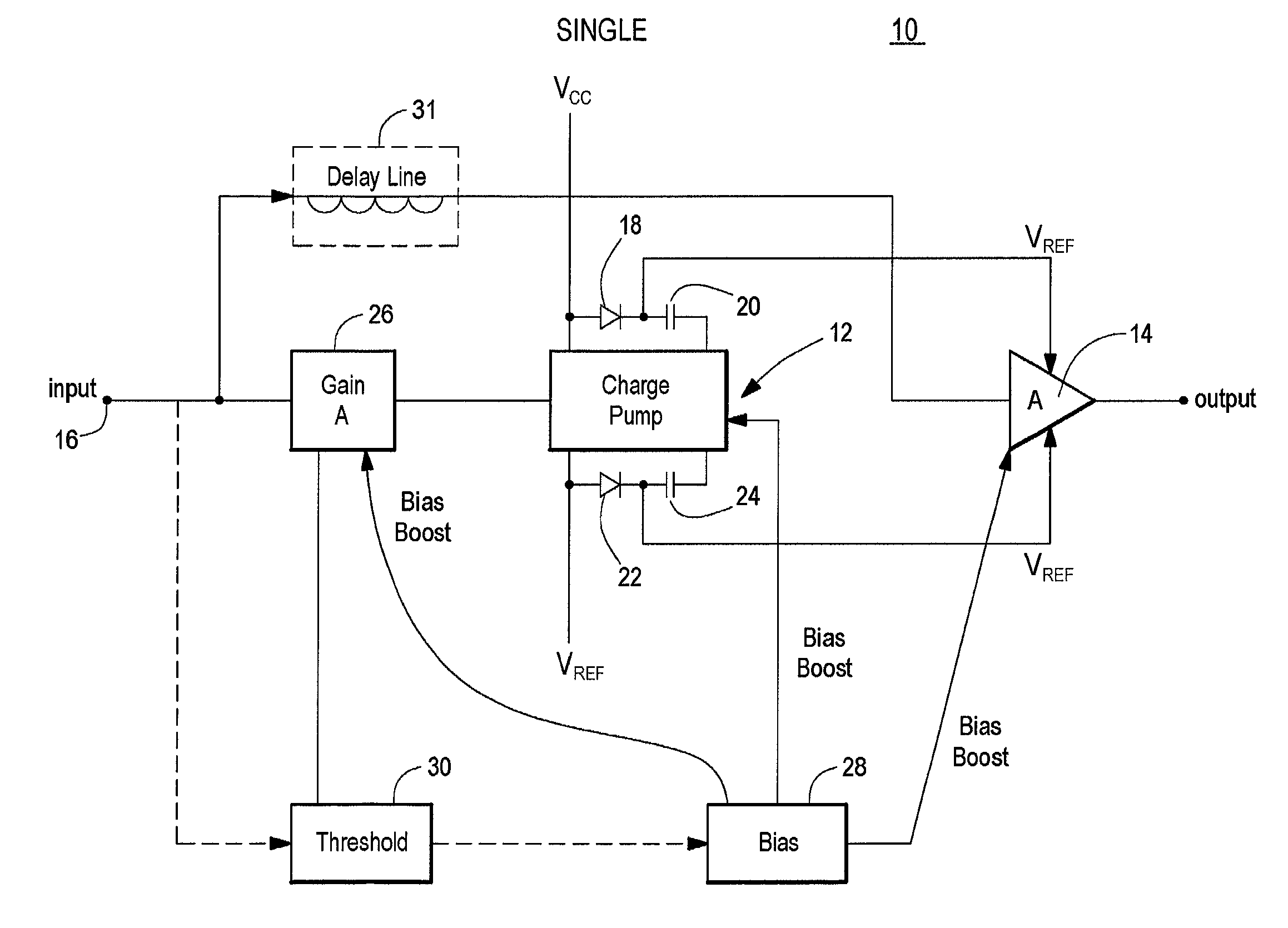
[0022] There shown in FIG. 1 an amplifier system with on-demand power supply boost 10 which includes a charge pump 12 and an amplifier 14. The circuit shown in FIG. 1 is a single ended type amplifier. Two power supplies V.sub.CC and V.sub.EE are provided to charge pump 12. V.sub.CC may for example, be +6 volts and V.sub.EE may be -6 volts. A varying input signal is delivered to input terminal 16. Charge pump 12 includes a diode 18 and a charge storage impedance such as capacitor 20 and a diode 22 and capacitor 24. Capacitor 20 charges through diode 18 and capacitor 24 charges through diode 22. As the input signal on terminal 16 fluctuates, the power supply boost V.sub.CCP and V.sub.EEP from capacitors 20 and 24, respectively, are provided to amplifier 14 to assure that there is sufficient power supply voltage to accommodate peak signals when necessary on demand and yet keep the voltage supplied on a low level when the signal is operating in its normal range of RMS voltage. This redu...
PUM
 Login to View More
 Abstract
Description
Claims
Application Information
 Login to View More