Network addressing scheme for reducing protocol overhead in an optical network

US20050047327A1Inactive Publication Date: 2005-03-03CISCO SYSTEMS INC
14 Cites 27 Cited by

Patent Information

Authority / Receiving Office
US · United States
Current Assignee / Owner
Publication Date
2005-03-03
Estimated Expiration
Not applicable · inactive patent

Smart Images

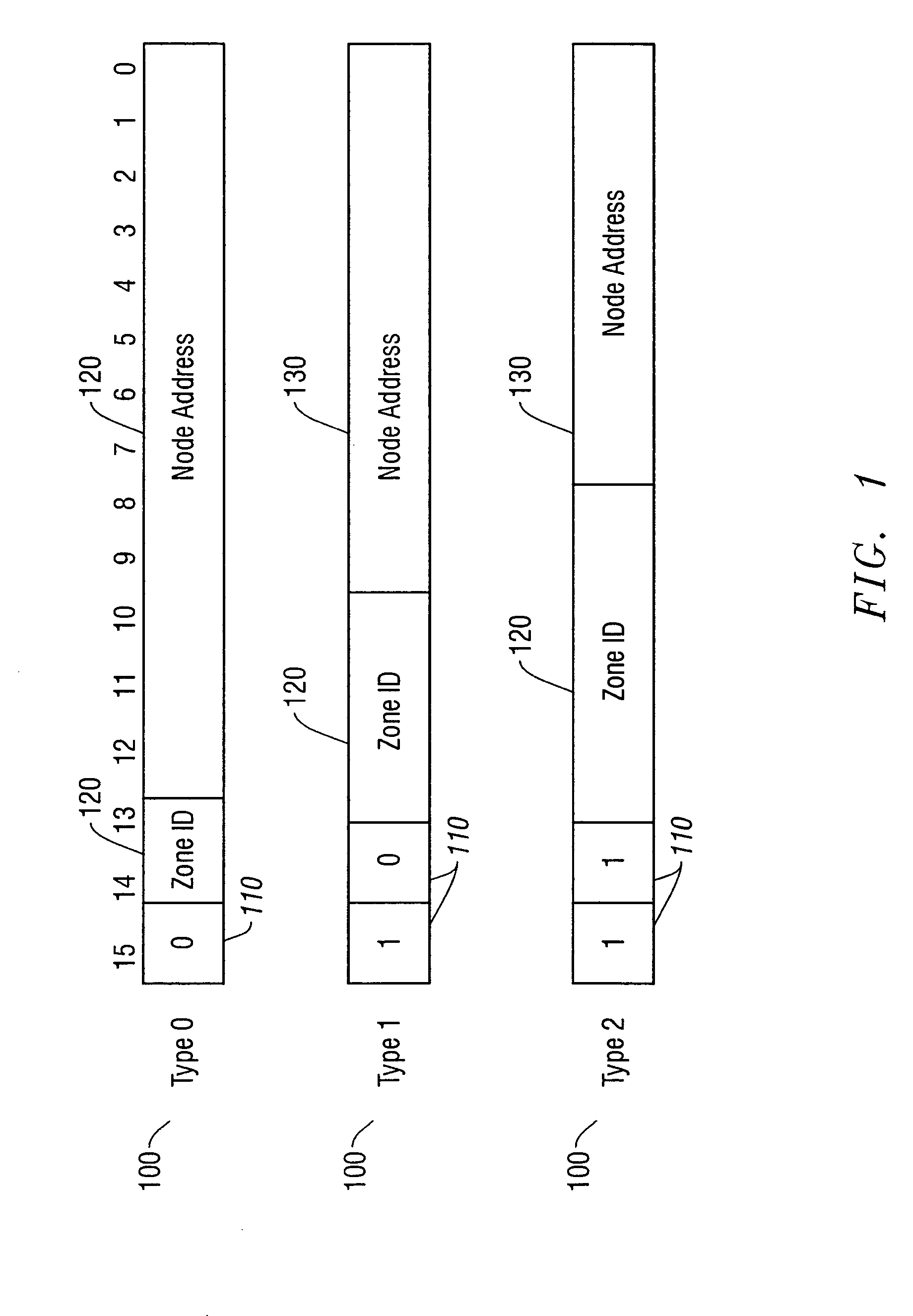
  • Figure 1
    Figure 1
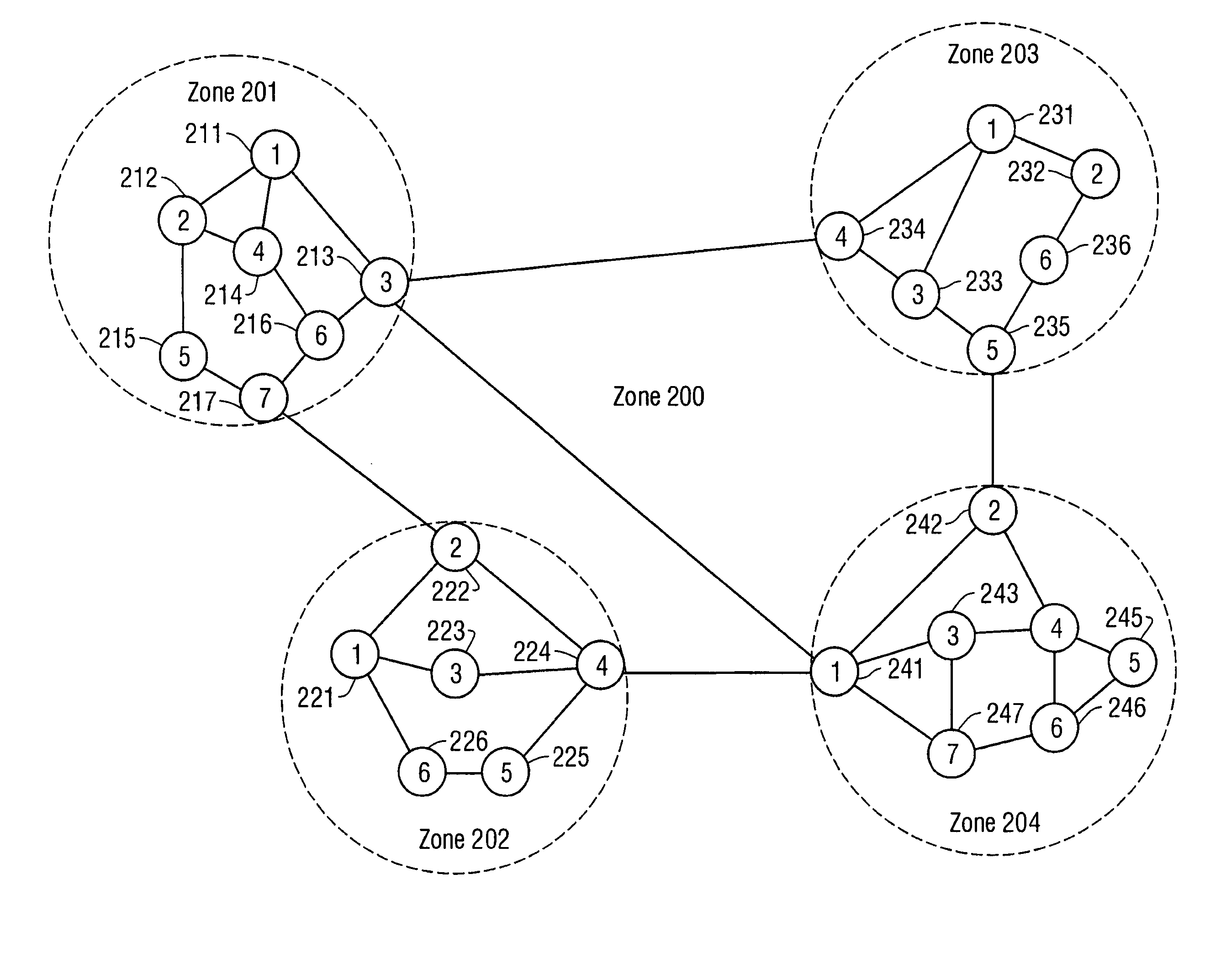
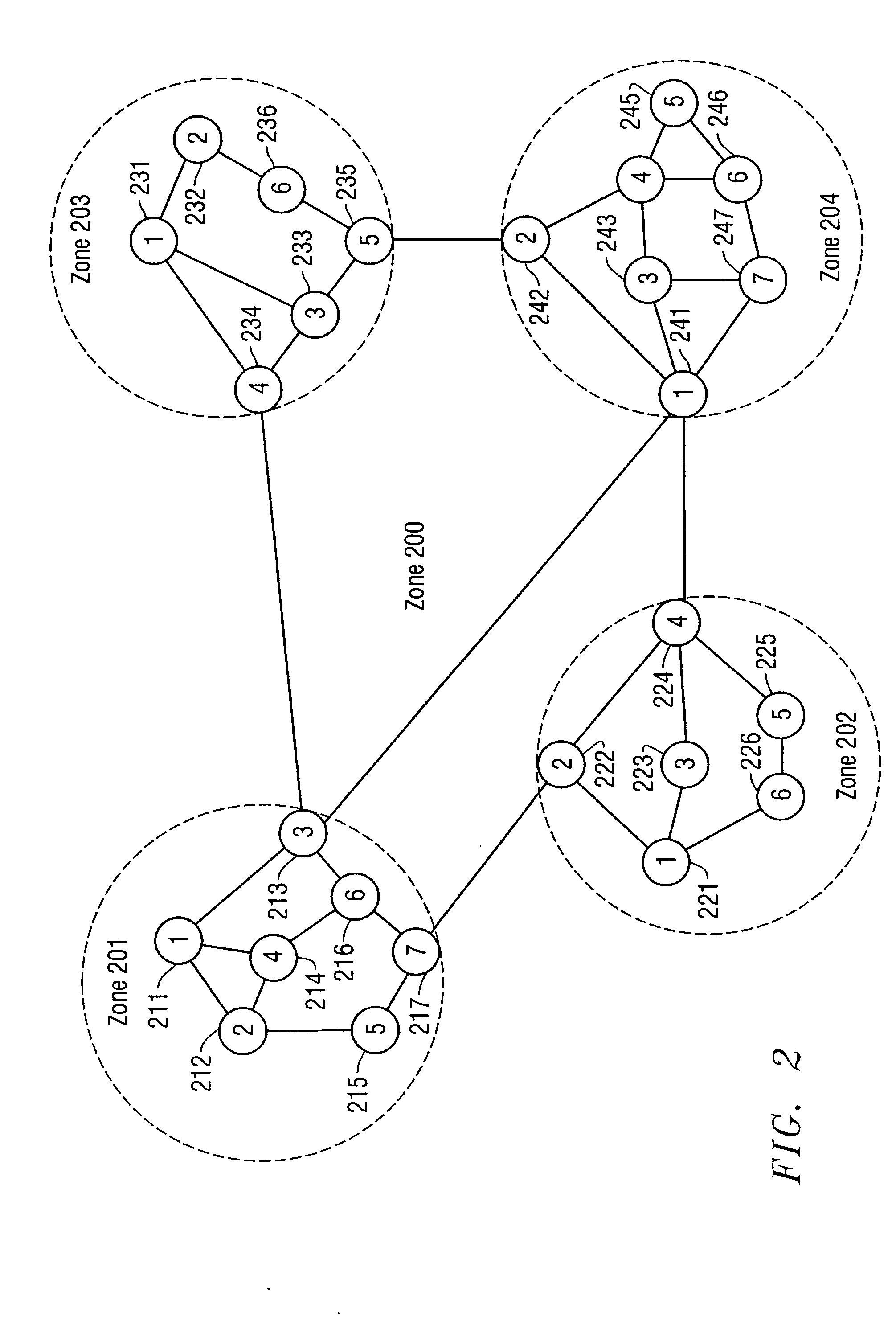
  • Figure 2
    Figure 2
  • Figure 3
    Figure 3
Patent Text Reader

Abstract

A method for operating a network and a network architecture implementing the method are described. The method, in one embodiment, begins by grouping a plurality of nodes into zones, where the network includes the plurality of nodes. At least one of the nodes in each one of the zones is one of a plurality of boundary nodes, and each of the boundary nodes in each one of the zones is coupled to a boundary node in another of the zones by one of a first number of inter-zone optical links. One of the zones includes a number of nodes, each of which is coupled to at least one other of the nodes by one of a second number of intra-zone optical links. Next, a non-boundary node is configured to transmit network information to other of the nodes. The non-boundary node is a node in the zone that is not a boundary node. Finally, a boundary node in the zone is configured to limit transmission of the network information through itself to other of the boundary nodes. The network information so limited can be restoration information (in the event of a failure), network topology information, and / or other network information.
Need to check novelty before this filing date? Find Prior Art

Description

BACKGROUND OF THE INVENTION 1. Field of the Invention This invention relates to the field of information networks, and more particularly relates to a protocol for configuring routes over a network. 2. Description of the Related Art Today's networks carry vast amounts of information. High bandwidth applications supported by these networks include streaming video, streaming audio, and large aggregations of voice traffic. In the future, these bandwidth demands are certain to increase. To meet such demands, an increasingly popular alternative is the use of lightwave communications carried over fiber-optic cables. The use of lightwave communications provides several benefits, including high bandwidth, ease of installation, and capacity for future growth. Optical infrastructures are capable of transmission speeds in the gigabit range, which helps address the ever-increasing need for bandwidth mentioned above. Such infrastructures employ various topologies, including ring and mesh top...

Examples

Embodiment Construction

The following is intended to provide a detailed description of an example of the invention and should not be taken to be limiting of the invention itself. Rather, any number of variations may fall within the scope of the invention which is defined in the claims following the description.

In one embodiment, a network architecture is described that provides many advantages, including a reduction in protocol overhead experienced by the network, quicker provisioning and restoration of circuits, support for highly efficient protocols, and other advantages. These and other advantages are particularly important when an embodiment of the present invention is used in an optical telecommunications network (e.g., a network employing the Synchronous Optical Network (SONET) protocol, such as that described herein), due in part to the enhancement in restoration times and reduction in protocol overhead provided thereby.

Network Architecture

To limit the size of the topology database used by so...