
DNA sequence detection by limited primer extension
a technology of dna sequence and primer extension, which is applied in the direction of fermentation, microbiological testing/measurement, biochemistry apparatus and processes, etc., can solve the problem that the structure of the pna backbone does not allow standard enzymatic ligation techniques
- Summary
- Abstract
- Description
- Claims
- Application Information
AI Technical Summary
Problems solved by technology
Method used
Image

Examples
Embodiment Construction
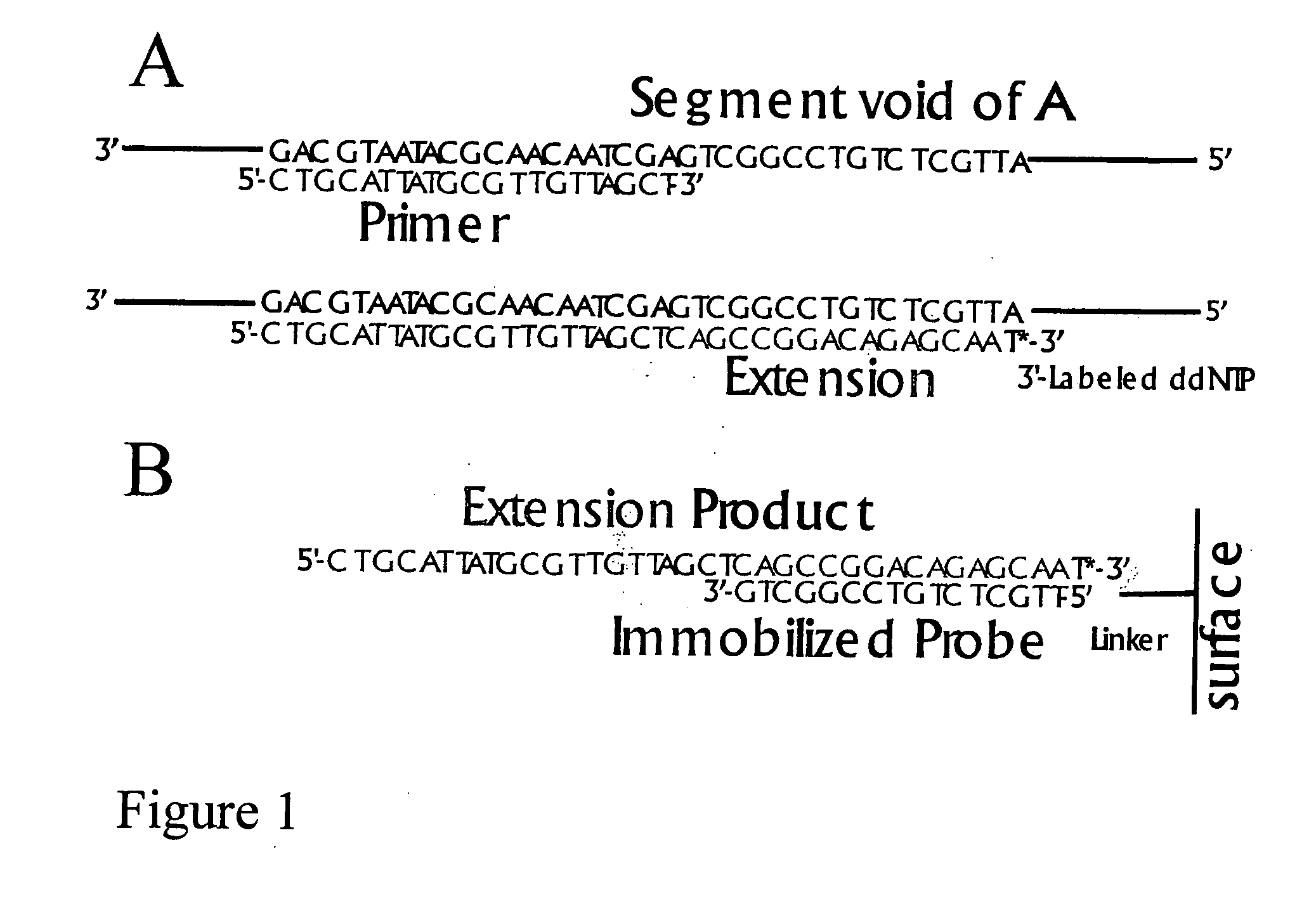
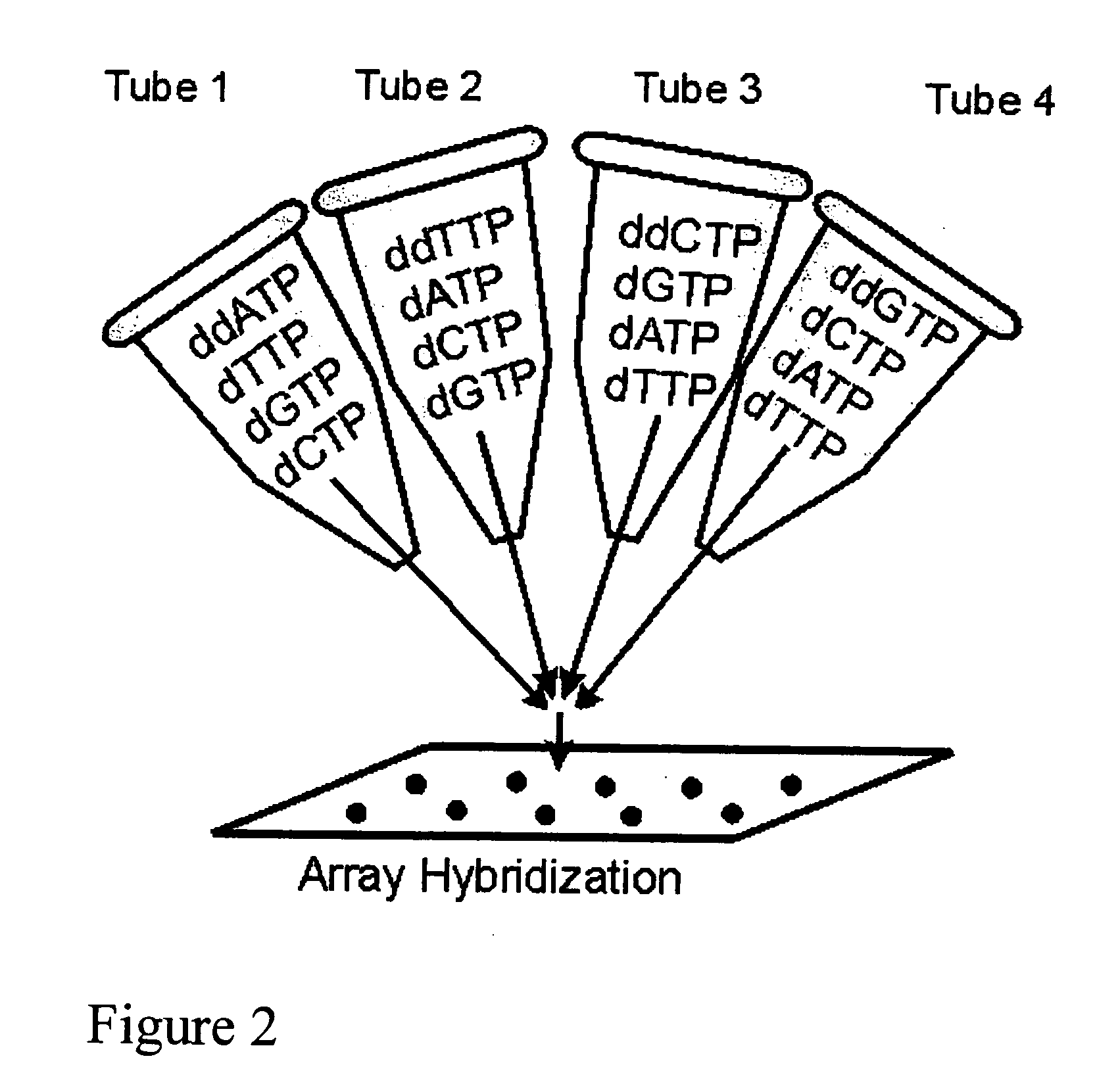
[0016] Limited Primer Extension (LPE) has a number of properties that provide advantages over direct labeling methods, or procedures based on the PCR. These include: [0017] The absence of chain reaction products and allows massive multiplexing. [0018] A short sequence is created for hybridization to probes. [0019] Thermal cycling or helicase reactions can be used to achieve a non-exponential, selective target sequence amplification. [0020] Because the amplification always occurs in one direction only, there is no reaction product to compete with association of the product to probes. [0021] When used to generate sequences for hybridization on microarrays, specificity arises not only from the requirement of complementarity for association of primer with the target, but also from the requirement for complementarity for association of the newly synthesized extension product with the immobilized probe.
[0022] Some of the advantages that result from these properties include:
[0023] Sample...
PUM
| Property | Measurement | Unit |
|---|---|---|
| dissociation temperature | aaaaa | aaaaa |
| dissociation temperature | aaaaa | aaaaa |
| thermal dissociation temperature | aaaaa | aaaaa |
Abstract
Description
Claims
Application Information
 Login to View More